Hanoi (VNA) – The Viettel Military Industry and Telecoms Group announced on December 11 that it has won honours in the “People & Culture” and “Best Operator in a Growth Market” categories at the 2025 World Communication Awards (WCA), alongside the “Best Digital Transformation Project” at the 2025 Global Telecoms Awards (Glotel).
At this year’s WCA, Viettel was recognised for its “People First – Innovation Always” philosophy. Internal surveys show that 92.8% of its employees feel encouraged to share their views, while 80% believe they are genuinely valued, reflecting a professional working environment capable of attracting global talent.
The “Best Operator in an Emerging Market” award was presented to Lumitel, Viettel’s brand in Burundi. This category honours operators that bring meaningful improvements to infrastructure, connectivity and digital access in emerging markets where socio-economic conditions remain challenging.
When Viettel entered Burundi, the national grid reached only 10-35% of the population, and many border areas had no mobile coverage whatsoever. Through long-term commitment, the firm has brought millions of Burundians into the mobile era and become the first operator to roll out 5G in the country, Viettel Burundi CEO Phan Truong Son noted.
In the core technology category, Viettel won Glotel’s “Best Digital Transformation Project” with its “Digital Twin” platform developed by the Viettel Artificial Intelligence and Data Service Centre. This marks the first time a Vietnamese enterprise has triumphed in this category.
The WCA, organised by a leading UK-based publication, has a history of more than 20 years and is regarded as the “Oscars” of the global telecoms industry. Glotel is likewise highly regarded within the international technology community, attracting major corporations such as Samsung, Huawei, NVIDIA and Ericsson./.
See more
Vietnam, RoK seek to expand cooperation in AI and semiconductor sectors
Vietnamese Deputy Minister of Science and Technology Tran Trung Tinh stressed that the Politburo's Resolution No. 57-NQ/TW identifies science and technology, innovation and digital transformation as leading breakthroughs and key drivers of rapid and sustainable development. Semiconductors and artificial intelligence (AI) are among the strategic technologies prioritised for development.
16th NA's second session: Higher sci-tech funding, faster disbursement urged
The 2026 state budget allocated about 95 trillion VND (3.65 billion USD) for science, technology, innovation and digital transformation. As of October 30, disbursement was only 42.12%, with innovation at 27.98%, and digital transformation 29.9%.
Vietnamese company joins Cambodia’s digital transformation efforts
The agreement establishes a cooperation framework to modernise higher education through digital governance, digital learning, artificial intelligence (AI) applications, and capacity building through training and knowledge sharing. It also aims to expand internship, employment and scholarship opportunities for students.
From lab to factory: Driving self-reliance in materials technology
By 2035, Vietnam is expected to have a workforce and corporate base with financial capacity, technology ownership and markets, according to Assoc. Prof. Vu Viet Hung, Chairman of the Canadian Vietnamese Scientists and Experts Association (CVSEA).
Vietnam's digital technology industry revenue surges 53% to 254.6 billion USD
Hardware and electronics exports reached an estimated 30.681 billion USD in October, up 108% from the same month last year.
Vietnam ranks among world's top 50 economies in digital and AI competitiveness
Vietnam ranked 13th in AI application, 15th in digital and AI governance, and 21st in efficiency, highlighting its strengths in digital technology and AI application, and in digital governance.
Strategic technologies key to improving Vietnam’s Global Innovation Index
The 2025 and 2026 GII reports show that Vietnam continued to rank first globally in the share of high-tech exports and creative goods in total trade.
Vietnam’s AI ambition runs into talent wall
AI is becoming a foundational technology, cutting across industrial production, healthcare, education, finance, governance and public service delivery. But turning technological potential into practical value requires a workforce able to study, master and apply AI to Vietnam’s real-world problems.
Vietnam, Malaysia hold potential for cooperation in robotics industry
Businesses from both countries should lead joint research and field-testing projects in areas such as electronic component inspection, warehouse transport, agricultural monitoring and medical logistics, said Samirul Ariff Othman, a policy, economic and business analyst at Global Asia Consulting and visiting lecturer at Universiti Teknologi PETRONAS.
Ericsson establishes R&D capability in Vietnam
This initiative builds on Ericsson’s growing software engineering and testing capabilities in the country, and will further strengthen Vietnam’s contribution to Ericsson’s global technology development.
RoK’s AI robotics drive opens cooperation opportunities with Vietnam
Dao Tuan Hung, President of the Business Association of Vietnamese in Korea (BAVIK), said Vietnam should adopt a practical approach by prioritising specialised robots, including autonomous mobile robots (AMR/AGV), collaborative robots and machine vision systems, in sectors such as agro-fishery processing, textiles and garments, electronics and logistics.
Russian survey vessel docks in Hai Phong
This is the third joint marine scientific survey in Vietnamese waters, running from November 4 - December 12, and one of the opening field activities under the Vietnam–Russia roadmap for marine scientific research cooperation for 2026-2035.
Vietnam-Japan semiconductor cooperation paves the way for high-tech investment
The two countries are implementing five semiconductor research projects involving leading universities, with funding agreements signed in July. The projects cover three-dimensional integrated circuits, advanced semiconductor materials, secure artificial intelligence (AI) chips and power electronic components.
Vietnam to open registration for two-character “.vn” domain names for first time
Short, memorable and limited in number, these domains offer businesses, organisations and individuals an opportunity to establish distinctive online identities and strengthen their brands in the digital environment.
Mobilising international resources to drive Vietnam’s technology development
Vietnam previously focused mainly on attracting overseas experts and intellectuals to work in the country over the long term, but this approach encountered certain difficulties. Cooperation methods are now shifting towards greater flexibility, allowing experts to take part in conferences and scientific seminars, contribute to addressing major national challenges, or participate in short-term training and research programmes.
Fines of up to 200 million VND for violations in digital technology industry
Decree No. 401/2026/ND-CP, signed by Deputy Prime Minister Ho Quoc Dung on behalf of the Government, stipulates violations, forms and levels of penalties, remedial measures, and the authority to impose sanctions and handle violations.
Vietnam needs to master robot integration technologies to develop robotics industry
Associate Professor Dr. Duong Minh Hai of the National University of Singapore said Vietnam has several advantages, including its industrial manufacturing base, network of industrial parks, foreign investment inflows and technical workforce.
Core technologies key to sustainable robotics development in Vietnam: expert
Vietnam should select suitable robotic platforms and gradually build capacity in core technologies, including sensing, environmental perception, positioning, state estimation, AI, control and system integration. This will help develop technologies applicable across multiple sectors while avoiding fragmented investment and dependence on a single product category.
AI robots help streamline administrative procedures
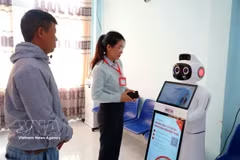
Operating around the clock, AI robots provide information on administrative procedures, required documents, processing times, fees and relevant regulations, complementing assistance from civil servants.
From QR codes to digital communities
Residents could send their QR codes to visitors and service providers, enabling them to find homes without asking for directions.