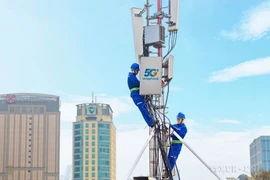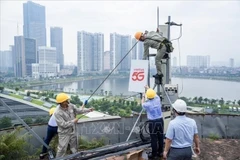
Hanoi (VNA) – Vietnam’s Internet speeds, particularly 5G mobile broadband, recorded strong growth in January 2026, with the upward trend expected to continue thanks to synchronised infrastructure investment.
Data from the i-Speed platform, operated by the Vietnam Internet Network Information Centre (VNNIC) under the Ministry of Science and Technology, showed marked improvements in mobile broadband quality nationwide, especially 5G services.
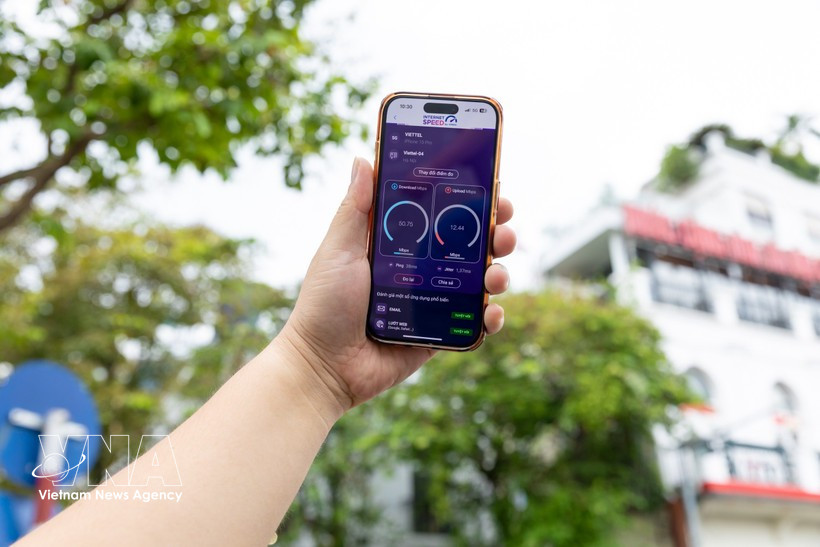
Average 5G download speeds reached 594.81 Mbps in January, up 52% from 391.05 Mbps in December 2025. Upload speeds rose 29.5% to 123.71 Mbps from 95.47 Mbps.
Among major cities, Da Nang maintained its lead with average 5G download speeds of 677.23 Mbps. Ho Chi Minh City and Can Tho posted strong monthly growth of 86% and 83.9%, reaching 632.02 Mbps and 595.88 Mbps, respectively.
By provider, Viettel continued to lead the 5G market with average download speeds of 616.99 Mbps and upload speeds of 127.09 Mbps, respectively rising from 402,61 Mbps and 98,4 Mbps in December. VNPT ranked second, followed by MobiFone.
In January, mobile broadband speeds stayed stable, with average download speeds of 90.05 Mbps and upload speeds of 29.77 Mbps. Viettel, VNPT and MobiFone remained the best performers.
Fixed broadband quality also remained stable nationwide, with average download and upload speeds of 256.86 Mbps and 170.28 Mbps, respectively. Hanoi continued to top the country in fixed broadband performance. The leading service providers were Viettel, CMC Telecom and VNPT.
In 2026, the Telecommunications Authority under the Ministry of Science and Technology aims to raise average mobile speeds to 170 Mbps and fixed broadband to 300 Mbps, while ensuring 5G coverage reaches 99% of the population.
The authority has also licensed Starlink Services Vietnam to provide low-earth orbit satellite telecommunications services. Once they go operational, Vietnam will become the fifth Southeast Asian country to deploy Starlink, marking a significant step forward in strengthening national digital infrastructure./.
See more
Hanoi creates favourable environment for high-tech projects
Hanoi identifies science and technology, innovation, and digital transformation as key growth drivers in the new development phase.
International conference spotlights advanced microscopy in life sciences, materials
The microscopy user community in Vietnam remains fragmented, lacking a common platform for sharing technical expertise, research experience and collaboration opportunities. This limited connectivity has, to some extent, curtailed the full potential of microscopy technologies in advancing scientific progress and industrial applications at home and abroad.
Viettel Telecom nominated for Global Mobile Awards
Since 2024, Viettel has migrated nearly 10 million 2G users, provided more than 800,000 free 4G devices to low-income subscribers, and expanded 4G/5G coverage to 98% of the population.
Blockchain becomes strategic pillar of national digital infrastructure
As Vietnam’s blockchain infrastructure layers such as NDADID and NDATrace become interoperable with international blockchain infrastructures, the country is positioned to build a production and trade ecosystem based on trust at the global level.
Vietnam makes scientific strides in decoding ancient human genomes
One of the most important outcomes was the successful sequencing of complete mitochondrial genomes from two ancient human bone samples over 2,000 years old excavated at the Dong Xa archaeological site, now in Luong Bang commune of Hung Yen province.
Science – technology: Driving force opening new avenues for growth
Science and technology create new knowledge and tools; innovation translates that knowledge into products and services; and digital transformation accelerates diffusion across society, unlocking growth and added value.
Digital transformation – a lever for building a smart tourism ecosystem
In recent years, digital transformation has become a common feature in socio-economic development strategies. For tourism – a multi-sector, experience-driven industry closely tied to information – digitalisation is no longer a trend but an inevitable requirement to enhance competitiveness and ensure sustainable development.
Harnessing digital transformation, green transition to bolster national strength
Despite slowing global growth and localised downturns in many economies, Vietnam has sustained robust growth, maintained macroeconomic stability, safeguarded key economic balances, recorded rapid gains in per capita income, and further strengthened its international standing.
VAST – core force in national science system: Prime Minister
The Party, the State, and the Government identify science, technology, and innovation as both a fundamental pillar and a central engine of growth, as well as a direct productive force driving rapid and sustainable development, Prime Minister Pham Minh Chinh said, stressing that VAST stands as a crucial “fortress” of knowledge that concentrates the intellectual resources and limitless creativity of the Vietnamese people.
Resolution No.57: driving shift to knowledge- and technology-based growth
With the official launch of the Hanoi Technology Exchange (HanoTEX) and the Digital Transformation Market (DTMarket) - combined with the development of hard infrastructure - Hanoi aims to become a place where technology is translated into practical value, directly contributing to the city’s GRDP growth target of at least 11% in 2026.
Central bank moves to tighten AI use in banking
Under the draft, banks and intermediary payment service providers must inform customers before deploying AI-powered tools such as virtual assistants, automated hotlines and chatbots in customer communications.
Central bank moves to tighten AI use in banking, requires prior customer notification
The State Bank of Vietnam (SBV) has moved to tighten oversight of artificial intelligence (AI) in the banking sector, requiring lenders and e-wallet providers to notify customers in advance when AI systems are used to interact directly with them.
Smooth, secure telecommunications ensured during Tet holiday
Service providers proactively enhanced system capacity, maintained round-the-clock technical duty and stood ready to respond at peak traffic times.
Vietnam officially becomes IEA association country
Becoming an association country is particularly important as Vietnam enters a new stage of development, remaining steadfast in its goal of carbon neutrality and green energy transition.
Finastra research: Vietnam’s financial sector accelerates AI adoption
The Finastra Financial Services State of the Nation 2026 report shows that 94% of financial institutions in Vietnam plan to increase investment in AI over the next 12 months, underscoring strong momentum to expand AI capabilities despite structural constraints.
Spring Fair 2026: Strong potential for Vietnam-Australia cooperation in high technology
Priority areas for cooperation between Vietnam and Australia include agricultural technology; computer vision; and smart cities and cybersecurity.
Digital transformation helps reduce information poverty in mountainous region
When knowledge is digitalised and spread from school to community, escaping from poverty will be more sustainable.
Viettel launches talent search to develop young workforce for core technologies
Unlike conventional internship or management trainee schemes, both programmes are designed and implemented directly by Viettel, integrating training with real-world work in a global technology group. Participants are entrusted with solving major challenges that directly impact Viettel’s research, production and business operations.
Vietnam’s first cross-sea UAV delivery route inaugurated
The event marked the debut of the country’s first cross-sea unmanned postal route, representing a pioneering step in smart mobility solutions aimed at boosting the digital economy and easing pressure on road transport infrastructure in Ho Chi Minh City.
Digital transformation in tourism for comprehensive, sustainable growth
Vietnam is well positioned to become a leading digital tourism destination in the region. By capitalising on current growth momentum and implementing targeted support measures for small and medium-sized enterprises, the country can build a smart and sustainable tourism ecosystem aligned with global digital transformation trends.