Hanoi (VNS/VNA) - Vietnam’s space industry stands on the brink of a breakthrough with solid foundations and timely policy support. Space technology is now a tangible and fast-evolving field in Vietnam.
Associate Professor Pham Anh Tuan, General Director of the Vietnam Space Centre under the Vietnam Academy of Science and Technology, said the country began researching remote sensing applications as early as the 1980s.
However, true mastery of satellite technology only began in 2006, when the Prime Minister approved the National Strategy for Research and Application of Space Technology through 2020.
Since then, Vietnam has successfully launched multiple satellites: VINASat-1 (2008), VINASat-2 (2012), VNREDSat-1 and PicoDragon (2013), MicroDragon (2019), and NanoDragon (2021).
Most recently, LOTUSat-1, the nation’s first Earth observation radar satellite, has been completed and is ready for launch.
"The achievements form a crucial technical and operational foundation for the next phase of growth," Tuan said.
The ruling Communist Party and State have paid close attention to the development of space technology, as reflected in key national science and technology policies.
Resolution 57 issued by the Party's Politburo in December 2024 on breakthroughs in science, technology, innovation and digital transformation highlights the task of applying scientific and technological advances to space exploration and development.
Similarly, Decision 1131 signed by the Prime Minister in June, which lists the nation’s strategic technologies, identifies aerospace technology as one of the 11 key technology groups.
In addition, the National Assembly's Resolution 93 on pilot telecommunications services using low-Earth orbit satellite technology has created an important legal framework to further accelerate progress in the field.
Building human capital
In terms of human resources and infrastructure, the Vietnam Space Centre has established a core workforce through master’s and doctoral training programmes in satellite technology conducted in Japan.
The programmes combine academic study with practical training in design, integration, testing and satellite operation.
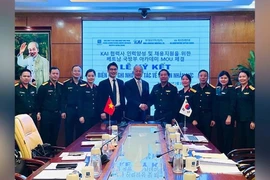
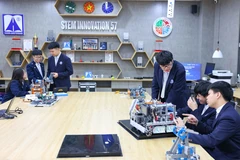
The centre has also partnered with leading universities, including Vietnam National University, Hanoi; the University of Science and Technology of Hanoi; and the Posts and Telecommunications Institute of Technology, to train space technology experts at undergraduate and postgraduate levels.
The emerging team is directly involved in satellite projects, ground stations and data platforms, gradually nurturing a new generation of system engineers and chief designers for the future.
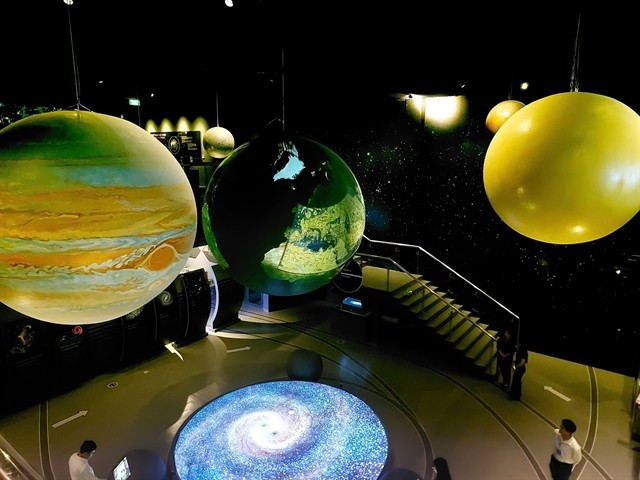
Regarding infrastructure, the centre has completed several major facilities such as the satellite data reception and processing station, the satellite integration and testing complex, and most recently, the Vietnam Space Museum, which opened in August.
These facilities help popularise scientific knowledge and support the formation of a satellite data ecosystem connected to the national data infrastructure.
Despite this progress, experts caution that Vietnam’s space sector still faces many challenges. Coordination between ministries and agencies remains limited, while there is a lack of a long-term strategy, specialised legislation, and unified technical standards, resulting in fragmented investments and weak connectivity.
Technical infrastructure, though expanding, is still modest. The pool of specialists - especially system engineers and chief designers - remains small, with no formal skill standards or attractive incentive mechanisms.
Moreover, space research and development require substantial capital, long investment cycles, and involve high risks - significant hurdles for domestic institutions and enterprises.
Choose the right path
Vietnam now has the policy framework, human resources, and initial infrastructure in place.
The next step is choosing the right direction for growth.
Tuan of the Vietnam Space Centre said: “Vietnam can only narrow the gap if it starts now, chooses the right path and stays the course.”
A pragmatic approach is to start small and scale up gradually, focusing on small, low-Earth orbit satellites, developing synchronised control and data-receiving stations, and enhancing capabilities in integration, testing and data utilisation.
The direction aligns with global trends towards small satellites with shorter lifespans, open standards and lower costs - an opportunity for developing nations to take the lead in selected core components.
According to Tuan, a feasible roadmap would involve building a cluster of small Earth-observation satellites over the next 10-20 years, serving national needs such as disaster reduction, climate change mitigation, agriculture, environmental protection, infrastructure development, and maritime security.
In the immediate term, Vietnam could adopt a mission-based service procurement model, prioritising projects with clear social and economic benefits, while investing strategically in domestic capabilities, standardising data, elevating remote sensing data to national data status, and gradually localising space products.
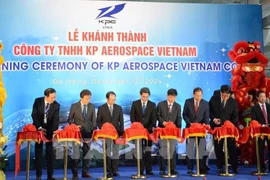
The recent entry of private enterprises such as VinSpace also underscores the rising appeal of Vietnam’s space industry and adds new momentum for its robust development in the years to come./.
PM welcomes US aerospace, defence, security enterprises
Prime Minister Pham Minh Chinh received a delegation of aerospace, defence and security companies under the US-ASEAN Business Council (USABC) in Hanoi on December 18.