Party chief demands urgent acceleration on strategic tech push

Party General Secretary To Lam stressed that strategic technologies must directly serve the goals of raising productivity and economic competitiveness, forming new industries, and securing technological autonomy in key sectors.

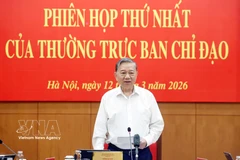
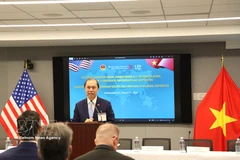
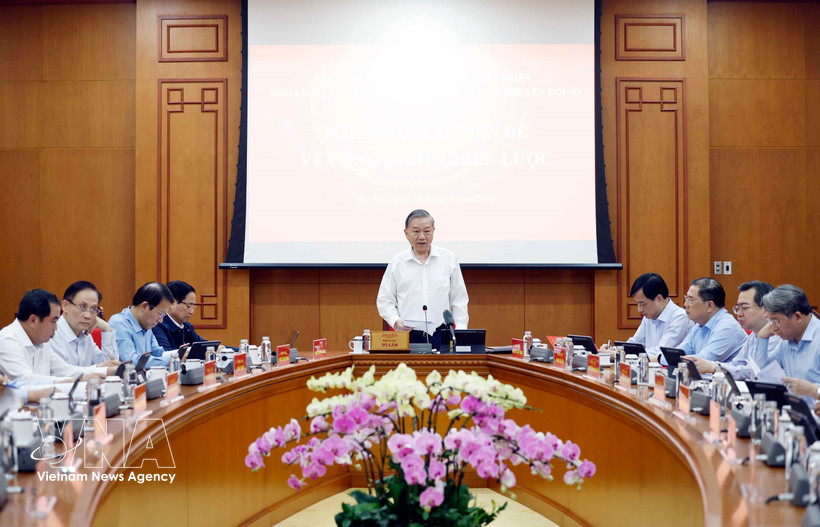
Party General Secretary To Lam speaks at the meeting (Photo: VNA)

Hanoi (VNA) - Vietnam can't keep dragging its feet on developing strategic technologies; it's time for tougher, faster, and more hard-hitting moves, Party General Secretary To Lam told a meeting of the Central Steering Committee for Science and Technology Development, Innovation and Digital Transformation in Hanoi on March 18.

Following the Resolution No. 57-NQ/TW, the Politburo issued a list of 11 groups of strategic technologies and 35 groups of strategic tech products under a decision issued on June 12, 2025, while picking six priority strategic technology products for immediate rollout with detailed roadmaps. However, the progress remains uneven. To date, none of the designated priority products has advanced to a stage where it generates substantial, measurable economic contributions.

General Secretary Lam stressed that strategic technologies must directly serve the goals of raising productivity and economic competitiveness, forming new industries, and securing technological autonomy in key sectors. Picking the right ones, he said, boils down to three fundamental factors: real development and competitiveness needs, potential of domestic industries, and the ability to build value chains and markets.

On nailing down the strategic tech list, he wanted it to split into two groups: proven technologies in established markets where the payoff is big, fast, and direct; and technologies that create new growth drivers, foundational tech for the future, and technologies for self-reliance in national defence-security.

Businesses, especially private players, need to be the beating heart of the whole tech ecosystem. Policies have to supercharge them to pour money into R&D and innovation, while the State sticks to high-level guidance, building a friendly regulatory playground, bankrolling key studies, and helping turn lab breakthroughs into market winners.

Resources must zero in on just a handful of truly vital areas, going all-in with depth, strength, smart tactics, efficiency, and unbreakable follow-through till the job's done, he said.

For every strategic tech and product, there must be a clear assignment of the lead ministry or agency, coordinating bodies, and resources. Heads of lead agencies must personally direct the work and bear full responsibility before the Party and State for outcomes within their domains.
vnanet-g.jpg
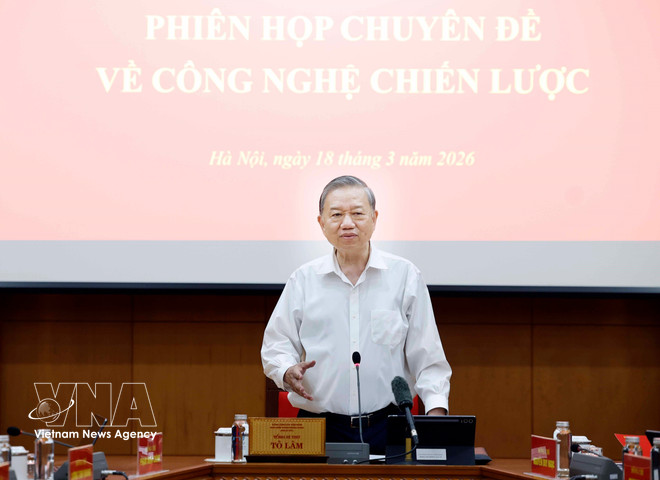
Party General Secretary To Lam, who also serves as head of the Central Steering Committee for Science and Technology Development, Innovation and Digital Transformation, speaks at the event. (Photo: VNA)

At the central level, a robust, authoritative inter-agency coordination body is required to clear major bottlenecks. Mechanisms must ensure smooth and seamless cooperation, avoiding a situation in which each body acts differently, shifts responsibility, or waits for others to move first.

In his view, training and attracting talent must maintain a forward lead. It is also necessary to empower the broader innovation ecosystem, including start-ups, sci-tech enterprises, and spin-off companies originating from research institutes and universities, while building innovation hub that are strong, open and flexible enough to connect studies with the market.

Among pressing next steps, the leader called for a review and refinement of the list of strategic tech and products toward greater focus on what truly matters for the nation's short- and long-term future. He also pushed for a unified direction and coordination mechanism at the Government level to launch strategic tech schemes; an inter-agency task force for coordination, with monthly progress reports straight to the Steering Committee and its head; and the fast-track rollout of clear standards for strategic tech, core tech, and priority products.

He also ordered overhaul of funding and finance rules for these efforts, especially special output-tied mechanisms that allow controlled risk-taking, tax breaks, cheap credit, public-private funding models, and state budget mechanisms for targeted procurement.

The Party chief also demanded training pipelines geared toward strategic tech needs, with priority given to engineers, master’s and doctoral graduates, elite experts and strong research teams, while forging tight links among schools, companies, research institutes and major projects. At the same time, urgent efforts are needed to clear bottlenecks facing ministries, agencies, businesses, research institutes and universities./.
VNA

See more

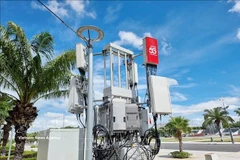
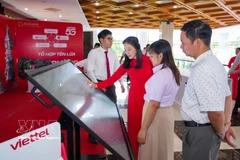
A Viettel 5G base station provides coverage at the April 16 Square area in Dong Hai ward, Khanh Hoa province. (Photo: VNA)

Conquering 6G networks helps Vietnamese businesses master strategic technologies

The global 6G alliance marks not only a technological milestone but also an opportunity for Vietnamese enterprises to strengthen their position on the global technology landscape. With the involvement of FPT, Viettel and VNG, Vietnam is gradually emerging as an early mover in the development and application of 6G technology.

At the Online Product Safety Summit in Hanoi on March 18. (Photo: dms.gov.vn)

Hanoi summit advances operation of ASEAN product safety portal

The Online Product Safety Summit in Hanoi on March 18 focused on practical enforcement solutions for identifying and removing non-compliant goods from online marketplaces, thereby strengthening consumer protection amid the rapid growth of e-commerce.

Illustrative image (Photo: VNA)

Resolution 57 charts directions for Vietnam’s technology ecosystem

Vietnam's sci-tech sector must evolve from a manufacturing base toward mastering technologies and ultimately developing original products independently, which requires shifting away from outsourcing and assembly models to one where domestic scientists lead in design, development and ownership of core technologies.

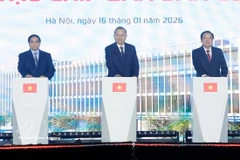
Party General Secretary To Lam (centre), Prime Minister Pham Minh Chinh (left), and Chairman of the Party Central Committee’s Commission for Internal Affairs Phan Dinh Trac mark the start of work on a high-tech semiconductor manufacturing plant in Hanoi on January 16, 2026. (Photo: VNA)

Resolution 57 refines technology priorities for new growth phase

The Ministry of Science and Technology is seeking feedback on a draft Prime Minister decision outlining four key categories: priority high technologies for investment, encouraged high-tech products, strategic technologies, and strategic tech products. The move is intended to capture emerging technology trends while strengthening the policy framework for high-tech development.

Professor Geert Angenon of Vrije Universiteit Brussel (Photo: VNA)

European experts highlight potential for AI cooperation with Vietnam

Experts believe that as demand for technological innovation grows and international partnerships expand, Vietnam has big opportunities to deepen cooperation with European partners in high-tech agriculture, healthcare, digital transformation and artificial intelligence.

A seminar on AI use hosted by the Vietnam Intellectual Association in the UK and Ireland in February 2026. (Photo: VNA)

AI – unmissable opportunity for Vietnam: Experts

AI also emerges as a key enabler for Vietnam's ambition to build financial and technology hubs. Applications can boost efficiency, automate workflows, cut costs, and sharpen data analytics, which are essential pillars of a modern financial system.

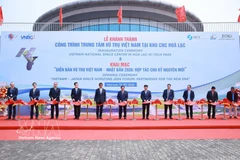
Prime Minister Pham Minh Chinh (C) and delegates cut a ribbon to innaugurate the Vietnam National Space Centre (VNSC) at Hoa Lac Hi-Tech Park in Hanoi on March 13 (Photo: VNA)

PM calls for accelerated space technology development in Vietnam

Vietnam aims by 2030 to achieve a mid-level position in space science and technology development within Southeast Asia, and after 2030 to build national capabilities to independently develop satellite technologies and apply space data to address global challenges and national security needs.

Students control robots at the FPT Schools AI & Robotics Challenge (Photo: VNA)

National AI ethics framework issued to guide safe, responsible rollout

According to the circular taking effect on March 10, the framework imposes specific obligations on entities and individuals involved in AI activities. In particular, the AI use must ensure safety, reliability, while preventing harm to human life, health, dignity, honour, and mental well-being.

Party General Secretary To Lam speaks at the first meeting in 2026 of the Central Steering Committee for the Development of Science, Technology, Innovation and Digital Transformation on March 12. (Photo: VNA)

Party chief urges stronger, result-oriented implementation of Resolution 57

Turning science, technology, innovation and digital transformation into the main drivers of a new growth model requires substantial efforts. In the coming period, the focus must shift from merely carrying out tasks to delivering tangible and measurable outcomes, while concentrating resources on addressing strategic national challenges, said Party General Secretary To Lam.

Vietnamese Ambassador to the US Nguyen Quoc Dung addresses the forum. (Photo: VNA)

High-level forum advances Vietnam–US technological cooperation

The ambassador highlighted that Vietnam and the US are highly complementary. Vietnam offers a dynamic economy, a young and increasingly skilled workforce and rapidly growing innovation ecosystem, while the US offers frontier technologies, world class research institutions, capital and leading global companies.

Participants at the first meeting of the National Steering Committee on Semiconductor Industry Development in 2026 (Photo: VNA)

Vietnam becomes vital player in global semiconductor value chain: Deputy PM

Vietnamese companies have also gradually joined the global value chain by improving their capabilities in chip design, production and related services. Notably, a semiconductor chip manufacturing plant project developed by the Viettel Military Industry and Telecoms Group (Viettel) has already commenced.

Young voters in Ho Chi Minh City scan an QR code to participate in an online quiz about the Election Law. (Photo: VNA)

Digital technology helps enhance transparency, trust in elections

The use of technology in this election is not merely a short-term measure but reflects Ho Chi Minh City’s broader commitment to comprehensive digital transformation and smart urban governance, reinforcing public trust in the democratic process and administration.