Malaysia tightens controls on border-town fuel stations

Deputy KPDN Minister Datuk Dr Fuziah Salleh said the government is currently reviewing existing policies to further restrict fuel purchases in high-risk zones, acknowledging that current limits have not completely stopped the leakages.

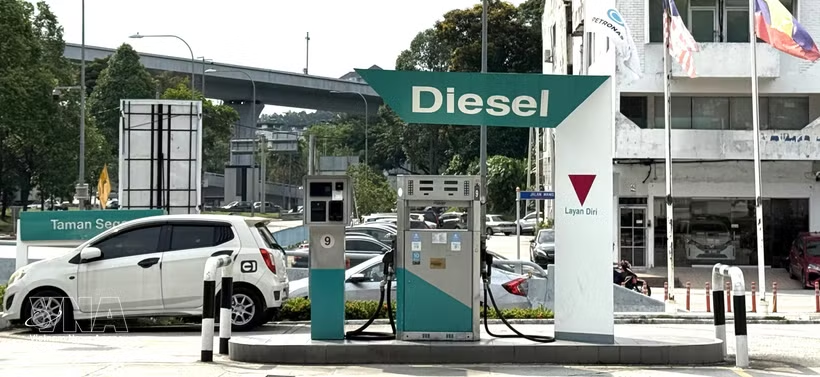
A Petronas filling station in Kuala Lumpur (Photo: VNA)

Kuala Lumpur (VNA) – The Malaysian government is considering casting a massive dragnet over border-town fuel stations by enforcing mandatory audits on all fuel retailers located within a 50km radius of the national border.

The proposed move is part of a strategic policy shift being weighed by the Domestic Trade and Cost of Living Ministry (KPDN) to choke the supply lines of cross-border fuel smuggling syndicates.

Deputy KPDN Minister Datuk Dr Fuziah Salleh said the government is currently reviewing existing policies to further restrict fuel purchases in high-risk zones, acknowledging that current limits have not completely stopped the leakages.

While fuel purchase limits in border areas are already in place, further tightening measures are being considered, she stressed.

These include stricter fleet card compliance systems and rigorous audits of all petrol stations within a 50km radius of the border, she said, noting that the 50km audit zone would encompass hundreds of fuel stations across northern peninsula states like Kelantan, Perlis and Kedah, as well as border towns in Sabah and Sarawak.

The Malaysian cabinet had recently approved a proposal for police officers to be deployed at petrol stations near border areas to strengthen enforcement against fuel leakages and smuggling.

Fuziah warned that the ministry will continue to show “zero tolerance” toward any petrol station operator found colluding with syndicates.

Such actions not only violate the law but constitute a betrayal of Malaysians by misappropriating fuel subsidies worth billions of ringgit intended for eligible citizens, she said.

According to the official, her ministry is now actively going after the syndicate masterminds by invoking the Anti-Money Laundering Act (AMLA, with focus extending beyond fuel seizures. Efforts are now directed at dismantling syndicate networks at their core, including freezing assets and tracking financial flows under AMLA to prevent syndicates from re-emerging under different identities.

Calling local communities the nation’s “first line of defence”, she urged residents in border towns to report suspicious activities and refuse to let syndicates operate in their backyards, through communication channels, including social media, hotlines, online portals and the ministry’s service applications./.

VNA

See more

Illustrative image (Photo: Thai PBS)

Thai capital introduces recycling initiative

Thailand's Bangkok Metropolitan Administration (BMA) is introducing a sustainable twist to this year’s Songkran festivities by inviting revellers to donate their used or unwanted plastic squirt guns for recycling.

Thailand warns public of online scams during Songkran festival

Thailand warns public of online scams during Songkran festival

It identified four major scam tactics now spreading widely, which involve fake accommodation and travel ticket bookings, hacked social media accounts being used to ask for money, fake links offering cash giveaways or discounts, and fake pages selling festival-related products.

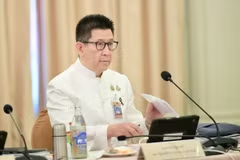
Thailand's Finance Minister Ekniti Nitithanprapas (Photo: Royal Thai Government)

Thailand implements emergency relief package to protect economy

The Thai Government has allocated more than 7.74 billion THB (about 241 million USD) from the central budget to support citizens in coping with rising energy prices, subsidise transport costs, and implement measures to reduce the cost of living nationwide.

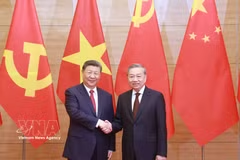
Party General Secretary To Lam (R) welcomes Party General Secretary and President of China Xi Jinping in Hanoi in April 2025. (Photo: VNA)

Top Vietnamese leader’s visit highlights strategic importance of bilateral ties: Chinese newspaper

The newspaper noted that To Lam announced his visit to China just two days after being elected State President of Vietnam. Earlier, in August 2024, shortly after assuming the position of Party General Secretary, he also chose China as the destination for his first overseas trip. That both of his first state visits in his new roles have been to China is a clear indication of the strategic nature and elevated importance of China–Vietnam relations.

Thailand eyes major investment law reform

Thailand eyes major investment law reform

The Thai economy remains imbalanced, relying heavily on exports and services such as tourism, which together account for roughly 70% of GDP. Meanwhile, domestic investment aimed at strengthening the country’s production structure and keeping pace with global changes remains insufficient, said Finance Minister Ekniti Nitithanprapas.

Indonesia tightens management of forest resources

Indonesia tightens management of forest resources

The total value of recovered assets is equivalent to nearly 10% of Indonesia’s 2026 state budget, estimated at about 240 billion USD, highlighting the large scale of past violations in the forestry sector.

Thailand seeks to offset fertiliser supply shortfall

Thailand seeks to offset fertiliser supply shortfall

Thailand's Agriculture and Cooperatives Minister Suriya Juangroongruangkit reaffirmed the policy to suspend farmers' debts for three years, which was announced during his party's election campaign, though details of the measure will be finalised after consultations with state agencies, including the Finance Ministry.

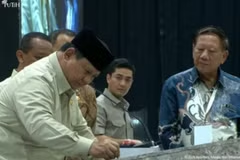
 President Prabowo Subianto signs an inscription at the inauguration of PT VKTR Teknologi Mobilitas' electric commercial vehicle assembly plant in Magelang, Central Java, on Thursday, April 9, 2026. (Photo: Antara)

Indonesia targets ending fuel imports within three years

In addition to electrifying power plants, the Indonesian government is promoting electric vehicles and the utilisation of other renewable energy sources. Solutions include processing palm oil and used cooking oil into aviation fuel to further reduce reliance on fossil fuels.