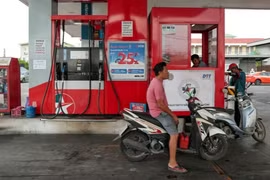
Bangkok (VNA) - Thailand’s economic outlook is facing mounting uncertainty as the ongoing conflict in the Middle East continues to weigh on global energy markets, prompting authorities to reassess growth projections and warn of rising stagflation risks.
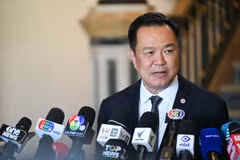
Danucha Pichayanan, Secretary-General of the National Economic and Social Development Council (NESDC), said the conflict is exerting increasing pressure on global energy markets, leading to oil price volatility despite emerging signs of negotiations between the US and Iran.
NESDC has outlined four possible scenarios to reassess Thailand’s economic trajectory in 2026.
In the first scenario, if fighting spreads across parts of the region but concludes within two months, disruptions to oil transport through the Strait of Hormuz and the Red Sea would remain temporary, with no further damage to energy infrastructure. Under this scenario, oil supply would gradually return, with prices averaging 85–95 USD per barrel for the year. Financial markets will remain volatile, with investors shifting towards safer assets and the baht weakening. Thailand’s GDP growth would slow to 1.4%, with inflation rising to 2.7%.
Previously, under the baseline pre-conflict scenario, Thailand’s economy was projected to grow by around 2% this year.
In the second, if the conflict expands across multiple countries and lasts three to five months, oil production infrastructure could be damaged, leading to prolonged supply disruptions. Average oil prices would rise to 105–115 USD per barrel. This will significantly tighten global energy supply, drive up inflation, and disrupt industrial supply chains. Many economies, including Thailand, could enter a stagflationary phase marked by slowing growth and rising prices. Thailand’s GDP would fall to 0.9%, with inflation climbing to 4.4%.
In the third, more severe scenario envisions a conflict lasting six to nine months, with energy supply from the Middle East slow to recover even after hostilities end. Oil prices could surge to 135–145 USD per barrel, potentially triggering a deep global recession marked by widespread supply chain disruptions, trade fragmentation and shortages of both energy and food. Under this scenario, Thailand’s GDP growth will drop sharply to just 0.2%, while inflation will spike to 5.8%.
Meanwhile, in the worst-case scenario, where the conflict expands beyond the Middle East and escalates globally, the world will lead to prolonged global recession, widespread shortages, and the risk of conflict spilling into other regions. Thailand will be impossible to reliably forecast oil prices, inflation or economic growth.
NESDC warned that the impact of the conflict extends beyond energy prices, driving up goods costs and weakening purchasing power. As demand declines while inflation rises, the risk of stagflation becomes more pronounced. At the same time, supply chain disruptions, particularly shortages of materials, could continue to weigh on production and industrial activity./.