Thailand implements emergency relief package to protect economy

The Thai Government has allocated more than 7.74 billion THB (about 241 million USD) from the central budget to support citizens in coping with rising energy prices, subsidise transport costs, and implement measures to reduce the cost of living nationwide.

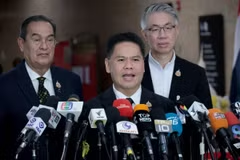
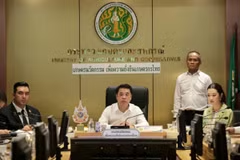
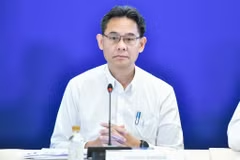
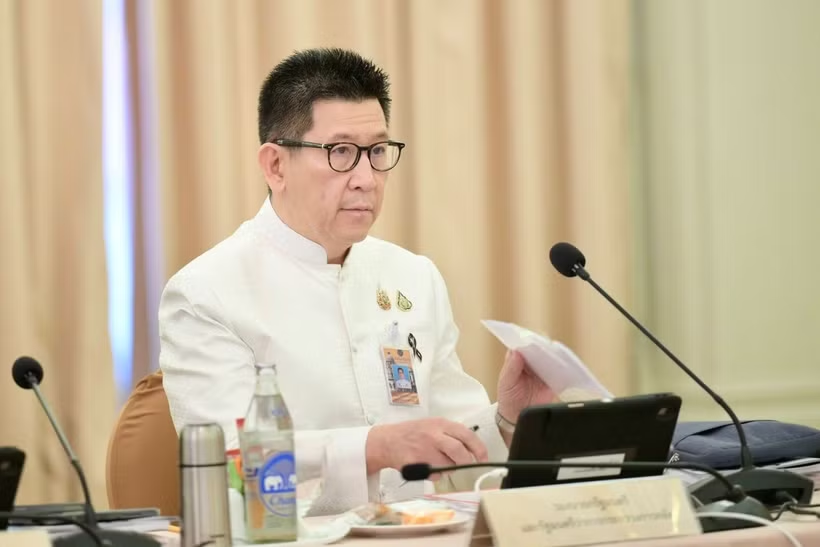
Thailand's Finance Minister Ekniti Nitithanprapas (Photo: Royal Thai Government)

Bangkok (VNA) – The Thai cabinet has approved a large-scale emergency relief package aimed at curbing inflation, protecting small and medium-sized enterprises (SMEs), and strengthening energy security amid escalating conflicts in the Middle East that threaten growth.

The Thai Government has allocated more than 7.74 billion THB (about 241 million USD) from the central budget to support citizens in coping with rising energy prices, subsidise transport costs, and implement measures to reduce the cost of living nationwide.

The package is designed to prevent stagflation by balancing direct government subsidies with a large-scale credit injection into the industrial sector, Deputy Prime Minister and Finance Minister Ekniti Nitithanprapas said in an announcement on April 11.

To ease the rising cost of living, the Government will increase monthly allowances for 13.22 million state welfare cardholders, raising the spending limit for essential goods from 300 THB to 400 THB per month, effective from April 13.

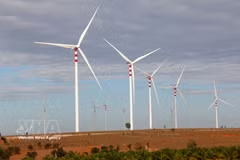
The Ministry of Finance is also leveraging state-owned banks to promote energy independence. The Government Savings Bank (GSB) will establish a 5-billion-THB preferential loan fund for households to install solar panels or purchase electric vehicles (EVs), with a loan cap of 2 million THB per person. Meanwhile, the Government Housing Bank (GHB) will offer “Green Home” mortgage loans at a low interest rate of 2.2%.

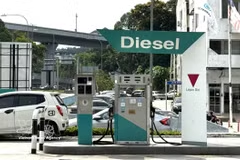
To manage the energy price surge, the cabinet has earmarked over 2 billion THB in fuel subsidies for lorries and public transport for 42 days, along with a 200-million-THB package to reduce public transport fares during the Songkran festival. In addition, Industry Minister Varawut Silpa-archa announced a 20-billion-THB support package to assist SMEs facing rising operating costs.

Furthermore, the cabinet has instructed all government agencies to tighten spending by cancelling international study trips and replacing them with domestic alternatives. Public sector employees are also encouraged to work from home to help reduce energy consumption during the crisis./.

VNA

See more

 Malaysia strengthens national energy supply mix

Malaysia strengthens national energy supply mix

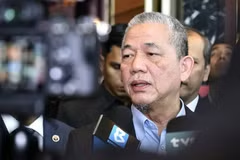
The Malaysian government will intensify efforts to strengthen the national energy mix to ensure electricity supply security amid extreme weather changes, which are beginning to affect existing resources, according to Deputy Prime Minister Datuk Seri Fadillah Yusof.

Illustrative image (Photo: Thai PBS)

Thai capital introduces recycling initiative

Thailand's Bangkok Metropolitan Administration (BMA) is introducing a sustainable twist to this year’s Songkran festivities by inviting revellers to donate their used or unwanted plastic squirt guns for recycling.

Thailand warns public of online scams during Songkran festival

Thailand warns public of online scams during Songkran festival

It identified four major scam tactics now spreading widely, which involve fake accommodation and travel ticket bookings, hacked social media accounts being used to ask for money, fake links offering cash giveaways or discounts, and fake pages selling festival-related products.

A Petronas filling station in Kuala Lumpur (Photo: VNA)

Malaysia tightens controls on border-town fuel stations

Deputy KPDN Minister Datuk Dr Fuziah Salleh said the government is currently reviewing existing policies to further restrict fuel purchases in high-risk zones, acknowledging that current limits have not completely stopped the leakages.

Party General Secretary To Lam (R) welcomes Party General Secretary and President of China Xi Jinping in Hanoi in April 2025. (Photo: VNA)

Top Vietnamese leader’s visit highlights strategic importance of bilateral ties: Chinese newspaper

The newspaper noted that To Lam announced his visit to China just two days after being elected State President of Vietnam. Earlier, in August 2024, shortly after assuming the position of Party General Secretary, he also chose China as the destination for his first overseas trip. That both of his first state visits in his new roles have been to China is a clear indication of the strategic nature and elevated importance of China–Vietnam relations.

Indonesia tightens management of forest resources

Indonesia tightens management of forest resources

The total value of recovered assets is equivalent to nearly 10% of Indonesia’s 2026 state budget, estimated at about 240 billion USD, highlighting the large scale of past violations in the forestry sector.

Thailand seeks to offset fertiliser supply shortfall

Thailand seeks to offset fertiliser supply shortfall

Thailand's Agriculture and Cooperatives Minister Suriya Juangroongruangkit reaffirmed the policy to suspend farmers' debts for three years, which was announced during his party's election campaign, though details of the measure will be finalised after consultations with state agencies, including the Finance Ministry.

 President Prabowo Subianto signs an inscription at the inauguration of PT VKTR Teknologi Mobilitas' electric commercial vehicle assembly plant in Magelang, Central Java, on Thursday, April 9, 2026. (Photo: Antara)

Indonesia targets ending fuel imports within three years

In addition to electrifying power plants, the Indonesian government is promoting electric vehicles and the utilisation of other renewable energy sources. Solutions include processing palm oil and used cooking oil into aviation fuel to further reduce reliance on fossil fuels.

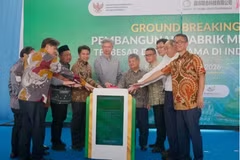
A groundbreaking ceremony for Indonesia's first melamine project, invested by PT GEABH Joint Technology, is held in the Gresik Special Economic Zone, East Java Province, Indonesia, April 8 (Photo: Xinhua)

Indonesia develops strategic chemical industry

Indonesia's first melamine plant in the Gresik Special Economic Zone is seen as a strategic step to boost the development of the country’s chemical industry and enhance domestic value creation.