Kuala Lumpur (VNA) – Amid escalating geopolitical tensions in the Middle East, energy security is emerging as a critical concern for fast-growing Southeast Asian economies, including Vietnam, as they pursue green transition goals, said Ei Sun Oh, a senior fellow at the Pacific Research Centre of Malaysia.
Distant geopolitical disruptions are no longer abstract risks but direct challenges requiring flexible and sustainable policy responses, he told Vietnam News Agency correspondents in Malaysia.
According to the expert, instability in the Middle East presents two major challenges for regional economies. The first is heavy dependence on imported energy. Like many of its neighbours, Vietnam relies significantly on oil and gas supplies from the region. Any disruption to transport routes could trigger supply shortages, leading to soaring energy prices that place pressure on household incomes and hinder socio-economic growth. This risk is particularly acute for high-growth economies where energy serves as the lifeblood of production and services.
The second challenge lies in the trade-oriented structure of Southeast Asian economies. With exports and imports heavily reliant on maritime routes passing through or near the Middle East, rising energy costs not only increase domestic production expenses but also drive up shipping costs. This “double impact” weakens the competitiveness of exports and calls for a more comprehensive approach to energy security strategies.
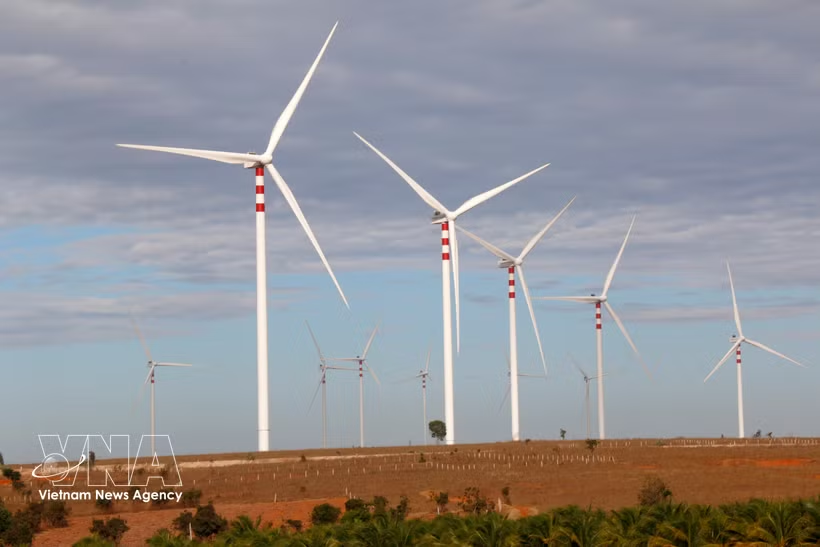
Drawing on Malaysia’s experiences as a key regional oil and gas producer, Ei Sun Oh noted that short-term measures often involve fiscal tightening and reducing costly energy subsidies. However, long-term strategies focus on reducing dependence on Middle Eastern supplies by prioritising domestically produced oil and gas for internal use. At the same time, Malaysia is accelerating the development of renewable energy sources such as solar and wind, while exploring nuclear power options.
These efforts reflect a regional trend towards enhancing self-reliance through diversified energy sources and greener systems.
Assessing Vietnam’s current energy roadmap, which includes reducing coal-fired power, expanding renewables, investing in transmission infrastructure, and strengthening international cooperation, the expert described the plans as highly promising. Vietnam is also looking to export clean energy to other ASEAN countries and promote peaceful nuclear energy research through international organisations such as the International Atomic Energy Agency (IAEA).
However, he emphasised that the gap between plans and actual outcomes depends on determination. While Vietnam, Malaysia, and Indonesia share similar ambitions for energy autonomy and resilience, success ultimately hinges on the effective implementation of commitments.
One key recommendation for the region is to strengthen cross-border electricity grid connectivity in ASEAN. Integrated power grids would allow countries to support one another during supply shortages. With advances in undersea cable technology, connecting island nations such as Indonesia and the Philippines to mainland grids is increasingly feasible.
The expert cited Malaysia’s Sarawak state, which produces significant hydropower and plans to export electricity to neighbouring countries via submarine cables, as an example of how regional cooperation can help mitigate energy shocks.
Despite these prospects, financing remains the greatest challenge. Balancing energy costs with green transition goals requires innovative approaches to mobilising resources. The transition is not only a technical endeavour but also a financial and strategic one.
In an increasingly volatile global landscape, a combination of strong political will, innovative financing, and enhanced regional cooperation will be key for Vietnam to build a resilient, sustainable, and self-reliant energy system capable of withstanding external shocks./.