Singapore accelerates in global AI race

According to the PwC study, Singapore businesses (67%) are more willing to take risks when investing in AI compared to those in other countries (41%).

Higher risk appetite and more advanced use cases set Singapore firms apart, but gaps in governance, data and workflow integration continue to separate top performers from the rest, finds PwC's study. (Photo: Pexels)

Singapore (VNA) - Businesses in Singapore are adopting artificial intelligence (AI) at a significantly faster pace than their global peers, positioning the city-state as a strong contender for a regional AI hub, according to a global AI performance survey released on April 13 by PwC.

The study, conducted between July and September 2025, polled more than 1,200 senior executives primarily from large corporations worldwide. Of these, 30 respondents are based in Singapore.

According to the study, Singapore businesses (67%) are more willing to take risks when investing in AI compared to those in other countries (41%).

Meanwhile, 63% of Singapore respondents surveyed reported that they are able to make key decisions regarding financial and human resources on the basis of AI opportunities, higher than the 51% on average in other countries.

In particular, 43% of Singapore respondents reported using AI to compete with companies outside their own sectors, compared to 20% globally.

|The global study also found that organisations in many countries are still using AI for less advanced tasks such as analysis, prediction and recommendation (37% globally) compared to just 20% in Singapore.

In contrast, Singapore businesses are ahead in deploying AI in more sophisticated ways, such as autonomous and self-optimising ways at 17% compared to only 8% globally.

However, when measured against AI leaders, Singapore’s overall standing trails in the following areas: governance and risk management; data; workflow redesign; unlocking new value.

It is noted that over half of Singapore businesses surveyed (53%) have robust, up-to-date security in place to protect data, AI models and underlying infrastructure, compared to 69% among AI leaders.

In 2025, the Infocomm Media Development Authority (IMDA) and the AI Verify Foundation advanced efforts to operationalise trust in GenAI through initiatives such as the Global AI Assurance Pilot, enabling organisations to test applications and strengthen assurance at scale.

More recently, Budget 2026 added further momentum with the announcement of a National AI Council and National AI Missions across four priority sectors, advanced manufacturing, connectivity, finance and health care, alongside regulatory sandboxes and enhanced tax incentives./.

VNA

See more

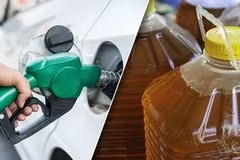
A Petronas filling station in Kuala Lumpur (Photo: VNA)

Malaysia tightens controls on border-town fuel stations

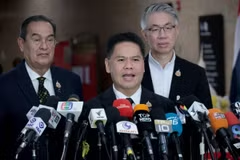
Deputy KPDN Minister Datuk Dr Fuziah Salleh said the government is currently reviewing existing policies to further restrict fuel purchases in high-risk zones, acknowledging that current limits have not completely stopped the leakages.

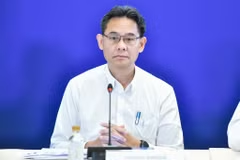
Thailand's Finance Minister Ekniti Nitithanprapas (Photo: Royal Thai Government)

Thailand implements emergency relief package to protect economy

The Thai Government has allocated more than 7.74 billion THB (about 241 million USD) from the central budget to support citizens in coping with rising energy prices, subsidise transport costs, and implement measures to reduce the cost of living nationwide.

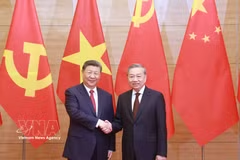
Party General Secretary To Lam (R) welcomes Party General Secretary and President of China Xi Jinping in Hanoi in April 2025. (Photo: VNA)

Top Vietnamese leader’s visit highlights strategic importance of bilateral ties: Chinese newspaper

The newspaper noted that To Lam announced his visit to China just two days after being elected State President of Vietnam. Earlier, in August 2024, shortly after assuming the position of Party General Secretary, he also chose China as the destination for his first overseas trip. That both of his first state visits in his new roles have been to China is a clear indication of the strategic nature and elevated importance of China–Vietnam relations.

Thailand eyes major investment law reform

Thailand eyes major investment law reform

The Thai economy remains imbalanced, relying heavily on exports and services such as tourism, which together account for roughly 70% of GDP. Meanwhile, domestic investment aimed at strengthening the country’s production structure and keeping pace with global changes remains insufficient, said Finance Minister Ekniti Nitithanprapas.

Indonesia tightens management of forest resources

Indonesia tightens management of forest resources

The total value of recovered assets is equivalent to nearly 10% of Indonesia’s 2026 state budget, estimated at about 240 billion USD, highlighting the large scale of past violations in the forestry sector.

Thailand seeks to offset fertiliser supply shortfall

Thailand seeks to offset fertiliser supply shortfall

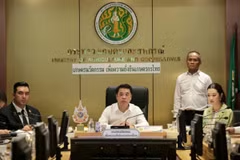
Thailand's Agriculture and Cooperatives Minister Suriya Juangroongruangkit reaffirmed the policy to suspend farmers' debts for three years, which was announced during his party's election campaign, though details of the measure will be finalised after consultations with state agencies, including the Finance Ministry.

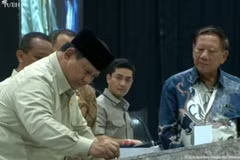
 President Prabowo Subianto signs an inscription at the inauguration of PT VKTR Teknologi Mobilitas' electric commercial vehicle assembly plant in Magelang, Central Java, on Thursday, April 9, 2026. (Photo: Antara)

Indonesia targets ending fuel imports within three years

In addition to electrifying power plants, the Indonesian government is promoting electric vehicles and the utilisation of other renewable energy sources. Solutions include processing palm oil and used cooking oil into aviation fuel to further reduce reliance on fossil fuels.

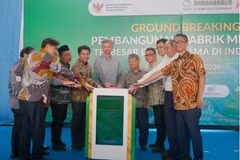
A groundbreaking ceremony for Indonesia's first melamine project, invested by PT GEABH Joint Technology, is held in the Gresik Special Economic Zone, East Java Province, Indonesia, April 8 (Photo: Xinhua)

Indonesia develops strategic chemical industry

Indonesia's first melamine plant in the Gresik Special Economic Zone is seen as a strategic step to boost the development of the country’s chemical industry and enhance domestic value creation.