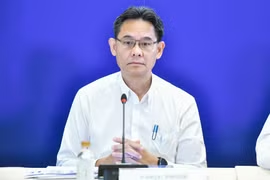
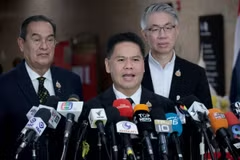
Bangkok (VNA) – Thailand’s Finance Minister Ekniti Nitithanprapas has said that the current energy crisis could be the last opportunity for the Southeast Asian country to restructure its economy and ensure long-term sustainability.
The Thai economy remains imbalanced, relying heavily on exports and services such as tourism, which together account for roughly 70% of GDP. Meanwhile, domestic investment aimed at strengthening the country’s production structure and keeping pace with global changes remains insufficient, he noted.
Before the 1997 economic crisis, Thailand’s total investment reached around 40% of GDP, but today it stands at only 24%.
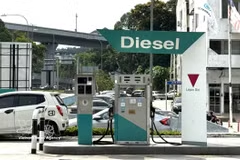
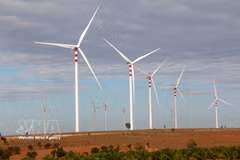
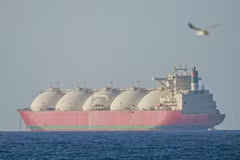
The conflict in the Middle East has triggered a global energy crisis, providing an impetus for Thailand to accelerate investment, particularly in renewable energy such as solar power to replace fossil fuels. This is essential to strengthen energy security, which underpins all industries, the official said.
However, investment in Thailand must pass through numerous rules and regulations governed by various laws and agencies, making the process cumbersome. For example, obtaining construction permits must comply with the Land Act, property laws, and other regulations.
There are also restrictive rules for foreign investors, such as visa regulations that allow them to stay for only 90 days before requiring a new visa stamp.
Ekniti said Thailand needs to create a fast-track system for domestic investment by consolidating regulations into a single law to improve efficiency.
This concept, known as an omnibus law, would represent a major transformation in Thailand’s investment landscape, he added./.