Vietnam, India see strong potential in manufacturing, supply chain integration: CII official

Rohin Agarwal, Regional Director for ASEAN and Oceania at the Confederation of Indian Industry (CII), noted that sectors within the digital economy such as information technology, financial technology (fintech), and agricultural technology (agritech) are also seen as having strong cooperation potential.

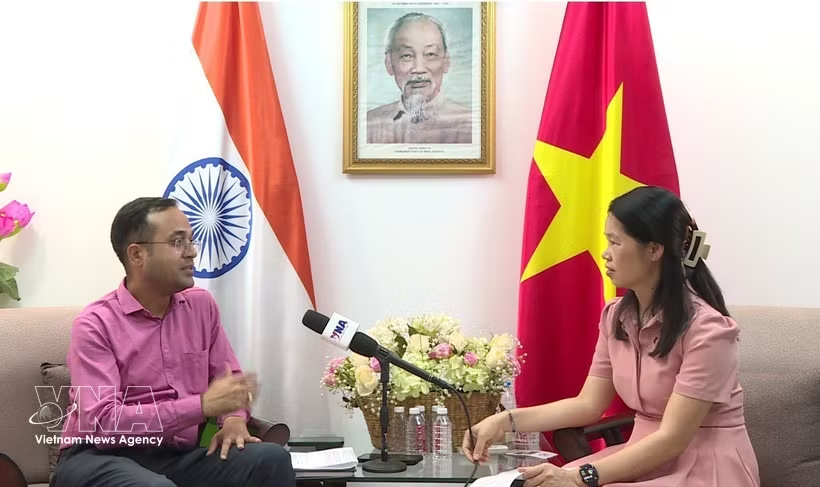
Rohin Agarwal (left), Regional Director for ASEAN and Oceania at the Confederation of Indian Industry, speaks to a Vietnam News Agency correspondent in New Delhi. (Photo: VNA)

New Delhi (VNA) – Vietnam and India hold substantial potential for further development, particularly in manufacturing and supply chain integration, especially in electronics and engineering – sectors in which Vietnam is emerging as a global manufacturing hub.

Rohin Agarwal, Regional Director for ASEAN and Oceania at the Confederation of Indian Industry (CII), made the remark in an interview with Vietnam News Agency correspondents in New Delhi following his visit to Vietnam alongside an Indian business delegation attending the 35th Vietnam International Trade Fair (Vietnam Expo 2026) in Hanoi from April 8–11. During the trip, Agarwal held working sessions with various organisations and enterprises in Vietnam to promote economic cooperation and explore investment and business opportunities between the two countries.

He noted that sectors within the digital economy such as information technology, financial technology (fintech), and agricultural technology (agritech) are also seen as having strong cooperation potential.

In addition, industries such as pharmaceuticals, agriculture and food processing, renewable energy, and infrastructure development offer numerous opportunities for businesses from both countries. Notably, the startup and innovation ecosystem is showing increasing convergence. Agarwal stated that they have identified around 12 sectors that can drive cooperation between India and Vietnam.

He described the trip as highly productive, delivering tangible outcomes and long-term direction. According to the official, Indian businesses had the opportunity to gain comprehensive insights into Vietnam’s economic ecosystem, from its robust growth trajectory to its increasingly prominent role in global supply chains.

As part of the visit, participation in Vietnam Expo 2026 was a central activity, with the delegation attending the opening ceremony and actively engaging in business-to-business (B2B) matchmaking sessions. These activities facilitated substantive dialogue between CII member companies and Vietnamese industrial partners, while also demonstrating Vietnam’s openness and strong willingness to cooperate.

The delegation also held working sessions with major organisations and business associations, including the Vietnam Chamber of Commerce and Industry (VCCI), the Vietnam Software and IT Services Association (VINASA), and Sovico Group, thereby further strengthening ties and expanding opportunities for bilateral cooperation.

Regarding next steps, Agarwal emphasised the importance of maintaining momentum after the visit. Many companies in the delegation have already reconnected with Vietnamese partners to advance deeper discussions on joint ventures, technology collaboration, and market entry strategies.

He affirmed that the organisation will continue to serve as a bridge through sector-specific programmes, specialised business delegations, and close coordination with partners such as the VCCI and relevant associations. With support from the trade offices of both countries, the CII expects that initial connections will soon be translated into long-term cooperative projects, contributing to the sustainable development of India–Vietnam economic relations./.
VNA

See more

Malaysia’s job losses surge 47% in the first quarter of 2026 (Photo: AFP)

Malaysia's layoffs rise 47% in first quarter

The report, based on figures from Malaysia’s Social Security Organisation, showed layoffs peaked in January with around 10,700 cases before easing to 7,500 in February and 5,900 in March. Despite the slowdown toward the end of the quarter, the total remained significantly higher than the roughly 16,500 layoffs recorded in the same period of 2025.

People take part in the Songkran Festival in Bangkok, Thailand, on April 13, 2026. (Photo: Xinhua/VNA)

Thailand's tourism sector enjoys windfall during Songkran Festival 2026

TAT estimated that around 500,000 foreign tourists visited Thailand during the April 11–15 period, generating about 8.1 billion THB, a 2% year-on-year increase. Domestic travel is projected at 5.96 million trips, up 7%, contributing about 22.25 billion THB, an annual rise of 8%.

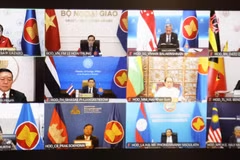
The sixth ASEAN Digital Ministers’ Meeting (ADGMIN) approves the Hanoi Declaration on digital cooperation, reaffirming the bloc’s goals and principles as outlined in the 1967 Bangkok Declaration and the ASEAN Charter. (Photo: ASEAN/Facebook)

ASEAN, Japan envision joint AI development

Amid intensifying US–China rivalry and deepening technological fragmentation, ASEAN and Japan have strong potential to collaborate in developing more inclusive and comprehensive artificial intelligence (AI) models, according to an article published on fulcrum.sg on April 14.

At the video conference (Photo: Nation Thailand)

Thailand backs Japan’s push for energy security

At the summit, Japan announced a new initiative to support AZEC member countries through low-interest loans for the procurement of crude oil, refined fuel and essential goods, alongside broader fiscal support measures.

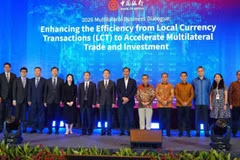
Indonesia steps up local currency use to reduce reliance on USD

Indonesia steps up local currency use to reduce reliance on USD

According to the Indonesian government data, total LCT transaction value reached 8.45 billion USD in January and February, a sharp increase from 3.21 billion USD in the same period last year. User participation has also risen significantly, surpassing 14,600 by February, with monthly averages exceeding 16,000, well above 2025 levels.

SMEs are the backbone of the Malaysian economy. (Photo: thestar.com.my)

Malaysia rolls out low-interest financing package for SMEs

The latest funding forms part of the government’s broader PowerUp10K campaign, a year-long initiative aimed at strengthening SMEs at different stages of growth. Under the programme, the ministry is targeting total disbursements of up to 15 billion MYR in low-cost financing, higher than the previously allocated 10 billion MYR.

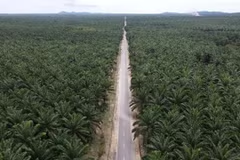
Illustrative photo (Photo: thejakartapost.com)

Indonesia strengthens palm oil industry through sustainability certification

Indonesia’s palm oil industry is a major pillar of the national economy, with more than 16 million hectares under cultivation and crude palm oil (CPO) output reaching 51.66 million tonnes in 2025. This scale has helped the country maintain its position as one of the world’s largest producers and exporters of palm oil.