Vietnam values US business community as trusted partner: NA Vice Chairwoman

Representatives of USABC member companies shared views on investment and business policies in Vietnam, voicing strong confidence in the country’s cooperation potential and investment environment.

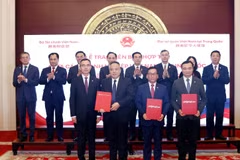
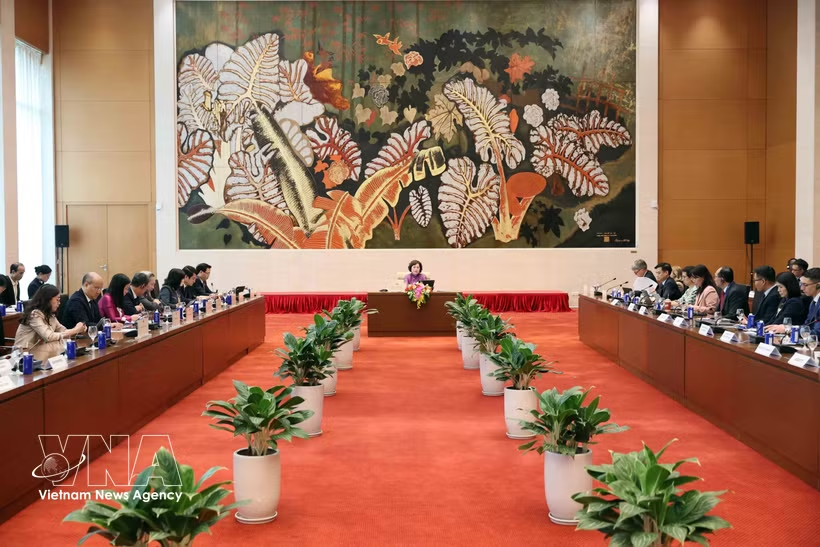
Vice Chairwoman of the National Assembly (NA) Nguyen Thi Hong meets with the delegation from the US-ASEAN Business Council on April 15 in Hanoi. (Photo: VNA)

Hanoi (VNA) – Vice Chairwoman of the National Assembly (NA) Nguyen Thi Hong on April 15 received a delegation from the US-ASEAN Business Council (USABC), reaffirming Vietnam’s strong appreciation of the US business community as a reliable partner in advancing the country’s economic priorities.

During the reception, Hong stressed that Vietnam regards the US as a leading partner and spoke highly of its consistent support for a strong, independent and prosperous Vietnam. She highlighted the effective operation of the US business community and the USABC in particular, describing them as trusted partners with valuable resources to promote Vietnam’s economic goals and priorities.

She expressed hope to advance bilateral ties in line with the Comprehensive Strategic Partnership, for the benefit of the people and businesses of both countries, while contributing to peace, stability and prosperity in the region and the world.

For his part, USABC Interim President and CEO Brian McFeeters thanked the Vietnamese legislator for the meeting, noting it provided an opportunity for both sides to discuss cooperation, clarify regulatory and policy issues, and address obstacles faced by US investors in Vietnam.

He expressed confidence that with close coordination of the NA, the Government and the business community in addressing institutional bottlenecks, Vietnam would achieve strong breakthroughs and enter a phase of rapid, sustainable and high-quality development.

Representatives of USABC member companies shared views on investment and business policies in Vietnam, voicing strong confidence in the country’s cooperation potential and investment environment. They also proposed measures to improve the legal and institutional framework, including administrative reform, and ensure greater transparency, consistency and stability in regulations to facilitate foreign investors.

vnanet-potal-pho-chu-tich-quoc-hoi-nguyen-thi-hong-lam-viec-voi-doan-doanh-nghiep-hoi-dong-kinh-doanh-hoa-ky-asean-8703255.jpg
Vice Chairwoman of the National Assembly (NA) Nguyen Thi Hong at the meeting with the delegation from the US-ASEAN Business Council. (Photo: VNA)

Hong reaffirmed that the Vietnamese NA consistently supports the development of Vietnam–US relations, aiming to bring tangible benefits to both countries. She underlined ongoing efforts to build a stable, transparent and favourable legal and policy framework to enable foreign enterprises, including those from the US, to expand operations and make long-term investments in Vietnam.

She affirmed that the legislature remains ready to listen to the concerns and recommendations of the business community regarding policies and laws.

She called on the USABC and its member enterprises to expand investment in Vietnam, particularly in strategic breakthrough areas such as human resources development, infrastructure, science and technology, innovation and digital transformation, as well as energy security. She also encouraged stronger cooperation with Vietnamese firms and greater technology transfer, especially in core technologies, to help Vietnam integrate more deeply into regional and global value chains.

Hong expressed hope that the USABC and US enterprises would support Vietnam to successfully host APEC Economic Leaders’ Week in 2027 (APEC 2027), thus enhancing market openness, attracting more investments, and improving national competitiveness./.
VNA

See more

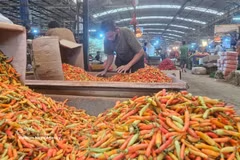
Chili peppers are on the list of essential goods in Indonesia (Photo: VNA)

Indonesia reduces imports of strategic food commodities

In 2026, Indonesia is expected to have approximately 12 million tonnes of rice carried over from the previous year, supported by annual production of around 34.7 million tonnes. With projected consumption of 31.1 million tonnes, national rice reserves could reach approximately 16 million tonnes by the end of the year.

Hanoi’s roadmap to implement low-emission zones from July is providing a strong boost to the electric two-wheeler market (Photo: VNA)

Low-emission zone roadmap drives electric two-wheeler boom in Hanoi

From July 1, Hanoi will introduce time-based or area-based restrictions on petrol-powered motorcycles within Ring Road 1, with plans to expand coverage across the entire zone by 2028 and extend to areas within Ring Road 3 by 2030. The policy is expected to reshape travel habits for millions of urban residents.

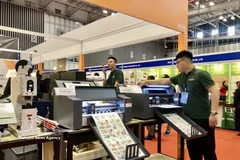
Delegates at the opening ceremony of the Made in Da Nang Expo 2026 (Photo: VNA)

Nearly 300 firms join Made in Da Nang Expo 2026

Speaking at the opening ceremony, Vice Chairman of the Da Nang People’s Committee Tran Chi Cuong said the exhibition is a large-scale trade promotion event aimed at showcasing products, connecting markets, and helping businesses enhance competitiveness while expanding domestic and export markets.

 Green production, standardised value chains key to fruit, vegetable sector growth

Green production, standardised value chains key to fruit, vegetable sector growth

Facing mounting pressure from increasingly stringent domestic and international standards, Vietnam’s fruit and vegetable sector is accelerating its shift toward green, safe, and sustainable production models. Beyond changing farming practices, localities and businesses are stepping up efforts to standardise value chains and build brands to achieve growth targets for 2026.

Hiep Phuoc Industrial Park in Ho Chi Minh City. (Photo: VNA)

Southern industrial real estate enters strategic growth phase

Key industrial hubs in the south, including Ho Chi Minh City, Dong Nai and Tay Ninh, are transitioning from a period driven largely by supply expansion and rising land prices to a more refined growth model. This new phase is shaped by infrastructure upgrades, supply chain restructuring, product improvement and greater emphasis on operational performance.