US journal highlights reasons why global firms should choose Vietnam for expansion strategy

Vietnam is highly regarded for maintaining economic momentum, recording GDP growth of 8.02% in 2025, alongside robust foreign direct investment (FDI) inflows with cumulative registered capital exceeding 322 billion USD.

A view of central Da Nang city (Photo: VNA)

Hanoi (VNA) – An article published on US-based Entrepreneur.com on April 1 highlighted that an increasing number of international companies are choosing Vietnam as a key destination in their global growth strategies, amid a growing trend of supply chain diversification aimed at reducing risks from trade and economic uncertainties.

Vietnam is highly regarded for maintaining economic momentum, recording GDP growth of 8.02% in 2025, alongside robust foreign direct investment (FDI) inflows with cumulative registered capital exceeding 322 billion USD. Its large population and a young, skilled workforce position the country as both a promising consumer market and an efficient manufacturing base. Competitive labour costs also continue to help businesses optimise expenses, particularly in labour-intensive industries.

Participation in multiple free trade agreements, including the Comprehensive and Progressive Agreement for Trans-Pacific Partnership (CPTPP) and the EU–Vietnam Free Trade Agreement (EVFTA), facilitates exports and deeper integration into global value chains, reinforcing Vietnam’s role as a manufacturing and export gateway. The investment climate and business establishment procedures have also become more flexible, while major economic hubs such as Hanoi and Ho Chi Minh City offer relatively strong infrastructure and international connectivity, enabling firms to integrate into regional networks.

However, the article also noted several challenges. Administrative procedures remain multi-layered, covering investment registration certificates, business registration, tax, and invoicing requirements, with documentation largely conducted in Vietnamese. Certain sectors require additional licences, and company leaders may need to be physically present for some procedures, increasing market entry costs and timelines. Initial operations also involve completing procedures related to capital contribution, taxation, e-invoices and labour insurance, with processing times varying by sector.

Overall, the article assessed Vietnam’s appeal as stemming from a rare combination of low cost, high growth, deep integration and an open investment environment. Nonetheless, administrative barriers and compliance requirements remain factors to consider, making Vietnam particularly suitable for companies pursuing long-term expansion strategies and prepared to navigate regulatory procedures./.


VNA

See more

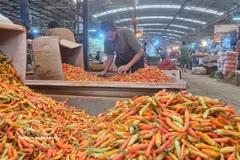
Chili peppers are on the list of essential goods in Indonesia (Photo: VNA)

Indonesia reduces imports of strategic food commodities

In 2026, Indonesia is expected to have approximately 12 million tonnes of rice carried over from the previous year, supported by annual production of around 34.7 million tonnes. With projected consumption of 31.1 million tonnes, national rice reserves could reach approximately 16 million tonnes by the end of the year.

Hanoi’s roadmap to implement low-emission zones from July is providing a strong boost to the electric two-wheeler market (Photo: VNA)

Low-emission zone roadmap drives electric two-wheeler boom in Hanoi

From July 1, Hanoi will introduce time-based or area-based restrictions on petrol-powered motorcycles within Ring Road 1, with plans to expand coverage across the entire zone by 2028 and extend to areas within Ring Road 3 by 2030. The policy is expected to reshape travel habits for millions of urban residents.

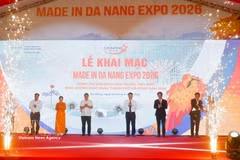
Delegates at the opening ceremony of the Made in Da Nang Expo 2026 (Photo: VNA)

Nearly 300 firms join Made in Da Nang Expo 2026

Speaking at the opening ceremony, Vice Chairman of the Da Nang People’s Committee Tran Chi Cuong said the exhibition is a large-scale trade promotion event aimed at showcasing products, connecting markets, and helping businesses enhance competitiveness while expanding domestic and export markets.

 Green production, standardised value chains key to fruit, vegetable sector growth

Green production, standardised value chains key to fruit, vegetable sector growth

Facing mounting pressure from increasingly stringent domestic and international standards, Vietnam’s fruit and vegetable sector is accelerating its shift toward green, safe, and sustainable production models. Beyond changing farming practices, localities and businesses are stepping up efforts to standardise value chains and build brands to achieve growth targets for 2026.

Hiep Phuoc Industrial Park in Ho Chi Minh City. (Photo: VNA)

Southern industrial real estate enters strategic growth phase

Key industrial hubs in the south, including Ho Chi Minh City, Dong Nai and Tay Ninh, are transitioning from a period driven largely by supply expansion and rising land prices to a more refined growth model. This new phase is shaped by infrastructure upgrades, supply chain restructuring, product improvement and greater emphasis on operational performance.

The launch of the Vietnam National Brand Week 2026 on April 16 (Photo: VNA)

Vietnam National Brand Week 2026 opens

Running from April 16 to 23 nationwide, the Vietnam National Brand Week 2026 marks the 18th anniversary of Vietnam Brand Day (April 20, 2008 – 2026).