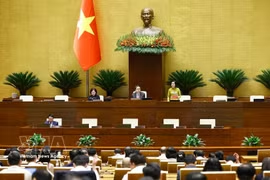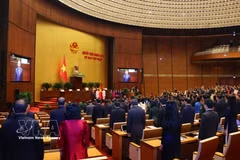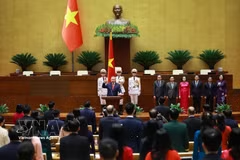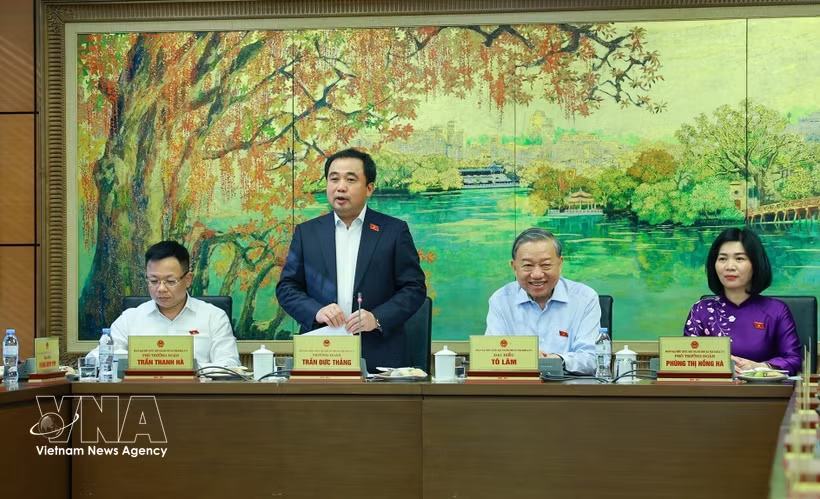
Hanoi (VNA) - The National Assembly (NA) on the afternoon of April 8 held group discussions on the draft revised Capital Law as part of the legislature's ongoing first session.
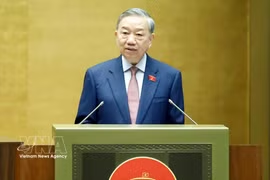
Speaking at the discussions, Party General Secretary and State President To Lam, a deputy of the Hanoi delegation, emphasised that the revision of the Capital Law is not merely about improving a specific piece of legislation, but represented a substantive opportunity and a strategic step to establish a new development model for the capital, which holds a very special position.
He highlighted that the overarching principle must be to develop the Capital Law into a distinctive and outstanding legal framework with sufficient guiding force to remove development bottlenecks, while still ensuring discipline and the high level of uniformity of the national legal system in the common interest of the country. This requires stronger empowerment and more thorough decentralisation, alongside clearer accountability and stricter mechanisms for power oversight rather than any relaxation of control.
According to the top leaders, practical experience shows that the capital currently faces major bottlenecks in several areas, including planning, infrastructure, urban governance, decentralisation and resource mobilisation. Citing urban planning as an example, he said planning must have a long-term vision and sustainability, rather than changing with each five-year leadership term.
He stressed that Hanoi’s spatial planning should allow residents to see clearly how the capital will develop over the next 50 or even 100 years, including the number of wards in the next decade, the layout of major transport corridors, and the designated areas for urban development, cultural heritage conservation, industrial zones, schools, hotels and cultural spaces.
He emphasised the need to shift decisively from a management mindset to a governance approach that actively facilitates development. The law, he said, should not merely stipulate what is permitted or prohibited, but should create institutional space for the capital to design, pilot and implement policies suited to its particular development needs.
In drafting the law, he suggested that only fundamental principles should be stipulated, while flexible and rapidly changing matters should be delegated to the Government and the city authorities to ensure practical implementation. Frequent amendments to the law shortly after its adoption will undermine its durability, he noted.
He said that decentralisation is a decisive factor but must be clear, substantive and subject to oversight. Granting authority without clearly defined scope will make implementation difficult, while decentralisation must also go hand in hand with implementation capacity and adequate financial resources.
Regarding mechanisms allowing policies that differ from existing regulations, he said such pilot mechanisms are necessary but must be limited to genuinely specific areas and accompanied by strict monitoring, evaluation and accountability mechanisms.
He said that Hanoi, as the national centre with greater resources, high-quality human capital and research capacity, is well positioned to pilot innovative policies that can later be expanded nationwide if successful.
Policies for the capital’s development in areas such as science and technology, innovation, finance, infrastructure investment and regional connectivity should continue to be reviewed to ensure they are genuinely breakthrough and not duplicative of general national mechanisms.
The top leader underscored that the capital cannot develop separately from its surrounding region, and regional connectivity mechanisms should therefore focus on strengthening socio-economic, infrastructure and supply linkages.
Hanoi, he said, must lead by example as a model of modern governance, strict discipline and accountability.
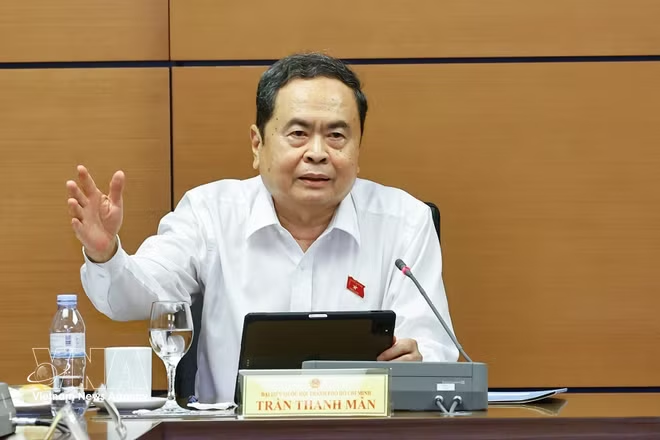
Discussing the draft revised Capital Law, NA Chairman Tran Thanh Man expressed strong support for its promulgation.
Explaining why the law needs further revision despite being amended in 2024, he noted that the NA adopted 89 laws in 2025, some of which introduced mechanisms and policies more advanced than those in the current Capital Law, making the existing legislation outdated.
He noted that the Politburo has issued Resolution No. 15-NQ/TW on the development of Hanoi to 2030 with a vision to 2045, and recently revised and issued a new resolution signed by General Secretary To Lam about three weeks ago.
Earlier, at the 10th session of the 15th NA, Hanoi was authorised under Resolution No. 258 to pilot specific mechanisms and policies for major projects in the capital, helping remove obstacles for a number of key developments.
He added that similar mechanisms had been applied in Ho Chi Minh City through Resolution 54 (2017), followed by Resolution 98 (2023) and Resolution 260 (2025), though the city still considers them insufficient for its development needs. The revision of the Capital Law will therefore serve as a premise for Ho Chi Minh City to develop a future Special Urban Law
He said that this is a highly important draft law with a strategic vision, demonstrating the strong political determination of the Party and the State to build the capital into a city of regional and international stature.
If finalised with a balance between strong empowerment, strict oversight and high transparency, the law will serve as a springboard for Hanoi to address major bottlenecks such as traffic congestion, environmental pollution and shortages of social housing, while creating breakthroughs in economic development, he stressed.
Also on April 8, NA deputies also discussed the draft Law amending and supplementing some articles of the Law on Emulation and Commendation, and the draft Law on Belief and Religion (revised)./.