Indian opinion values Vietnam’s political stability for regional balance

According to Indian observers, a stable political foundation enables Vietnam to engage more proactively in shaping regional norms, rules and initiatives, gradually enhancing its influence in both regional and global governance.

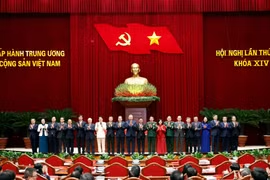
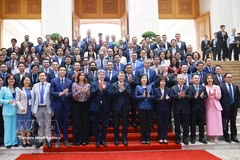
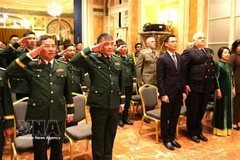
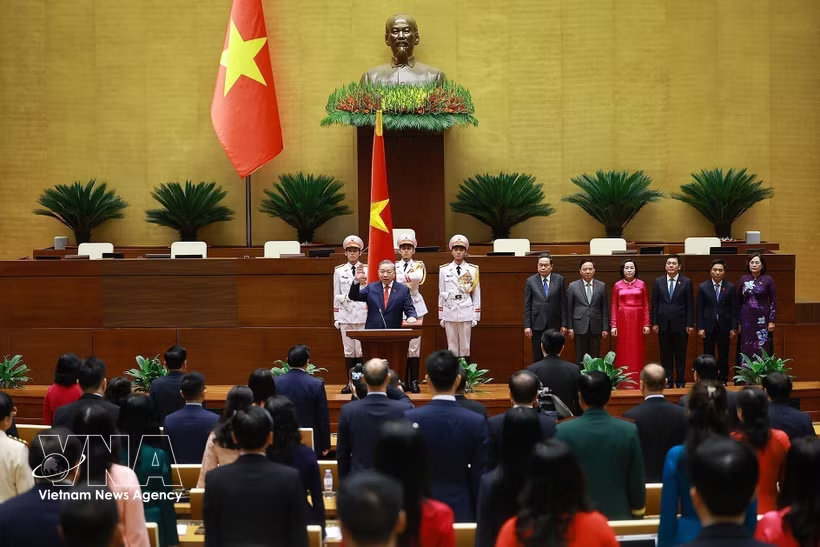
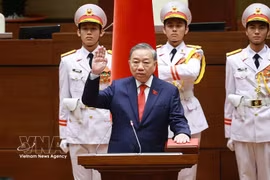
State President To Lam takes the oath of office on April 7. (Photo: VNA)

New Delhi (VNA) – Indian political, media and analytical circles have spoken highly of Vietnam’s political stability, viewing it as a factor directly influencing the structure and development momentum of the Indo-Pacific.

From these perspectives, Vietnam’s recent consolidation of its high-ranking leadership is seen not only as a domestic matter but also as an important message of political stability and effective governance capacity amid increasingly complex regional developments.

India regards Vietnam not only as a stable partner but also as an important pillar in a balanced, inclusive and rules-based regional architecture. At a time when competition among major powers is intensifying, a country with a solid political foundation like Vietnam plays a constructive role in maintaining equilibrium, mitigating polarisation, and contributing to the preservation of a rules-based order.

Vietnam’s political stability is also seen as an “anchor” helping the region cope with external shocks, particularly in the current global context marked by energy crises, supply chain disruptions and rising geopolitical risks. In this regard, a stable and adaptable Vietnam with effective governance is expected to help reduce negative spillover effects and support regional economic and security stability.

Another notable aspect highlighted by Indian observers is Vietnam’s growing role and position in multilateral institutions such as the Association of Southeast Asian Nations (ASEAN) and the United Nations. A stable political foundation is considered an advantage enabling Vietnam to engage more proactively in shaping regional norms, rules and initiatives, gradually enhancing its influence in both regional and global governance.

Looking further ahead, India expects that Vietnam’s consistent and stable leadership will create favourable conditions for the promotion of new strategic linkages across Asia, particularly in key areas such as technology, energy and cybersecurity. In this context, the Vietnam–India relationship is forecast to emerge as one of the important pillars of regional connectivity in the 21st century./.
VNA

See more

Prime Minister Le Minh Hung (R) hosts the UK's Ambassador to Vietnam Iain Frew in Hanoi on May 20 (Photo: VNA)

Vietnam attaches great importance to ties with UK: PM

Prime Minister Le Minh Hung suggested that the two countries work together towards raising bilateral trade turnover to 10 billion USD in 2026 and eventually 15 billion USD through expanded market access for each other’s goods.

Prime Minister Le Minh Hung (right) and Ambassador of the Democratic People’s Republic of Korea (DPRK) to Vietnam Ri Sung Guk at their meeting on May 20 (Photo: VNA)

Prime Minister receives DPRK Ambassador

Prime Minister Le Minh Hung affirmed that the Party, State and people of Vietnam always attach importance to and wish to continuously nurture and promote the Vietnam–DPRK relationship in a more substantive and effective manner in the new development era, in line with the common aspirations of the two peoples and contributing to peace, stability, cooperation and development in the region and the world.

Prime Minister Le Minh Hung (right) and Cuban Ambassador to Vietnam Rogelio Polanco Fuentes at their meeting on May 20 (Photo: VNA)

PM vows to deepen Vietnam-Cuba special ties

At a reception for Cuban Ambassador to Vietnam Rogelio Polanco Fuentes in Hanoi on May 20, Prime Minister Le Minh Hung stressed that the Party, Government and people of Vietnam always remember and treasure the solidarity and wholehearted support that the Party, Government and people of Cuba have extended to Vietnam during its past struggle for national liberation as well as the current cause of national construction and development.

Prime Minister Le Minh Hung has a phone conversation with New Zealand’s Prime Minister Christopher Luxon on May 20 (Photo: VNA)

PM holds phone talks with New Zealand counterpart

Prime Minister Le Minh Hung proposed six major orientations for future collaboration, including further strengthening political trust through increased delegation exchanges, high-level contacts and bilateral cooperation mechanisms, and promoting more substantive defence and security cooperation through enhanced exchanges and stronger naval and maritime security capabilities.

National Assembly Chairman Tran Thanh Man addresses the working session on May 20 (Photo: VNA)

NA leader urged more substantive, professional deputy affairs work

National Assembly Chairman Tran Thanh Man asked the NA Committee for Deputy Affairs to shift strongly from procedural consultation to strategic consultation, moving beyond the mindset of merely “following procedures correctly” towards policy design, process standardisation, quality control and forecasting.

General Secretary of the Communist Party of Vietnam Central Committee and State President To Lam speaks at the working session in Hanoi with the Party Central Committee’s Commission for Policies and Strategies and relevant agencies on assessing national development resources. (Photo: VNA)

Top leader orders decisive action to unlock idle resources for growth

Public resources must lead and activate private resources, while public investment should stimulate broader social investment. FDI, meanwhile, should move from quantity-based attraction toward quality-based absorption linked with technology transfer and stronger domestic linkages, said top leader To Lam.

Prof. Dr. Nguyen Xuan Thang speaks at the event. (Photo: VNA)

Editorial team meets to begin review of 100-year Party leadership

Politburo member Prof. Dr. Nguyen Xuan Thang described the review as a major strategic political task, adding that the process must deliver historical depth, theoretical vision, and strategic foresight to guide Vietnam toward fast and sustainable development in the decades ahead.

NA Chairman Tran Thanh Man speaks at the working session with standing members of the NA's Committee for Economic and Financial Affairs in Hanoi on May 20. (Photo: VNA)

NA Chairman asks for enhanced policy advisory to support double-digit growth target

National Assembly (NA) Chairman Tran Thanh Man has demanded the NA's Committee for Economic and Financial Affairs to enhance its policy advisory capacity, stressing that robust and evidence-based policymaking is essential to achieving the country’s ambition of double-digit economic growth while safeguarding macroeconomic stability.

Prime Minister Le Minh Hung (R) and Ambassador Rick Switzer, Deputy US Trade Representative, in Hanoi on May 20, 2026. (Photo: VNA)

Prime Minister receives Deputy US Trade Representative

The Vietnamese Government will continue to work closely with the US side to soon finalise the agreement, thereby further deepening economic, trade, and investment cooperation as the main driving force for bilateral relations, said Prime Minister Le Minh Hung.

Minister of Foreign Affairs Le Hoai Trung (R) and Swedish State Secretary for Foreign Affairs Dag Hartelius in Hanoi on May 19, 2026. (Photo: VNA)

Vietnam sees Sweden one of leading European partners in innovation, green development

Discussing regional and international issues of mutual concern, both sides affirmed their support for multilateralism and free trade, as well as the peaceful settlement of disputes and conflicts in line with international law and the UN Charter. They also stressed the importance of maintaining peace, stability, security, safety, and freedom of navigation and overflight in accordance with international law, particularly the 1982 United Nations Convention on the Law of the Sea (UNCLOS).