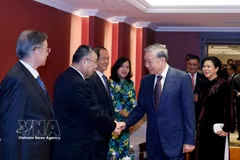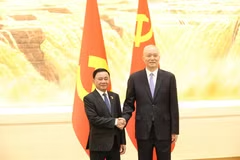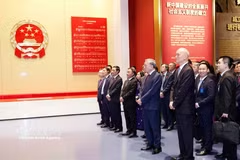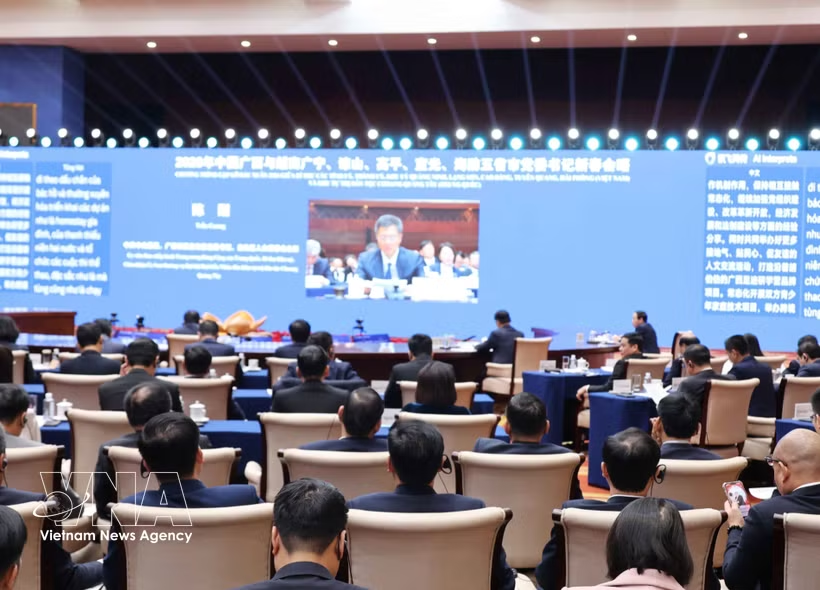
Hanoi (VNA) – Nanning, capital of China’s Guangxi Zhuang Autonomous Region, is reinforcing its role as a dynamic growth hub in southern China and a key gateway for the country’s cooperation with ASEAN, with Vietnam identified as a priority partner.
In recent years, Nanning has maintained steady socio-economic growth, modernising its economic structure driven by high-quality services and advanced industries. The city is accelerating an innovation-led development strategy, notably through the establishment of the China–ASEAN AI Innovation Cooperation Centre. The centre is envisioned as a regional platform for research and development, AI application, technology transfer and high-quality human resource training, fostering linkages among enterprises, research institutes and universities across China and ASEAN, including Vietnam.
Alongside technological development, Nanning continues to leverage its position as a China–ASEAN gateway through multilateral cooperation mechanisms, international forums and major trade fairs. Cooperation with Vietnam is becoming increasingly substantive and wide-ranging.
The city maintains close ties with many Vietnamese localities, including Hai Phong, Bac Ninh and Bac Giang. Vietnam is among Nanning’s leading trading partners, accounting for a significant share of its total trade with ASEAN. Bilateral cooperation has expanded across investment, logistics, agriculture, high technology and tourism.
Nanning is also home to historical sites linked to Vietnam’s revolutionary past, helping deepen the traditional friendship between the two countries. Among them is the Yucai School, which trained generations of Vietnamese students during wartime, as well as sites associated with the activities of President Ho Chi Minh. These locations serve as important venues for historical education to attract Vietnamese visitors.
People-to-people exchanges, delegation visits, and cooperation in education and training between Nanning and Vietnamese localities have been maintained regularly, strengthening the social foundation of bilateral ties.
Speaking to VNA correspondents in China, Professor Li Qiaoping of Guangxi University for Nationalities expressed confidence in the future of Vietnam–China relations and Guangxi–Vietnam cooperation. She emphasised the need to sustain high-level strategic guidance, enhance political trust, and uphold principles of mutual respect, equality and mutual benefit.
The professor also highlighted the importance of leveraging geographic proximity to promote substantive cooperation in trade, logistics, cross-border industries, modern agriculture and tourism, while shifting from a “border-gate economy” to sector- and value-chain-based collaboration.
Emerging areas such as cross-border healthcare, hydrology, meteorology, education and science-technology were identified as holding strong potential. Education and human resource development, in particular, were seen as strategically significant, including expanded language training, joint programmes and vocational education.
Notably, artificial intelligence and the digital economy were described as breakthrough areas for future cooperation. Potential initiatives include AI language technologies, machine translation, digital education, high-tech workforce training, and the development of smart cities, digital logistics and cross-border e-commerce. The growing “short video/livestream e-commerce” model, combined with improving border logistics and AI applications, is expected to facilitate two-way trade and reduce language barriers.
Professor Li also expressed hope for stronger youth exchanges to sustain and promote the longstanding Vietnam–China friendship across generations.
With its geographic advantages, improving infrastructure and innovation-driven strategy, Nanning is expected to remain a central hub for China–ASEAN cooperation and a key bridge in advancing comprehensive Vietnam–China relations in the coming period./.
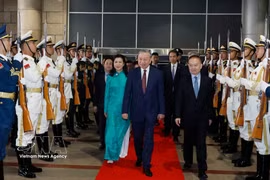
Top Vietnamese leader travels to Nanning, highlights bilateral rail cooperation
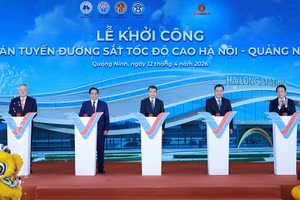
Highlighting the significance of high-speed rail cooperation, he called on Chinese railway authorities and enterprises to share expertise, support technology transfer and participate in the development of key railway projects in Vietnam.