Vietnam, China step up cooperation in science, technology, innovation

Politburo member and Chairman of the Party Central Committee’s Organisation Commission Nguyen Duy Ngoc, who also serves as Standing Deputy Head of the Central Steering Committee for the Development of Science, Technology, Innovation and Digital Transformation, toured the park’s exhibition area and was briefed on the formation and development of Zhongguancun, along with Beijing’s achievements in science, technology and innovation.

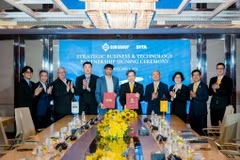
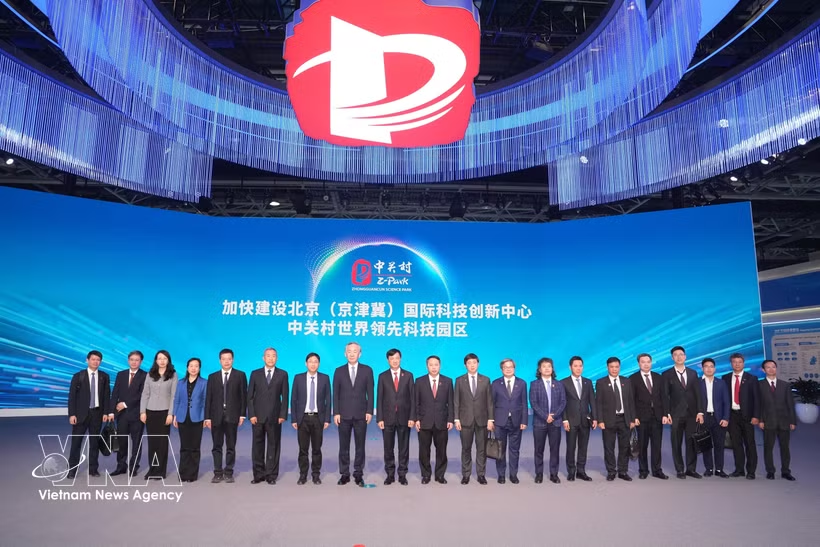
Politburo member and Chairman of the Party Central Committee’s Organisation Commission Nguyen Duy Ngoc (ninth, left) and the Vietnamese delegation pose for a group photo with leaders of the Zhongguancun Science Park and Beijing city. (Photo: VNA)

Beijing (VNA) – Politburo member and Chairman of the Party Central Committee’s Organisation Commission Nguyen Duy Ngoc on April 15 paid a working visit to Zhongguancun Science Park in Beijing while accompanying General Secretary of the Communist Party of Vietnam (CPV) Central Committee and State President To Lam, his spouse, and a high-level Vietnamese delegation on a state visit to China.

Ngoc, who also serves as Standing Deputy Head of the Central Steering Committee for the Development of Science, Technology, Innovation and Digital Transformation, toured the park’s exhibition area and was briefed on the formation and development of Zhongguancun, along with Beijing’s achievements in science, technology and innovation.

At a working session with the park’s management board, Ngoc praised Beijing and Zhongguancun for their progress in development of science, technology, innovation and digital transformation, noting that many of their experiences and models could serve as practical references for Vietnam in refining institutions, policies and implementation mechanisms.

He stressed that Vietnam is accelerating the implementation of the Politburo’s Resolution No. 57-NQ/TW, which identifies science, technology, innovation and digital transformation as key drivers for rapid and sustainable development. In that spirit, he expressed his hope that Beijing, Zhongguancun and relevant Chinese agencies will step up exchanges, share experience and promote cooperation with Vietnamese agencies and localities, including Hanoi. Priority areas include smart cities, artificial intelligence, robotics, semiconductors, elderly care, medical technology, and high-quality human resources training.
vnanet-cong-nghe2.jpg
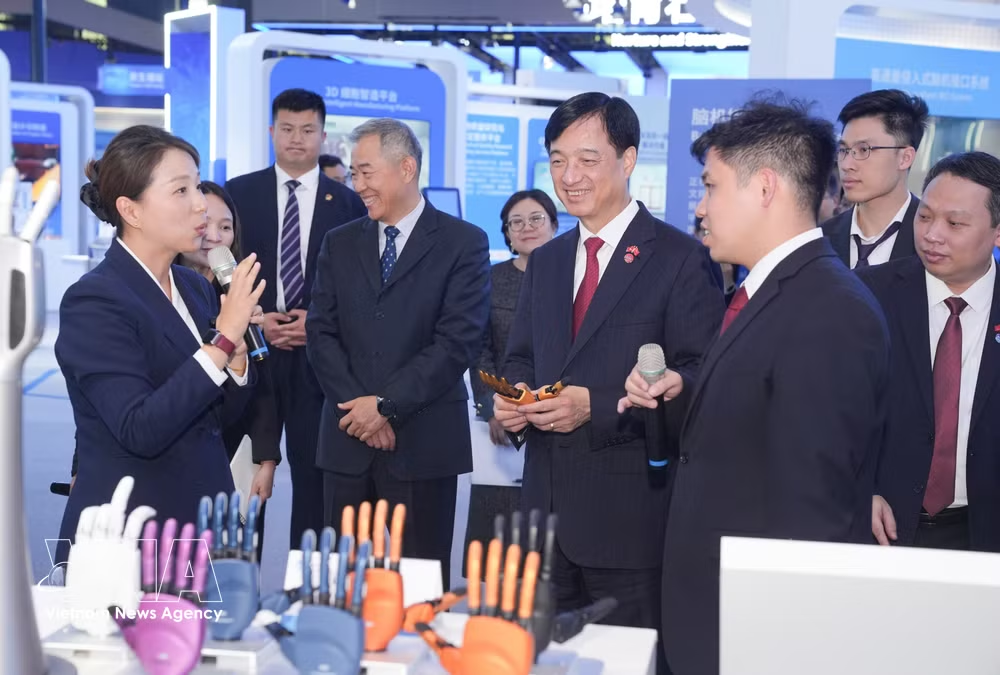
Politburo member and Chairman of the Party Central Committee’s Organisation Commission Nguyen Duy Ngoc (centre) and the Vietnamese delegation visit the exhibition area and listen to presentations about the formation and development of Zhongguancun and some outstanding achievements in science, technology, and innovation in Beijing. (Photo: VNA)

For his part, Vice Mayor of Beijing Jin Wei welcomed Ngoc and the Vietnamese delegation and outlined the city’s development orientations in science, technology and innovation.

Jin noted that, as a megacity, Beijing is addressing multiple governance challenges, including environmental protection, transport, urban management, and improving residents’ quality of life. He said the city has consistently placed science, technology and innovation at the core of its development strategy.

Beijing is home to more than 30,000 nationally recognised high-tech enterprises and has developed several large-scale industrial clusters. The city also has more than 400 key robotics enterprises and strong advantages in education, research, and high-quality human resources, with numerous leading universities and research institutes.

The Chinese official highlighted that Beijing has focused on creating a favourable environment for enterprises to raise practical issues, enabling authorities to promptly adjust policies and support mechanisms, thereby fostering a dynamic innovation ecosystem with close linkages among the State, schools, and businesses.

Jin expressed his belief that, based on the sound bilateral relationship, ministries, sectors, localities, and businesses of both sides will continue to expand substantive exchanges and cooperation in the coming time.

At the session, Zhongguancun representatives also introduced its organisational model, governance mechanisms, and methods for coordinating the innovation ecosystem, particularly cooperation among state agencies, enterprises, research institutes, and universities in implementing key science and technology tasks.

Zhongguancun, China’s first national innovation demonstration zone, is regarded as a typical model for developing a large-scale innovation ecosystem with the participation from the State, schools, and enterprises. Experiences shared at the working session are expected to provide useful references for Vietnam in developing high-tech parks and innovation zones, and in promoting enterprise engagement in addressing major national technological challenges./.
VNA

See more

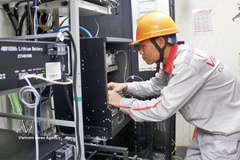
A technician from Viettel Bac Ninh examines equipment at a 5G base transceiver station. (Photo: VNA)

Bac Ninh accelerates development of 5G, data infrastructure

In the first quarter, Bac Ninh’s telecommunications infrastructure continued to develop in a synchronous manner. All communes have been connected to dedicated data transmission networks, and 100% of the population is covered by mobile services.

Illustrative photo (Photo: VNA)

An Giang identifies key tasks in science-technology development

The priorities focus on four pillars: science and technology, innovation, digital transformation, and real-world applications to boost socio-economic development. These are expected to create breakthroughs in governance, production, and daily life.

Illustrative image (Photo: VNA)

Vietnam Research Excellence Fellowship for 2026-2030 approved

Under the Vietnam Research Excellence Fellowship (VREF) for the 2026–2030 period, PhD students are identified as a core research force directly contributing to breakthroughs in sci-tech and innovation. Investing in top-tier doctoral candidates is more than workforce development, but a high-stakes strategic bet to forge a cohort of world-class scientists and technologists who can power Vietnam’s long-term economic ambitions.

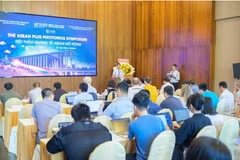
Participants in the ASEAN Plus Photonics Symposium in Gia Lai province on April 8 (Photo: baogialai.com.vn/)

Gia Lai province hosts ASEAN Plus Photonics Symposium

Participants presented and discussed a wide range of advanced topics shaping the future of photonics, including nanophotonics and metasurfaces; topological and non-Hermitian photonics; photonic crystals and optical lattices; light–matter interactions and polariton systems.

Vietnamese Ambassador to Brazil Bui Van Nghi (right) and Professor and quantum physicist Olival Freire Juniorin, President of Brazil's National Council for Scientific and Technological Development, at their meeting on April 7. (Photo: Vietnamese Embassy in Brazil)

Vietnam, Brazil to strengthen cooperation in science, technology

Ambassador Bui Van Nghi expressed Vietnam’s interest in strengthening cooperation with Brazil in areas such as renewable energy and environmental technologies, as well as high-tech sectors including artificial intelligence (AI), quantum technology, and the semiconductor industry.

Teachers guide students in experiencing the application of science (Photo: VNA)

Results become benchmark for science-technology governance

The transition to facilitative governance marks not only an operational reform but also a shift in development thinking. With expanded autonomy and controlled risk acceptance, science, technology, innovation and digital transformation are expected to become key drivers of rapid and sustainable growth in the years ahead.

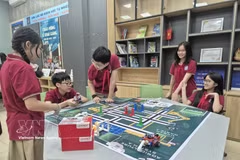
Students experience robotic products (Photo: VNA)

AI powers sweeping overhaul of Vietnam’s education system

Nguyen Son Hai, Deputy Director General of the Department of Information and Communication Technology under the Ministry of Education and Training (MoET), said the sector has made rapid strides in digital transformation, from online classes during the COVID-19 pandemic to nationwide platforms covering the national education database, registration for high school graduation exam, and online university admissions.

Voters can access essential information about candidates on the VNeID app, enabling them to proactively learn and enhance their awareness when participating in elections. (Photo: VNA)

Digital transformation gathers pace nationwide

Adopted by the Politburo in late 2024, Resolution 57 positions science – technology development, innovation, and digital transformation as a top important breakthrough and strategic pillar for Vietnam’s development in the new era. Early implementation shows a clear shift toward data-driven governance and technology-enabled public services.

Can Tho city pledges to allocate at least 1% of total budget spending to science, technology and innovation (Illustrative image. Source: VNA)

Plan issued to implement Vietnam–France agreement on science-technology cooperation

Under the plan, the Ministry of Science and Technology will take the lead, in coordination with relevant ministries and agencies, in directing, guiding, monitoring and inspecting the implementation of the agreement. The ministry will also prepare reports on the signing and implementation progress for submission to the Ministry of Foreign Affairs for consolidation and reporting to competent authorities as required.