Hanoi (VNA) – Electronics imports have surged in early 2026, signaling strong investment momentum to expand manufacturing capacity in response to rising global demand and a swelling pipeline of orders flowing into Vietnam.
Signals of large orders
As of April 15, electronics exports posted robust growth, reaching 55.4 billion USD. Computers, electronic products and components generated 36.5 billion USD, surging 47.3% year-on-year, while phones and components contributed 18.9 billion USD, up 19.7%.
Fueled by the rapid expansion of its flagship electronics sector, Vietnam’s overall exports in the first four months jumped more than 20%. Customs data showed that total export value hit 144.58 billion USD, a 20.3% increase that added 24.4 billion USD compared with the same period a year earlier.
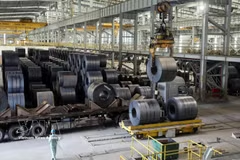
Robust manufacturing activity has driven heavy demand for imported machinery, equipment and production inputs, which totaled 56.93 billion USD. The electronics sector’s export-import turnover in the first three and a half months exceeded 110 billion USD, a record high even as it posted a modest trade deficit of about 1.53 billion USD, a typical early-year pattern.
Do Thi Thuy Huong, Vice Chairwoman and Secretary General of the Vietnam Electronic Industries Association (VEIA), noted that hi-tech production cycles often generate early-year deficits as manufacturers stockpile inputs ahead of a new export wave.
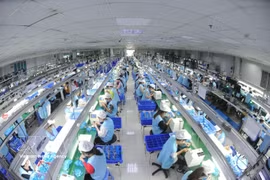
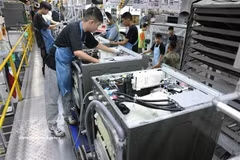
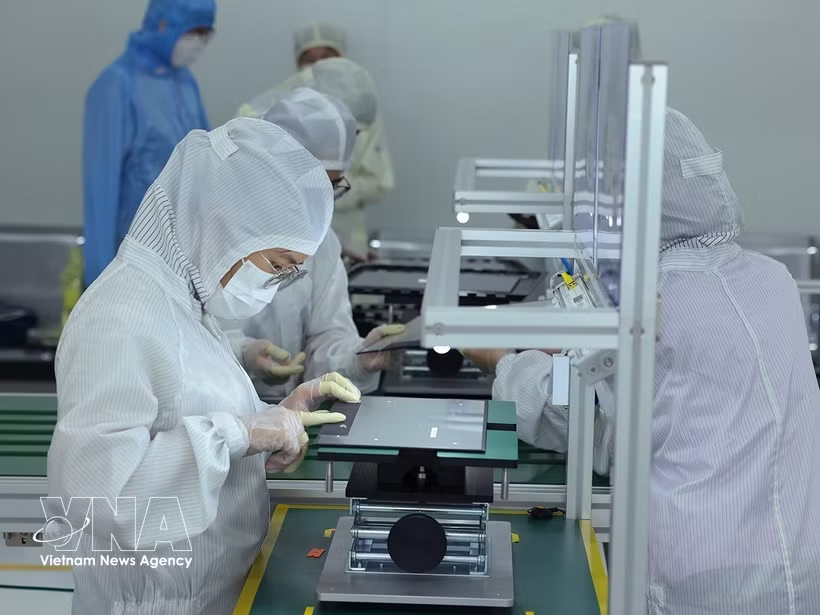
Major corporations like Samsung, LG, Pegatron and Foxconn are expanding production across key industrial provinces, cementing Vietnam’s position as a critical electronics assembly and manufacturing hub in Southeast Asia. Once production lines reach full capacity from mid-year, finished goods are expected to ship in much larger volumes, especially to the US, European Union and Northeast Asia.
Over 90% of their import value consists of machinery, components and materials for production underscoring efforts to scale capacity to meet surging global consumption, Huong said.
Output set to continue surging
Foreign direct investment (FDI) in the electronics sector has risen sharply over the past decade, considerably boosting supply capacity, a trend clearly mirrored in export performance.
Vietnam’s electronics exports more than tripled, from around 47 billion USD in 2015 to over 165 billion USD in 2025. This growth was closely tied to the deep footprint of global technology giants such as Samsung, Intel, LG, Foxconn and Luxshare, which operate large-scale facilities in Bac Ninh, Thai Nguyen, Hai Phong, Bac Giang and Ho Chi Minh City.
Current order momentum points to another strong year for exports, supporting Vietnam’s ability to deliver high results and sustain a trade surplus. In 2025, total exports reached 475 billion USD, up 17% year-on-year, with a trade surplus exceeding 20 billion USD. The electronics sector alone generated 165 billion USD, of which the FDI component contributed 162.5 billion USD.
The sharp rise in imports of components and production equipment is directly tied to optimistic output forecasts. As companies accelerate purchases of materials and semi-finished goods, production and sales are expected to climb in the coming months.
Stronger supplier position
In 2025, nearly 52 billion USD worth of electronics were exported to the US. Of this, computers and components led the way at over 41 billion USD, surging 81.4%, while phones and components hit 9.86 billion USD, up 0.4% year-on-year. The steep increase in shipments to the US reflects not only robust consumer demand but also steady gains in the quality and technological sophistication of Vietnam-made electronics.
Other key markets also saw rising orders, including the EU at 10.89 billion USD, up 9.9%, and combined ASEAN, Japan and China at 16.89 billion USD, up 33.6%.
While Vietnam has long specialised in final-stage assembly within global value chains, many enterprises are now pushing into higher value-added segments, including product design, testing and production of critical components.
Geopolitical shifts and the ongoing reconfiguration of global supply chains are creating new opportunities. According to the Vietnam Electronic Industries Association (VEIA), the “China + 1” strategy and new-generation free trade agreements are accelerating the relocation of manufacturing to Vietnam, India and Mexico.
However, the sector remains vulnerable to external risks. Geopolitical tensions in the Middle East since February have driven up maritime shipping costs considerably, especially on routes to the US and Europe. At the same time, evolving trade policies and technical barriers in major markets continue to weigh on export operations.
Despite these headwinds, VEIA said Vietnam retains strong potential to set a new export record in 2026, provided current order trends hold and tensions in the Middle East ease./.