LED lighting drives efficiency gains in fisheries

LED systems are stable, cost-efficient and productivity-enhancing thanks to stronger water penetration and optimised light spectra that attract high-value species, ensuring consistent catches.

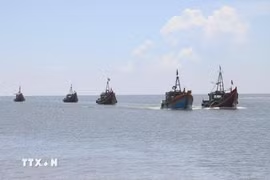
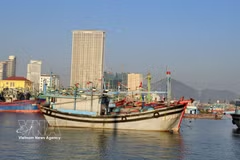
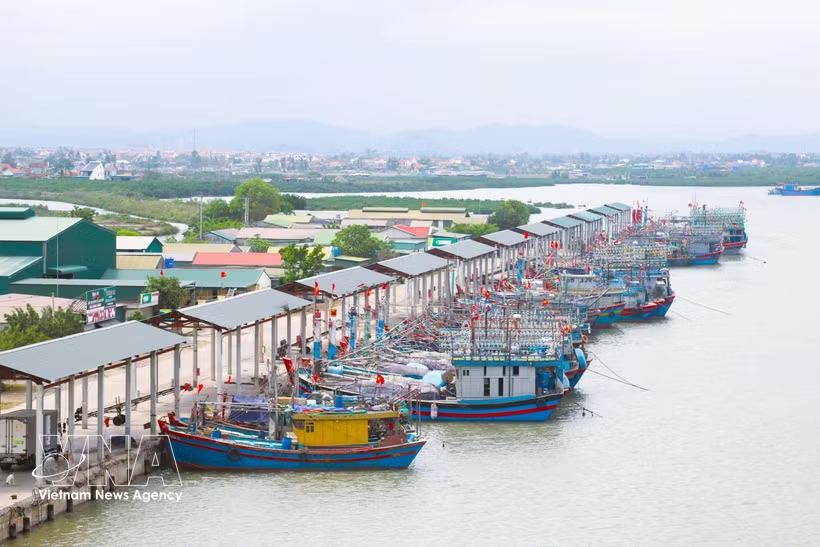
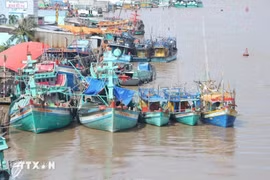
Large-capacity fishing vessels from Quynh Phu commune, Nghe An province, dock at Lach Quen fishing port, where nearly all offshore boats have now been equipped with LED lighting systems. (Photo: VNA)

Nghe An (VNA) – As fuel prices surge, fishing vessel owners in Quynh Phu commune, the central province of Nghe An, are moving away from trawling towards purse seining while upgrading to modern LED lighting systems, a shift that is lowering costs, stabilising yields and improving overall efficiency.

In 2019, Le Van Thanh, owner of vessel NA-90463-TS, piloted LED use by replacing half of his halogen bulbs. The trial showed improved fish aggregation and reduced generator load. He later invested over 350 million VND (13,300 USD) in 2023 to fully convert to LEDs, and by late 2025 upgraded 11 units with newer and higher-performance models.

Thanh said LED systems are stable, cost-efficient and productivity-enhancing thanks to stronger water penetration and optimised light spectra that attract high-value species, ensuring consistent catches.

Fishermen at Lach Con and Lach Thoi ports highlighted the drawbacks of traditional halogen and mercury lamps, which consume large amounts of fuel, emit CO₂, generate heat and UV radiation harmful to crews, and take 10–15 minutes to restart. LEDs, by contrast, provide instant illumination, longer reach and better directional lighting, significantly improving effective coverage.

As a result, LED adoption has boosted catches by 10–16% while reducing fuel costs by 20–30%, enhancing seafood quality and raising incomes.

The technology also avoids mercury and heavy metals, helping cut waste and protect the environment.

Local authorities note that the fisheries sector is under increasing strain from climate change, dwindling resources, growing sustainability requirements and rising fuel costs, which now account for up to 70% of trip expenses, making technological upgrades increasingly urgent.

Quynh Phu, one of the province’s largest fishing centres with nearly 850 vessels, including more than 350 boats over 15 metres long, has seen widespread adoption of LEDs since 2018. More than 90% of offshore vessels now use the system.

Vice Chairman of the communal People’s Committee Cao Xuan Diep described the transition as a practical step towards fleet modernisation and more advanced fishing practices.

Authorities are also encouraging fishermen to invest in vessel monitoring systems (VMS), modern fish-finding equipment and fishing ground forecasting tools to improve efficiency, reduce risks and comply with anti-IUU fishing regulations. Training and access to concessional finance are being expanded to support the shift.

At the same time, fishermen are recommended to replace ageing lighting systems with reliable LED products to maintain performance and optimise costs for each fishing trip./.
VNA

See more

Can Tho, Belarus eye trade, investment opportunities

Can Tho, Belarus eye trade, investment opportunities

Belarusian Consul General in Ho Chi Minh City Alexander Sidoruk said his working visit to Can Tho city exposes ample untapped economic potential. The Belarus side brings strengths in exporting fertilisers, crop protection chemicals, agricultural equipment, and high-tech products, and is interested in importing Vietnamese rice, coffee, rubber, seafood, and dairy products.

Retail fuel prices are simultaneously reduced from 15:00 on May 14. (Photo: VNA)

Retail fuel prices cut from May 14 afternoon

Retail fuel prices were simultaneously reduced from 15:00 on May 14 following the latest adjustment by the Ministry of Industry and Trade (MoIT) and and the Ministry of Finance, with E5RON92 biofuel recording the sharpest decline.

A chip assembly and testing plant of Intel at the Saigon Hi-Tech Park in Ho Chi Minh City (Photo: VNA)

Intel deepens engagement in Vietnam’s semiconductor industry

According to the Saigon Hi-Tech Park (SHTP) management board, Intel has relocated part of its production line from Costa Rica to SHTP as part of its global manufacturing restructuring strategy aimed at improving efficiency and competitiveness.

A customer purchase E10 biofuel petrol at a PVOIL filling station on Thai Thinh street in Hanoi. (Photo: VNA)

Biofuel ready for nationwide rollout

For biofuels, particularly E10, to develop successfully, stronger and more coordinated policies are needed, especially pricing mechanisms capable of creating a sufficiently attractive gap between E10 and mineral-based petrol, an expert has said.

An automobile assembly line of the THACO Truong Hai Group in Da Nang. (Photo: VNA)

Da Nang promotes investment attraction to achieve over 11% growth

Da Nang's foreign direct investment (FDI) attraction showed strong growth, reaching 237.7 million USD, double the level recorded a year earlier. The city granted licences for 47 new FDI projects, approved capital adjustments for 16 projects and recorded 10 transactions involving capital contributions and share acquisitions in economic organisations.

Deputy Prime Minister Nguyen Van Thang speaks at the forum. (Photo: vneconomy.vn)

Vietnam pivots to selective, high-quality FDI attraction for sustainable growth: Deputy PM

The FDI sector remains a key pillar of Vietnam’s economy, with more than 46,500 valid projects and total registered capital exceeding 543 billion USD so far. Disbursed capital has reached around 357.6 billion USD. The FDI sector contributes over 20% of GDP, accounts for around 70% of total export turnover, and creates jobs for millions of workers. Vietnam continues to rank among ASEAN’s leading FDI destinations despite global investment slowdowns.