Export orders surge despite global headwinds

By late April, C&D Import-Export Co., Ltd., a wood and plywood exporter, had secured orders through the end of Q2. According to C&D Chairman Nguyen Tran Luat, contracts for Q3 are still being negotiated on a monthly basis rather than long-term deals. However, contrary to earlier concerns, order volumes in Q2 have risen sharply as buyers stockpile amid fears of prolonged geopolitical tensions, oil price volatility and shipping disruptions.

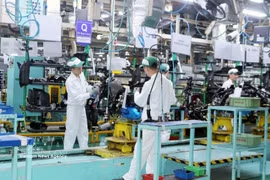
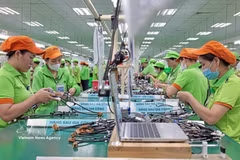
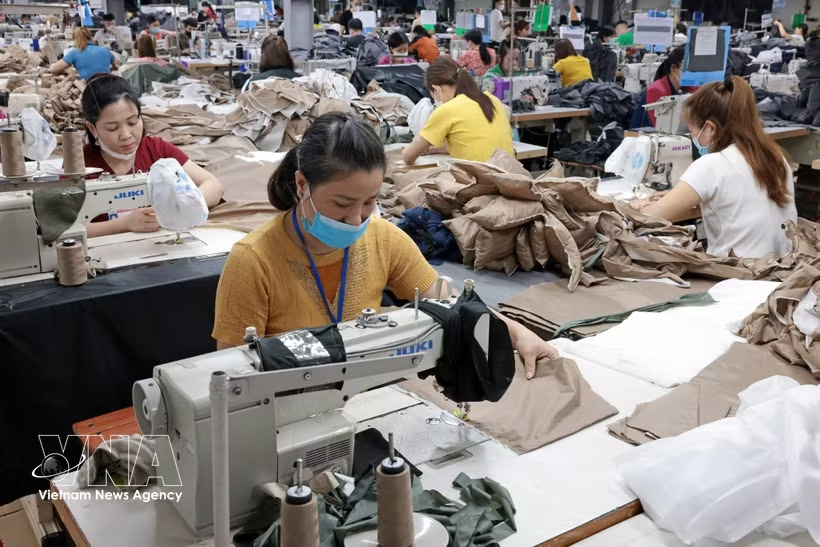
Producing garment products for export (Photo: VNA)

Hanoi (VNA) - Despite ongoing global uncertainties, Vietnamese exporters are reporting strong order growth through the second quarter of 2026, driven by precautionary demand and supportive government policies.

Orders booked through Q2

By late April, C&D Import-Export Co., Ltd., a wood and plywood exporter, had secured orders through the end of Q2. According to C&D Chairman Nguyen Tran Luat, contracts for Q3 are still being negotiated on a monthly basis rather than long-term deals. However, contrary to earlier concerns, order volumes in Q2 have risen sharply as buyers stockpile amid fears of prolonged geopolitical tensions, oil price volatility and shipping disruptions.

The company’s orders in Q2 have nearly doubled compared to the previous one. In Q1, it exported around 350 containers of goods, including timber and finished plywood. As of April 21, shipments delivered and signed contracts had already exceeded 500 containers, with further orders expected in May and June. Output for Q2 is projected to double, or even surpass, Q1 levels.

Luat credited recent government support measures, particularly in credit and administrative reform, for helping businesses maintain momentum. Lower interest rates, faster lending procedures and streamlined customs clearance have provided tangible support for exporters.

He added that businesses expect continued efforts to cut red tape and strengthen support for small and medium-sized enterprises.

Explaining trade deficit

According to the National Statistics Office under the Ministry of Finance, Vietnam recorded a trade deficit of 3.64 billion USD in Q1 2026, compared to a surplus of 3.57 billion USD in the same period last year. The domestic sector posted a deficit of 10.73 billion USD, while the foreign-invested sector (including crude oil) recorded a surplus of 7.09 billion USD.

NSO Director Nguyen Thi Huong said the shift to a trade deficit mainly reflects rising imports of machinery, equipment and raw materials for production.
She stressed that the deficit is temporary, linked to production cycles and price factors, and signals businesses’ proactive adaptation rather than structural imbalance.

Echoing this view, Nguyen Ba Hung, chief economist of the Asian Development Bank in Vietnam, noted that the country’s trade structure is characterised by the dominant role of the foreign-invested sector, which accounted for about 77% of export turnover in 2025, compared to just over 22% for domestic firms.

He added that the Q1 deficit aligns with a typical pattern in which imports grow faster than exports as businesses ramp up input purchases to fulfil future export orders. While it is too early to conclude any structural shift, a potential factor could be the recovery of the domestic market, where rising production, investment and consumption are driving higher demand for imported inputs and consumer goods./.

VNA

See more

Can Tho, Belarus eye trade, investment opportunities

Can Tho, Belarus eye trade, investment opportunities

Belarusian Consul General in Ho Chi Minh City Alexander Sidoruk said his working visit to Can Tho city exposes ample untapped economic potential. The Belarus side brings strengths in exporting fertilisers, crop protection chemicals, agricultural equipment, and high-tech products, and is interested in importing Vietnamese rice, coffee, rubber, seafood, and dairy products.

Retail fuel prices are simultaneously reduced from 15:00 on May 14. (Photo: VNA)

Retail fuel prices cut from May 14 afternoon

Retail fuel prices were simultaneously reduced from 15:00 on May 14 following the latest adjustment by the Ministry of Industry and Trade (MoIT) and and the Ministry of Finance, with E5RON92 biofuel recording the sharpest decline.

A chip assembly and testing plant of Intel at the Saigon Hi-Tech Park in Ho Chi Minh City (Photo: VNA)

Intel deepens engagement in Vietnam’s semiconductor industry

According to the Saigon Hi-Tech Park (SHTP) management board, Intel has relocated part of its production line from Costa Rica to SHTP as part of its global manufacturing restructuring strategy aimed at improving efficiency and competitiveness.

A customer purchase E10 biofuel petrol at a PVOIL filling station on Thai Thinh street in Hanoi. (Photo: VNA)

Biofuel ready for nationwide rollout

For biofuels, particularly E10, to develop successfully, stronger and more coordinated policies are needed, especially pricing mechanisms capable of creating a sufficiently attractive gap between E10 and mineral-based petrol, an expert has said.

An automobile assembly line of the THACO Truong Hai Group in Da Nang. (Photo: VNA)

Da Nang promotes investment attraction to achieve over 11% growth

Da Nang's foreign direct investment (FDI) attraction showed strong growth, reaching 237.7 million USD, double the level recorded a year earlier. The city granted licences for 47 new FDI projects, approved capital adjustments for 16 projects and recorded 10 transactions involving capital contributions and share acquisitions in economic organisations.

Deputy Prime Minister Nguyen Van Thang speaks at the forum. (Photo: vneconomy.vn)

Vietnam pivots to selective, high-quality FDI attraction for sustainable growth: Deputy PM

The FDI sector remains a key pillar of Vietnam’s economy, with more than 46,500 valid projects and total registered capital exceeding 543 billion USD so far. Disbursed capital has reached around 357.6 billion USD. The FDI sector contributes over 20% of GDP, accounts for around 70% of total export turnover, and creates jobs for millions of workers. Vietnam continues to rank among ASEAN’s leading FDI destinations despite global investment slowdowns.