Vietnam’s economy maintains strong momentum amid global uncertainties: AMRO

The Vietnamese economy has demonstrated notable resilience despite prolonged global headwinds. Growth has been underpinned by strong export-oriented manufacturing, sustained foreign direct investment, and firm domestic demand.

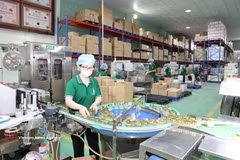
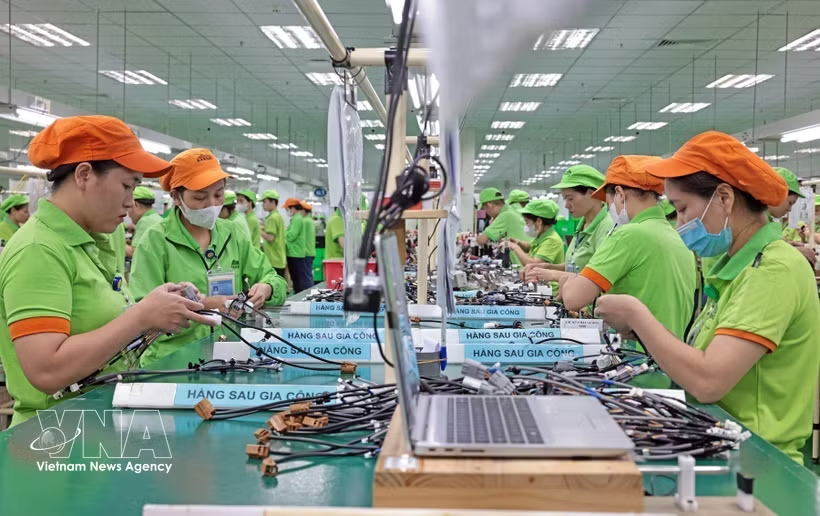
An assembly line for post-processing products at the factory of Bandai Vietnam Co., Ltd. (Photo: VNA)

Hanoi (VNA) – Vietnam’s economy continues to show strong resilience and steady expansion despite persistent global uncertainties, according to a press release on Vietnam’s economic outlook issued by the ASEAN+3 Macroeconomic Research Office (AMRO) on April 24.

This preliminary assessment follows AMRO’s Annual Consultation Visit to Vietnam from March 23 to April 3.

According to AMRO, the Vietnamese economy has demonstrated notable resilience despite prolonged global headwinds. Growth has been underpinned by strong export-oriented manufacturing, sustained foreign direct investment, and firm domestic demand.

​Principal Economist of AMRO Anthony Tan stressed that after an exceptionally strong growth performance last year, Vietnam’s economic growth is expected to soften to around 7.2% in 2026−2027, as the tailwinds from last year’s robust external demand gradually fade.

Domestic demand is expected to remain resilient, underpinned by continued policy support, including the extended value-added tax (VAT) rate reductions and planned public infrastructure spending, he added.

AMRO observed that inflation has remained contained so far, staying below the government’s operating ceiling of 4.5%. However, escalating tensions in the Middle East since February 28 have driven up global energy prices, prompting a sharp increase in retail fuel prices in Vietnam in early March. Continued strong credit growth and rising public expenditures are also expected to add to price pressures.

Against this backdrop, AMRO stressed that Vietnam’s near-term macroeconomic conditions require a cautious and well-coordinated policy to stabilise growth while containing emerging risks. It added that fiscal policy should prioritise targeted support for sectors most vulnerable to rising energy costs rather than broad-based expansion, with an emphasis on efficient spending that does not exacerbate macro-financial pressures.
vnanet-potal-3-cang-bien-cua-viet-nam-lot-top-100-cang-luu-thong-nhieu-hang-hoa-nhat-the-gioi-8265795.jpg
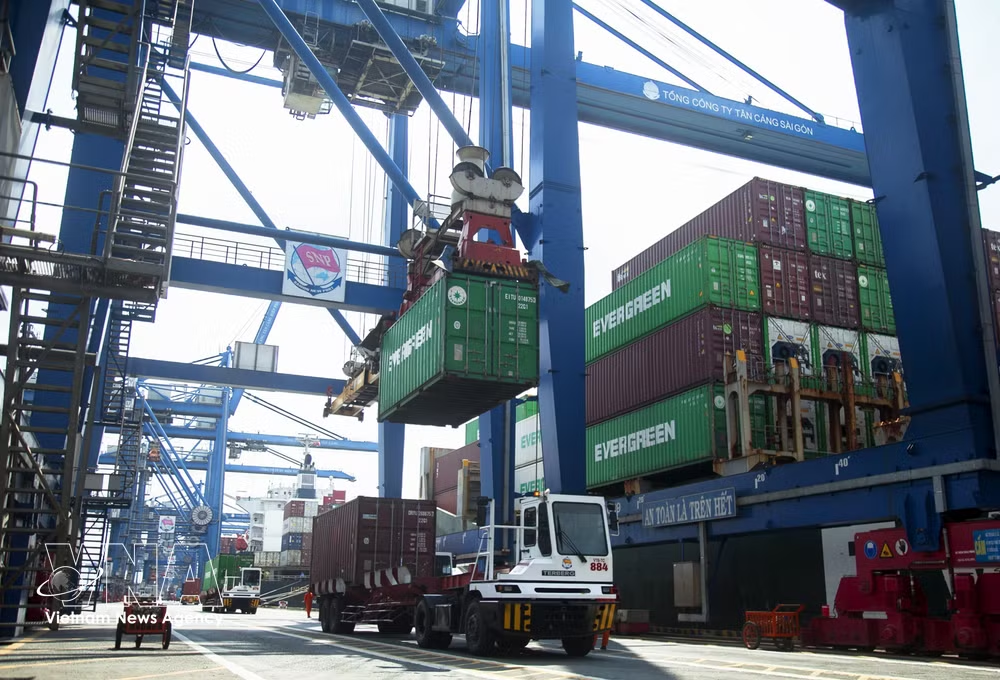
Cargo handling at Cat Lai Port (Cat Lai ward), part of Ho Chi Minh City’s seaport system. (Photo: VNA)

According to AMRO, strong growth alongside emerging financial imbalances points to the need for an unwinding of accommodative monetary policy, while closely monitoring liquidity and foreign exchange conditions. Financial regulators and supervisors should exercise stronger macroprudential oversight particularly on real estate and household lending.

Over the longer term, the office said the policy agenda should focus on three inter-related priorities: accelerating domestic industrial upgrading by deepening FDI−local linkages and raising further domestic value-added content; strengthening policy frameworks in tandem with growing economic complexity, including modernizing monetary and financial policy frameworks, revenue mobilization, and public investment management; and advancing financial sector and capital market reforms to create credible domestic investment opportunities, improve capital allocation, and reduce incentives for speculative capital outflows.

AMRO is an international organisation established to support macroeconomic resilience and financial stability of the ASEAN+3 region, comprising members of the Association of Southeast Asia Nations (ASEAN) and China, Japan, and the Republic of Korea. AMRO’s mandate is to conduct macroeconomic surveillance, support regional financial arrangements, and provide technical assistance to the members. It also serves as a regional knowledge hub and provides support to ASEAN+3 financial cooperation./.
VNA

See more

SIAL Canada CEO Stéphane Thuillier (right) visits the Vietnam pavilion and speaks with a representative of the Vietnam Trade Office. (Photo: VNA)

Vietnamese exports expand foothold in Canada

The Vietnam Trade Office in Canada organised a national pavilion this year, supporting 15 companies in product displays while helping connect five others operating independent booths. The initiative is designed to enhance product promotion, facilitate partnerships and broaden market access in North America, particularly in the processed food segment.

Core site (Vinh Truong hamlet, Phuoc Dinh commune) for the construction of the Ninh Thuan 1 nuclear power plant. (Photo: VNA)

All-out push to fast-track Vietnam’s first nuclear power plants

Khanh Hoa province has also intensified oversight, introduced housing support of 5 million VND (nearly 190 USD) per month for displaced residents awaiting resettlement, and clarified responsibilities for land inventory, measurement and site selection. Notably, more than 9.8 billion VND has been disbursed to relocate 570 graves, helping accelerate clearance for the Ninh Thuan 1 Plant.

Traditional handicraft products at the Vietnamese booth attract visitors at the Paris Fair (Photo: VNA)

Vietnamese products shine at Paris Fair

Amid deepening international integration, the presence of Vietnamese enterprises at the annual Foire de Paris continues to affirm the appeal of Vietnamese goods and culture in the French market. The event also provides an opportunity for Vietnamese businesses to directly engage with French and European consumers, thereby strengthening their foothold in this promising market.

Do Gia Thang, Secretary-General of the Vietnam Business Association in Australia (VBAA) and Chairman of the Vietnam–Australia Young Entrepreneurs Club (Photo: VNA)

International Financial Centre - Vietnam's strategic move in global race: Expert

Vietnam is pursuing a “one centre – two destinations” model. Ho Chi Minh City is envisioned as a comprehensive financial hub linked with a free trade zone, while Da Nang will focus on innovation, fintech, digital assets and serve as a testing ground for new financial models. This complementary structure allows Vietnam to develop a tailored approach rather than replicate existing financial centres.

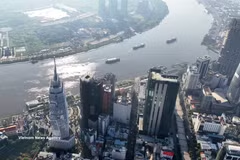
Financial buildings in central Ho Chi Minh City along the Saigon River, facing the Thu Thiem peninsula in An Khanh ward. (Photo: VNA)

Ho Chi Minh City attracts significant investment from France

Ho Chi Minh City is emerging as an attractive destination for French investors, particularly in infrastructure, sustainable urban development and green transition. French investment of more than 2.2 billion USD is contributing to economic growth and opening up broader prospects for long-term cooperation.

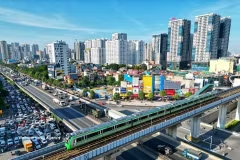
An aerial view of a crossroads in Hanoi (Photo: VNA)

Hanoi pushes SOEs to lead breakthrough growth

According to experts, Resolution 79-NQ/TW reaffirms the state economic sector’s leading role in the socialist-oriented market economy. The real shift, however, is moving SOEs from simply “holding” assets to actively “leading” development, and from traditional “management” to enabling growth across the board.

A representative of the Coast Guard speaks at the meeting. (Photo: VNA)

Ho Chi Minh City steps up decisive action to lift IUU “yellow card”

The city will fast-track eCDT implementation, study the feasibility of a fishing port in Can Gio, and propose granting accounts to border guard stations to strengthen oversight of vessel movements. Enhanced inter-provincial coordination, particularly with Lam Dong, Da Nang, Quang Tri and Ninh Binh, was also emphasised to tighten control and strictly handle violations, especially those related to VMS.

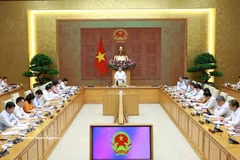
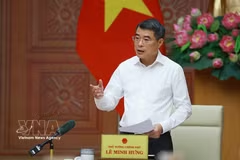
An overview of Prime Minister Le Minh Hung's working session with the Ministry of Finance on April 29 (Photo: VNA)

PM emphasises need for governance shift to drive growth

Ministries and agencies must enhance forecasting capacity, adopt more responsive policy tools, and fundamentally rethink how policies are designed and executed in a rapidly evolving environment, said PM Le Minh Hung.

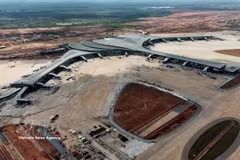
Long Thanh International Airport is currently under construction and is expected to be put into operation by the end of 2026. (Photo: VNA)

Dong Nai rolls out 4.3 billion USD plan for key transport links

Dong Nai will implement three major transport projects with a total capital exceeding 110 trillion VND (4.3 billion USD), aimed at strengthening connectivity between Dong Nai, Ho Chi Minh City, and key economic regions in the Central Highlands, central, and southwestern regions.