Private sector enters new growth cycle with stronger momentum

The rapid institutionalisation of Resolution No. 68-NQ/TW has reignited the desire to create wealth, encouraged new business formation and positively impacted market entry and business activity.

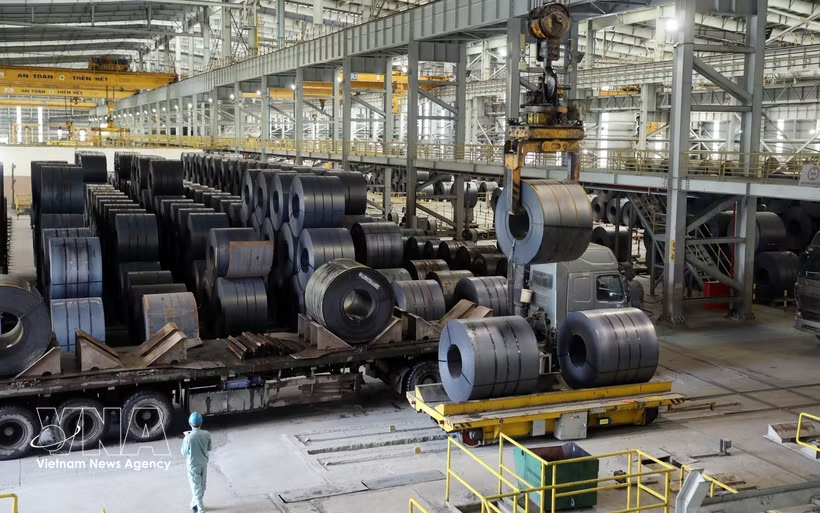
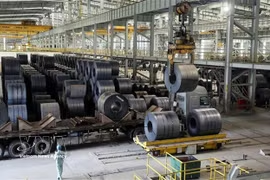
Steel products of Hoa Phat Group serve domestic demand and are exported to 40 countries and territories worldwide. (Photo: VNA)

Hanoi (VNA) – Nearly a year after the implementation of Politburo Resolution No. 68-NQ/TW on private economic sector development, a range of support policies for businesses have quickly been put into practice, delivering initial positive results and creating encouraging changes in the investment and business environment.

The clear improvement in confidence and entrepreneurial spirit suggests that Vietnam’s private sector is entering a new growth cycle with stronger momentum.

Strengthening business confidence

During the 2026 shareholders’ meeting season, the “dream” of building high-speed railways has become a major focus of attention, as many companies have officially added high-speed rail investment to their business plans and development strategies, particularly among Vietnam’s leading private economic groups.

Addressing shareholders in late April, Tran Dinh Long, Chairman of the Hoa Phat Group, said the company is making strong efforts in researching and producing various types of steel directly serving the railway sector, including for train carriages and locomotives.

Regarding rail steel, he noted that the factory broke ground at the end of 2025 and is expected to produce its first batch in the second quarter of 2027, a key milestone to ensure the timely supply of materials for major domestic railway infrastructure projects.

Hoa Phat is also actively offering rail steel for several projects, notably the Hanoi–Quang Ninh high-speed railway with a total investment of more than 5.6 billion USD, developed by the VinSpeed High-Speed Railway Investment and Development JSC. The project has already broken ground and is expected to become operational by the end of 2028. It also reflects Hoa Phat’s commitment to accompanying the Government in shifting towards the production of high-quality steel products serving the national industrialisation strategy.

With a target of 15% annual growth through 2028, FPT Group has identified railway technology as one of its core strategic areas as it transitions into an innovation-driven technology enterprise, alongside its traditional strengths such as artificial intelligence (AI), cybersecurity and unmanned aerial vehicles (UAVs).

Explaining the company’s move into a completely new field, FPT Chairman Truong Gia Binh said he and leaders of several major private economic groups had discussed opportunities to cooperate on high-speed railway projects.

Each enterprise, he said, would take responsibility for different parts of the project based on its strengths, forming an integrated ecosystem covering material production, construction, technical infrastructure and operational technologies for domestic high-speed rail projects before expanding internationally.

This reflects that entrepreneurs entering new sectors is not simply pursuing a new line of business, but are also taking responsibility for national development, including ensuring system security and safety and mastering strategic technologies.

According to lawyer Bui Van Thanh, the market is beginning to see strong differentiation, with a group of fast-accelerating enterprises such as Vingroup, Hoa Phat and Thaco officially participating in major national projects.

A second group continues to generate revenue but faces difficulties in capital and governance, forcing them to struggle to maintain operations. A third group is gradually being pushed out of the market and must restructure under new business models.

After one year, he said, the results are reflected not only in statistics but also in changes in expectations, strategy and the ambition of private businesses to grow and prosper. Private businesses are also paying greater attention to improving corporate governance and, notably, institutional reform. They increasingly seek legal advice on changes in tax, credit and investment policies, viewing institutions as drivers of business growth rather than barriers.
vnanet-private-economic-sector.jpg
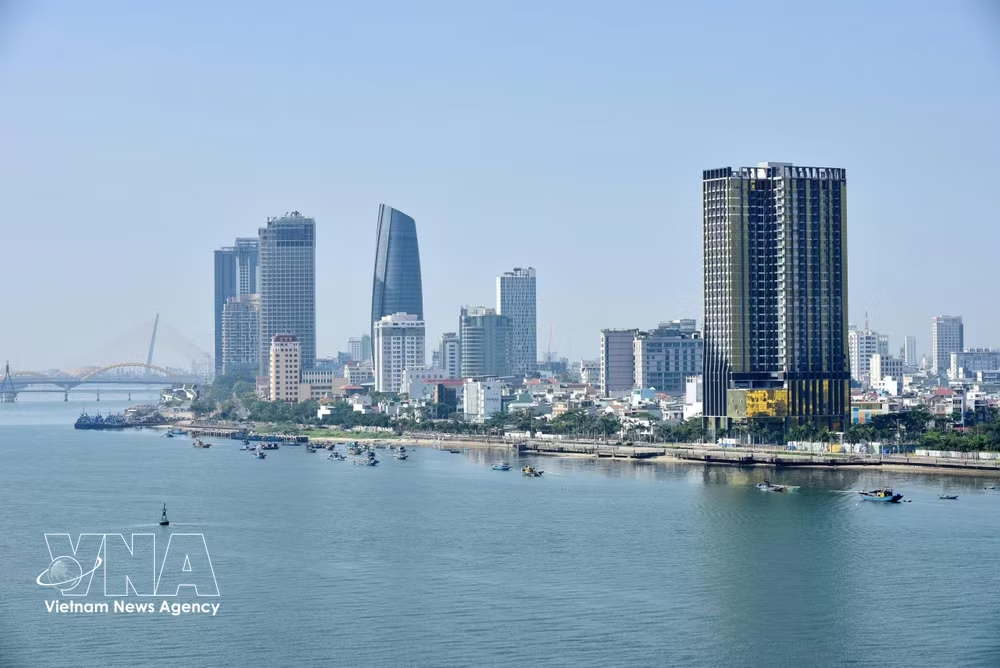
After one year of implementing Resolution No. 68-NQ/TW, the results are reflected not only in statistics but also in changes in expectations, strategy and the ambition of private businesses to grow and prosper. (Photo: VNA)

Reigniting entrepreneurial spirit

The rapid institutionalisation of Resolution No. 68-NQ/TW has reignited the desire to create wealth, encouraged new business formation and positively impacted market entry and business activity.

Statistics show that in 2025, nearly 297,500 enterprises were newly established or resumed operations nationwide, an annual increase of nearly 27.4%. Total additional registered capital injected into the economy was estimated at nearly 6.4 quadrillion VND (251.54 billion USD), up 77.8%.

Between May – the time the Politburo issued the resolution – and December, an average of around 18,000 new enterprises were established each month, an increase of more than 37.8% compared with the average of the first four months of the year.

Meanwhile, more than 102,000 enterprises resumed operations last year, up 34.3% year-on-year. This trend has continued into 2026. On average, 32,000 enterprises were freshly established or resumed operations each month during the first quarter, the highest level on record.

According to Bui Anh Tuan, Director General of the Department of Private Enterprise and Collective Economy Development under the Ministry of Finance, these initial positive results in market entry and business capital expansion show that Resolution No. 68-NQ/TW is not only strategically sound in vision, but is also delivering real practical impact.

When institutions are improved, resources are unlocked and confidence is strengthened, the private sector will make stronger breakthroughs, making substantial contributions to establishing a new growth model linked to economic restructuring and providing a foundation for the country’s double-digit growth ambitions in the years to come./.
VNA

See more

A view of the second Asia Agri Food International 2026 in Ho Chi Minh City on May 19 (Photo: VNA)

India pushes stronger agri-food cooperation with Vietnam

Experts noted that Vietnam has established itself as one of Southeast Asia’s leading agricultural product exporters, while India remains a major global supplier of agricultural and food products. By combining India’s production capacity and technological strengths with Vietnam’s dynamic processing and export ecosystem, the two countries can build more resilient supply chains in the region.

A panel discussion at the Meet Australia 2026 programme on May 19 (Photo: VNA)

Meet Australia 2026 promotes sustainable partnership opportunities

Meet Australia 2026 is not only a trade and investment promotion event but also a forum connecting trust, vision and action between Vietnam and Australia, as well as between national-level cooperation orientations and development needs of localities and businesses from both countries.

A customer purchases E10 biofuel petrol at a PVOIL station on Thai Thinh street in Hanoi. (Photo: VNA)

Authorities ordered to closely monitor rollout of E10 biofuel from June 1

According to the agency, the move is aimed at ensuring the effective and synchronised implementation of the E10 transition roadmap under Circular No. 50/2025/TT-BCT, issued by the Ministry of Industry and Trade on November 7, 2025. The plan seeks to avoid delays or supply disruptions that could affect the domestic fuel market.

Vietnamese Trade Counsellor in India Bui Trung Thuong speaks at the forum. (Photo: VNA)

Vietnam, India promote digital economy cooperation towards 25 bln USD trade target

With the strengthened Comprehensive Strategic Partnership, the rapid growth of digital economies in both countries and complementary strengths in technology, manufacturing and markets, Vietnam and India are well positioned to build a deeply connected digital trade ecosystem and enhance their participation in global value chains.

“Vietnam Economic Day” in St. Petersburg attracts crowds (Photo: VNA)

Vietnam showcases economic potential, investment opportunities in St. Petersburg

Vietnamese Ambassador to Russia Dang Minh Khoi stressed that economic cooperation between Vietnam and Russia is entering a new phase with promising opportunities for growth. He praised this year’s programme for combining a business roundtable, a youth business forum and traditional cultural and culinary activities, creating both an academic platform for dialogue and an opportunity to deepen mutual understanding between the two countries' people.

Lien Minh Agricultural Cooperative in Thai Nguyen province, provides stable employment for hundreds of its members. (Photo: VNA)

Private economic sector poised for breakthrough growth

More than a year after the Politburo's Resolution No. 68-NQ/TW on private sector development came into effect, expectations now extend beyond increasing the number of enterprises. The goal is to build a stronger business community with greater resilience, larger ambitions and the capacity to compete in global supply chains.

Milk collection at a dairy farm operated by Vinamilk at the Nhon Tan concentrated farming zone in An Nhon Tay commune, Gia Lai province. (Photo: VNA)

Self-reliance in raw materials fuels Vietnam’s dairy growth

The strategy targets annual industry growth of 12-14% by 2030, with processed liquid milk output reaching 4.2 billion litres annually. Domestic fresh milk production is projected to hit 2.6 billion litres per year, meeting 60-65% of processing demand, while milk powder output is expected to reach 245,000 tonnes annually. Per capita milk consumption is targeted at 40 litres per year.

Quang Ninh gives in principle approval to first offshore wind power plant

Quang Ninh gives in principle approval to first offshore wind power plant

Covering an area of 11.95 ha of land and water surface, the project is expected to have a designed capacity of 50 MW and will be implemented in nearshore waters of the Co To special zone. Its key components include wind turbines, a substation, a 110kV transmission line, and related auxiliary facilities.

At Nghi Son 2 thermal power plant in Thanh Hoa province. (Photo: VNA)

Vietnam’s national standards strategy for 2026–2035 approved

The strategy envisions a modern, open standards system welded to international norms, serving as a piece of soft institutional infrastructure, a policy tool and a technical backbone for state governance. It also casts standards as an engine of innovation, digital transformation, green transition and sustainable development.

Shrimp harvesting in Ca Mau province (Photo: VNA)

Vietnamese shrimp sector seeks distinct path in global race

Nguyen Duy Hoa, Deputy Technical Director of Cargill Vietnam, said Vietnam cannot compete with Ecuador on costs nor match India in scale. Instead, the country should focus on value rather than volume or price competition, prioritising quality improvement, technology adoption and value-added products.

Wind turbine No. 3 at the V1-3 site of the Duyen Hai Wind Power Plant in Truong Long Hoa ward, Vinh Long province.(Photo: VNA)

Retail market seen driving double-digit growth

Domestic consumption is being regarded as one of the key drivers for sustaining economic growth. Following the Government’s Resolution No. 88/NQ-CP on promoting the domestic market and stimulating consumption, many retailers have accelerated the expansion of distribution systems, invested in technology and improved supply chains.

Cargo containers are handled at Gemalink International Port, Ho Chi Minh City. (Illustrative photo: VNA)

Government delegation for international economic, trade negotiations established

The delegation is tasked with assisting the Prime Minister in directing ministries, sectors and localities in the negotiation, signing, coordination of ratification and approval, as well as implementation of international treaties and agreements on economic and trade matters involving the Vietnamese State and Government.

Lotte Mart Vietnam is currently distributing around 900 private-label products manufactured in Vietnam under the retailer’s strict quality control. (Photo: VNA)

RoK steps up trade cooperation with Vietnam, Malaysia

The Korean business delegation's trip aims to provide Korean firms with information on import – export trends across the ASEAN region and developments in local markets, while also offering opportunities to explore the latest industry trends and technologies.