Hanoi (VNA) – The push for greener development is rapidly shifting from external pressure to an internal economic imperative, requiring Vietnam to accelerate its transition to sustain long-term growth. In the decade to 2035, the challenge lies less in setting direction than in mobilising and efficiently deploying resources – from institutions and finance to technology and execution.
Go green or risk losing markets
Experts agree that the traditional growth model – based on natural resources, low-cost labour and fossil fuels – is reaching its limits, while global trade rules are pivoting toward low-carbon standards.
According to Associate Professor Dr Bui Quang Tuan, Vice Chairman of the Vietnam Economic Science Association, mechanisms such as the EU’s carbon border adjustment mechanism (CBAM), mandatory ESG requirements and emissions traceability will increasingly shape market access.
With annual trade turnover of roughly 370-380 billion USD and heavy reliance on high-standard markets, Vietnamese firms face a stark reality – failure to green operations could mean exclusion from key export destinations, he said.
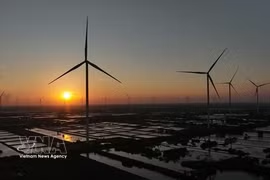
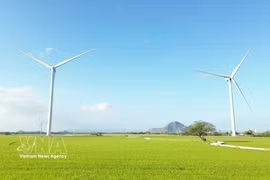
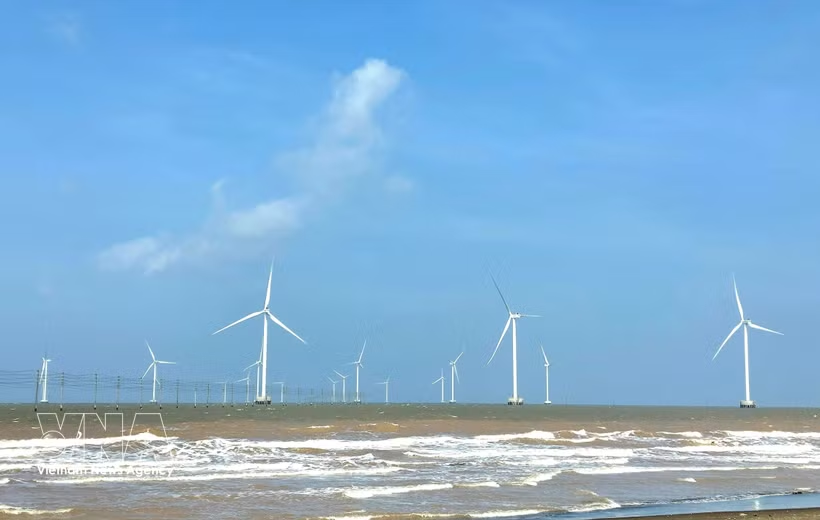
At the same time, green growth is opening new avenues. Energy transition alone presents vast investment potential, with electricity demand forecast to grow 8-10% annually through 2030. Under the revised Power Development Plan VIII, renewable energy (excluding hydropower) is targeted to reach 28-36% by 2030 and up to 75% by 2050, effectively ushering in a new industrial wave.
Export industries – from steel and cement to textiles and electronics – are also under pressure to decarbonise. Global corporations such as Apple and Nestlé are tightening supplier requirements, demanding renewable energy use and transparent emissions data, the expert added.
A decisive window for economic upgrading
The 2026–2035 period is widely seen as a critical window. If leveraged effectively, Vietnam can upgrade its economic structure and move deeper into global value chains; if not, it risks losing competitiveness and market share.
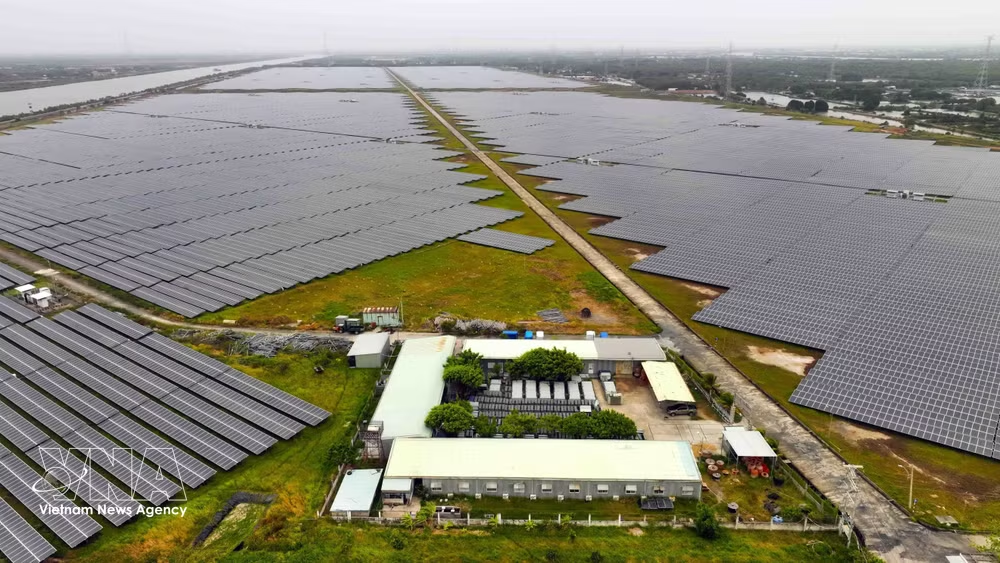
Green finance is emerging as a key driver. Globally, ESG assets exceed 30 trillion USD, while Vietnam’s green credit – currently about 4-5% of total lending – is expanding quickly, offering lower-cost capital to compliant businesses. Early climate action could also reduce GDP losses from climate impacts by 3-5% annually, strengthening economic resilience.
Despite strong policy groundwork, including national strategies and a carbon market roadmap, implementation remains uneven. Key constraints include fragmented regulations, limited access to finance for SMEs, reliance on imported technologies and insufficient awareness among businesses.
Around half of firms face funding challenges in green transition, while Vietnam’s climate finance needs could reach 368 billion USD by 2040.
Dr Nguyen Tri Hieu, an expert in financial markets, noted that the challenge is not only about capital availability but also about implementation capacity among both banks and businesses.
Green finance is expected to play a central role in channelling capital into sustainable sectors, but supply still lags demand. Smaller firms, in particular, struggle with unclear standards, high upfront costs and limited capacity to meet financing criteria.
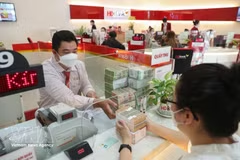
In this context, banks are positioned not just as lenders but as facilitators - developing tailored green credit products, simplifying procedures and providing technical guidance.
Experts emphasised that striking the right policy balance will be crucial. Overly rigid regulation risks pushing businesses into informality, while weak oversight could undermine market integrity./.