Gov’t not manage kerosene prices from April 29

The policy aims to give businesses greater pricing flexibility while allowing regulators to focus on more widely consumed fuels such as petrol and diesel.

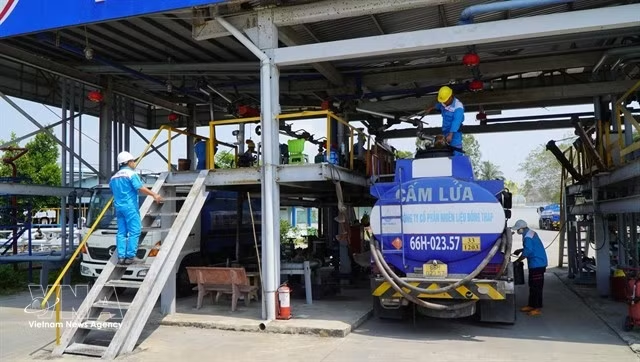
Petrol products pumped into a tank at a storage facility of Petimex. (Photo: VNA)

Hanoi (VNS/VNA) – Vietnam stops regulating kerosene prices from April 29, allowing businesses to set retail prices based on market conditions under a new decree issued by the Ministry of Industry and Trade on April 28.

The decree removes kerosene from the list of petroleum products subject to State price management under Circular 18/2025/TT-BCT dated March 13, 2025.

Nguyen Thuy Hien, Deputy Director of the ministry’s Domestic Markets Management Department, said that from April 29, enterprises will be responsible for determining kerosene prices.

Kerosene plays a limited role in the domestic fuel mix, accounting for just about 0.1% of total petroleum consumption. She said enterprises have already been allowed to decide prices for several high-grade gasoline products with low market demand.

The ministry said the policy aims to give businesses greater pricing flexibility while allowing regulators to focus on more widely consumed fuels such as petrol and diesel.

Kerosene, a refined petroleum product commonly used as household fuel and in industrial production, has become less widely used in recent years as consumers shift to alternative energy sources.

State-run fuel distributor Petrolimex currently lists kerosene prices at around 32,100 VND (1.26 USD) per litre in major urban areas and 32,740 VND per litre in other regions./.

VNA

See more

Of the total planned borrowing, around 60% will be used to cover the State budget deficit, while the remainder will go toward principal debt repayment. (Photo: VNA)

Government plans to borrow 37 bilion USD in 2026

The main funding source this year will be domestic government bond issuance, with an estimated volume of 500 trillion VND to be raised through auctions at the Hanoi Stock Exchange. This is expected to help ensure proactiveness and stability in the domestic capital market. ​

Deputy Minister of Agriculture and Environment Phung Duc Tien and delegates visit a booth at the VINAFIS EXPO 2026. (Photo: VNA)

Vietnam hosts first comprehensive fisheries tech expo

The event marks the first exhibition of its kind to cover the entire fisheries sector, providing a platform for domestic and international organisations and businesses to connect across the full value chain, from capture and aquaculture to logistics, processing and distribution. It is expected to accelerate integration and promote sustainable development of the industry.

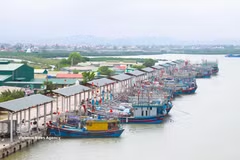
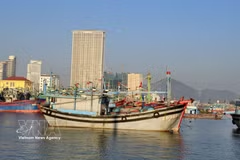
Large-capacity fishing vessels from Quynh Phu commune, Nghe An province, dock at Lach Quen fishing port, where nearly all offshore boats have now been equipped with LED lighting systems. (Photo: VNA)

LED lighting drives efficiency gains in fisheries

LED systems are stable, cost-efficient and productivity-enhancing thanks to stronger water penetration and optimised light spectra that attract high-value species, ensuring consistent catches.

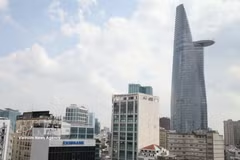
Bitexco Financial Tower in Ho Chi Minh City (Photo: VNA)

Ho Chi Minh City sees surge in FDI for hi-tech data infrastructure

Over the weekend, the municipal People’s Committee granted investment certificates to four hi-tech projects in the Saigon Hi-Tech Park (SHTP), with combined registered capital topping 1.23 billion USD. These projects focus on data centres, biomedical technology, and smart electronic equipment, which hold high value-added potential. Notably, two of the approvals are for hyperscale data centres.

A livestream sales session on an e-commerce platform by the Cuong La Co., Ltd. in Hai Thinh commune, Ninh Binh province. (Photo: VNA)

Tech-driven shift expands OCOP market access

From enhancing transparency in production processes to boosting sales on digital platforms, technology is not only reshaping traditional business models but also promoting a shift in the rural economy toward sustainable value-chain linkages.​

Dong Nai province improves its investment environment to attract more FDI. (Photo: VNA)

Foreign direct investment gains pace in Vietnam

Since early 2026, FDI inflows into Vietnam have not only grown in size but are also quickly moving toward high-tech industries, data, and green manufacturing. This shift offers a chance to boost Vietnam’s role in the global value chain, while also creating an urgent need to raise the quality of incoming investment.

Vice Chairman of the municipal People’s Committee Vuong Quoc Nam and Chairman of the Vietnam–Korea Business and Investment Association Tran Hai Linh pose for a commemorative photo. (Photo: VNA)

Can Tho seeks to deepen cooperation with Korean businesses

At a working session with a delegation from the Vietnam–Korea Business and Investment Association (VKBIA) led by its Chairman Tran Hai Linh on April 25, Nam praised the association’s role as a vital bridge linking the city with Korean partners. He reaffirmed the city’s readiness to facilitate VKBIA member enterprises in exploring and expanding investment.

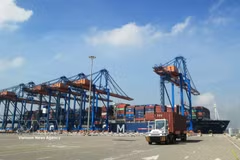
Container trucks operate at Gemalink International Port, part of the Cai Mep port complex in Tan Phuoc ward. (Photo: VNA)

Vietnam–Singapore trade witnesses strong growth amid global volatility

Data from Enterprise Singapore indicated that bilateral trade reached 13.6 billion SGD (10.6 billion USD) in Q1, up 38.3% year-on-year. Singapore’s exports to Vietnam rose 6.5% to 7.7 billion SGD (6.03 billion USD), while imports from Vietnam jumped 128.7% to 5.8 billion SGD, a strong signal of Vietnam’s rapidly growing export momentum in the Singapore market.