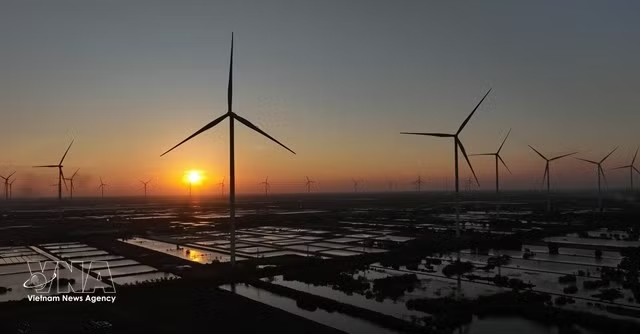
Hanoi (VNS/VNA) - Vietnam is coming under growing pressure to make battery energy storage systems (BESS) a cornerstone of its power infrastructure, as rapid renewable expansion and rising electricity demand, driven by double-digit economic growth, expose mounting strain on the national grid.
The global energy landscape is shifting quickly. The transition to green energy is moving into a new phase, from rapid expansion of renewable generation towards strengthening storage capacity to ensure system flexibility and grid reliability.
In Vietnam, renewable energy has expanded rapidly in recent years, laying the foundation for the country’s green transition but without sufficient storage capacity, renewable power cannot be fully utilised to support long-term economic growth.
Analysts said the next phase of the energy transition will depend less on how much renewable power is added and more on how effectively it can be stored and dispatched.
“BESS should be seen as essential infrastructure, not just a supporting technology,” said Phan Cong Tien, Director of the Institute of Smart Energy Application Research (iSEAR). “Without storage, it will be difficult to increase the share of renewables while maintaining system stability.”
Market shortfall
Vietnam’s energy storage sector could reach about 6 billion USD by 2030, reflecting national energy development goals under the Politburo’s Resolution 70-NQ/TW on ensuring energy security to 2030 with a vision to 2045 and the revised eighth Power Development Plan (PDP8).
However, current deployment remains limited. As of early 2025, installed BESS capacity is estimated at under 100 MW, far below the PDP8 target of 10,000 to 16,300 MW by 2030.
The shortfall highlights a key challenge: without a rapid scale-up in storage, the broader energy transition will struggle to deliver.
According to Deputy Director General of the National Electricity System and Market Operation Company Limited (NSMO) Nguyen Quoc Trung, electricity demand in Vietnam is expected to continue rising sharply in the coming years, driven by double-digit growth targets, digital transformation and a rapid electrification trend.
Amid volatile global energy markets placing significant pressure on the need for a stable, secure and sustainable power supply, rooftop solar combined with storage is emerging as a key solution to stabilise the system. BESS can help improve the system’s ability to absorb renewable energy and enhance operational flexibility.
The Prime Minister’s Directive No. 10/CT-TTg dated March 30 signals a policy shift from simply ensuring sufficient power supply to easing system pressure through demand-side management and distributed energy solutions.
The directive places electricity savings alongside load management, demand shifting and the development of on-site generation, creating new scope for energy storage solutions such as BESS to play a more central role in the power system.
The market is already gaining an early foothold as companies position themselves to capitalise on BESS potential, with participation from international players such as Goldwind and Schneider Electric alongside domestic firms including GG Industries and VinFast Energy.
GG Industries is set to launch a 5 GWh-per-year BESS plant in Hung Yen. Vingroup has also identified energy and infrastructure as strategic pillars, signalling growing corporate interest in the sector while Viettel Construction is expanding into BESS deployment to complement its renewable energy portfolio.
Policy bottlenecks
Despite growing interest, several barriers continue to limit deployment.
High upfront costs and limited access to green finance remained key constraints on investment, said Nguyen Anh Tuan, Vice President of the Vietnam Energy Association, citing financial and infrastructure risks in projects linked to direct power purchase agreements (DPPA).
In addition, the absence of a clear regulatory framework is hindering the deployment of BESS.
BESS is not yet fully defined within the power system and there is no dedicated market for ancillary services such as frequency regulation or voltage support, making it difficult for investors to secure stable revenue streams, according to Nguyen Van Thien, deputy chief executive for business and market development at GG Power Industry.
Thien stressed the need to clarify the role of BESS in the power system through the introduction of competitive procurement mechanisms and pricing structures that reflect time-of-use patterns and system costs.
“Storage is not just about equipment. It must be integrated into the overall energy system,” Thiện said, noting that clearer regulations, pricing mechanisms and technical standards are needed to accelerate deployment.
Path forward
Experts said a comprehensive policy framework will be key to unlocking the sector, including competitive procurement mechanisms, time-of-use pricing structures and stronger integration of BESS into direct power purchase agreements (DPPA) and self-consumption models.
According to Tien, policy reforms should begin with recognising BESS as a distinct asset class, followed by the development of market mechanisms that reflect its multiple functions, including peak shaving, load shifting and grid support.
Financial incentives such as tax breaks, concessional loans and improved access to green finance are also needed to reduce investment risks.
In addition, greater attention must be given to strengthening technical standards and safety regulations.
As BESS deployment scales up, issues such as fire safety, system integration and end-of-life battery management were becoming increasingly important, said Nguyen Truong Phuc Khanh, Deputy Director of the Ho Chi Minh City Office of Long Tech Trading & Technical Co., Ltd.
“Aligning with international standards while developing domestic guidelines will be key to ensuring safe and sustainable growth,” he said.
Tran Thuy Tien, development director at Constant Energy, said safety rather than financial returns remained the top priority in deploying BESS projects.
She said this would include both technical safety, such as compliant system design, proper installation, stable operation and fire and electrical protection, as well as legal safety, ensuring full adherence to Vietnam’s regulations, power planning requirements and transparent investment procedures.
Clearer policies on rooftop solar, direct power purchase agreements (DPPA) and energy storage were needed to create a stable legal framework for project implementation, she stressed.
“Demand is already there and growth potential is clear,” said economist Dinh Trong Thinh. “What is needed now is a clear development pathway, including technology strategy and policy support.
“With demand for energy storage already emerging and growth potential clear and domestic manufacturing capacity yet to take shape, the gap presents an opportunity that could translate into significant room for BESS industry development.”
He stressed that developing the sector would require a clear roadmap focused on mastering core technologies and building domestic capabilities alongside stronger linkages across the value chain./.
VNA