Ho Chi Minh City (VNA) - Hanoi and Ho Chi Minh City have been ranked among the top five fastest-growing urban centres in the world, according to a newly released Growth Hubs Index ranking by Savills.
The recognition underscores Vietnam’s rising role in regional and global value chains, driven by strong structural advantages and accelerating urban development.
Vietnam emerges thanks to structural advantages
The index, which evaluates 245 cities worldwide, highlights Asia as the primary engine of global urban growth over the next decade, supported by favourable fundamentals such as a young population, rapid urbanisation, and ongoing shifts in global manufacturing.
In this context, Vietnam stands out prominently as Ho Chi Minh City ranks second globally, while Hanoi takes fifth place in the growth potential ranking. The simultaneous presence of both Vietnamese megacities in the global top tier reflects not only strong growth potential, but also the country’s increasingly prominent role in regional value chains.
Chris Marriott, CEO of Savills Southeast Asia, noted that a young demographic is providing a powerful impetus for regional economies. A plentiful labour force, rising consumption, and accelerated urbanisation are driving demand across various real estate segments, ranging from industrial and logistics to residential and mixed-use developments.
Furthermore, the “China + 1” strategy continues to accelerate the wave of manufacturing relocation to emerging markets, with Vietnam emerging as a premier destination. The steady influx of foreign direct investment (FDI) is not only bolstering the manufacturing base but also creating a spillover effect on the real estate market, particularly in Ho Chi Minh City and Hanoi, which serve as the country’s primary hubs for infrastructure, labour, and consumer demand.
However, Savills cautioned that rapid growth alone does not guarantee long-term appeal. Reports on “Resilient Cities Index" indicated that established global leaders such as New York, Tokyo, London, and Seoul all share a common ability to balance economic expansion with quality of life, while continuously investing to enhance their overall competitiveness.
Increasingly, resilience is no longer a theoretical concept but a practical benchmark for evaluating a city. This encompasses economic foundations, technology ecosystems, Environmental, Social, and Governance standards, and the quality of the living environment. Crucially, the actual execution of development strategies is emerging as a key factor.
Neil MacGregor, CEO of Savills Vietnam, remarked that Vietnam possesses all the drivers to maintain high growth, from infrastructure and foreign investment to domestic demand. He noted that markets that can transform plans into reality will be the ones to capture the opportunities.
Infrastructure - a lever for transforming growth into resilience
As resilience is increasingly becoming a core benchmark for global cities, infrastructure is seen as a foundational factor enabling Vietnam to transform its growth potential into sustainable development capacity.
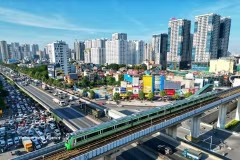
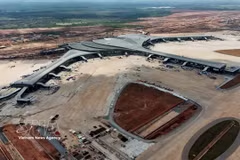
A large-scale wave of public investment is gradually reshaping the market structure. With around 234 infrastructure projects underway, representing an estimated total investment of about 3.4 quadrillion VND (over 129 billion USD), major works such as Long Thanh International Airport, metro systems in Hanoi and Ho Chi Minh City, and more than 380 km of newly operational sections of the North–South expressway are creating new economic development corridors.
Apart from improving connectivity, infrastructure is also reshaping urban space and investment flows. Satellite areas around Hanoi and Ho Chi Minh City are gradually emerging as new growth poles, while industrial real estate is directly benefiting from the development of integrated manufacturing and logistics ecosystems.
Notably, the impact of infrastructure goes beyond “hard infrastructure.” Factors such as quality of life, the environment, education and healthcare, often regarded as “soft infrastructure,” are increasingly influencing decisions by businesses and high-skilled labour forces. These elements are also becoming core components of a city’s long-term competitiveness.
Against the backdrop of the global growth centre continuing to shift toward Asia, Vietnam is targeting double-digit economic growth, anchored on two key pillars - infrastructure investment and FDI inflows. However, as experts note, the decisive factor lies not only in the scale of investment but also in implementation efficiency, ranging from project timelines and the legal framework to the financial environment.
In the long term, with a stable economic foundation, sustained positive FDI inflows, and rapid urbanisation, the market outlook remains highly positive./.
See more
Shrinking farmland forces agriculture to go high-tech
Ministry of Finance data show that about 60% of companies have started using basic digital tech, while roughly 20% now have clear digital strategies. But only 5% has gone all the way with full-blown digital transformation.
Vietnamese exports expand foothold in Canada
The Vietnam Trade Office in Canada organised a national pavilion this year, supporting 15 companies in product displays while helping connect five others operating independent booths. The initiative is designed to enhance product promotion, facilitate partnerships and broaden market access in North America, particularly in the processed food segment.
All-out push to fast-track Vietnam’s first nuclear power plants
Khanh Hoa province has also intensified oversight, introduced housing support of 5 million VND (nearly 190 USD) per month for displaced residents awaiting resettlement, and clarified responsibilities for land inventory, measurement and site selection. Notably, more than 9.8 billion VND has been disbursed to relocate 570 graves, helping accelerate clearance for the Ninh Thuan 1 Plant.
Banks stop processing instant 24/7 transfers for transactions about 500 million VND
All transfers exceeding the threshold of 500 million VND will be automatically routed through regular clearing. Transactions initiated after 3.55pm will be processed on the next working day.
Vietnamese products shine at Paris Fair
Amid deepening international integration, the presence of Vietnamese enterprises at the annual Foire de Paris continues to affirm the appeal of Vietnamese goods and culture in the French market. The event also provides an opportunity for Vietnamese businesses to directly engage with French and European consumers, thereby strengthening their foothold in this promising market.
International Financial Centre - Vietnam's strategic move in global race: Expert
Vietnam is pursuing a “one centre – two destinations” model. Ho Chi Minh City is envisioned as a comprehensive financial hub linked with a free trade zone, while Da Nang will focus on innovation, fintech, digital assets and serve as a testing ground for new financial models. This complementary structure allows Vietnam to develop a tailored approach rather than replicate existing financial centres.
Ho Chi Minh City attracts significant investment from France
Ho Chi Minh City is emerging as an attractive destination for French investors, particularly in infrastructure, sustainable urban development and green transition. French investment of more than 2.2 billion USD is contributing to economic growth and opening up broader prospects for long-term cooperation.
Import duty cuts to 0% for certain fuel products extended until June 30
Under Resolution No. 25/2026/NQ-CP, the application period of Decree No. 72/2026/ND-CP, which lowers preferential import duty rates on selected fuel products and raw materials to 0%, is extended until the end of June 30 this year.
Tax-free threshold for household businesses doubled to 1 billion VND
Under Decree No. 141/2026/ND-CP, the household businesses with annual revenue of 1 billion VND or less will not have to pay personal income tax and value-added tax.
Double-digit growth target: A view from business costs, opportunities
Khanh Hoa is among the first to adopt a double-digit growth resolution for 2025–2030, alongside plans to become a centrally governed city by 2028, and the challenge is not only to achieve fast growth, but to sustain it over time.
Hanoi pushes SOEs to lead breakthrough growth
According to experts, Resolution 79-NQ/TW reaffirms the state economic sector’s leading role in the socialist-oriented market economy. The real shift, however, is moving SOEs from simply “holding” assets to actively “leading” development, and from traditional “management” to enabling growth across the board.
Trade ministry organises investment-trade delegation to Japan
The Vietnamese trade-investment delegation is scheduled to visit Osaka and Tokyo from June 27 to July 3, 2026.
Ho Chi Minh City steps up decisive action to lift IUU “yellow card”
The city will fast-track eCDT implementation, study the feasibility of a fishing port in Can Gio, and propose granting accounts to border guard stations to strengthen oversight of vessel movements. Enhanced inter-provincial coordination, particularly with Lam Dong, Da Nang, Quang Tri and Ninh Binh, was also emphasised to tighten control and strictly handle violations, especially those related to VMS.
Vingroup breaks ground on 880-ha international university urban area in Ho Chi Minh City
The urban area will feature a large and comprehensive education and knowledge ecosystem covering more than 150 hectares, along with hospitals, shopping centres, and a chain of entertainment, dining and leisure facilities. Notably, it will also include a network of 100 parks spread throughout the development.
Vietnam pitches itself as promising trade partner to Mexican firms
Vietnam shines in light industry, apparel, electronics and processed agricultural products, while Mexico dominates in manufacturing, particularly automobiles, and boasts massive distribution networks across North America.
Ho Chi Minh City breaks ground on projects shaping modern megacity
The newly-launched large-scale projects in Ho Chi Minh City are expected to shape a megacity of regional and international stature, and generate strong momentum for the city's next phase of growth.
PM emphasises need for governance shift to drive growth
Ministries and agencies must enhance forecasting capacity, adopt more responsive policy tools, and fundamentally rethink how policies are designed and executed in a rapidly evolving environment, said PM Le Minh Hung.
Exchange rate, interest rate, credit management must align with 2-digit growth target: PM
Prime Minister Le Minh Hung also called for measures to stabilise interest rates, reduce operational costs within credit institutions, promote digital transformation, and ensure adequate system liquidity.
Dong Nai rolls out 4.3 billion USD plan for key transport links
Dong Nai will implement three major transport projects with a total capital exceeding 110 trillion VND (4.3 billion USD), aimed at strengthening connectivity between Dong Nai, Ho Chi Minh City, and key economic regions in the Central Highlands, central, and southwestern regions.
Private sector enters new growth cycle with stronger momentum
The rapid institutionalisation of Resolution No. 68-NQ/TW has reignited the desire to create wealth, encouraged new business formation and positively impacted market entry and business activity.