Digital transformation powers Hanoi metro expansion

Beyond convenience, stable fares and the elimination of fuel, parking and maintenance costs have made urban rail increasingly attractive. The growing preference for metro travel is also contributing to a greener, more modern urban lifestyle.

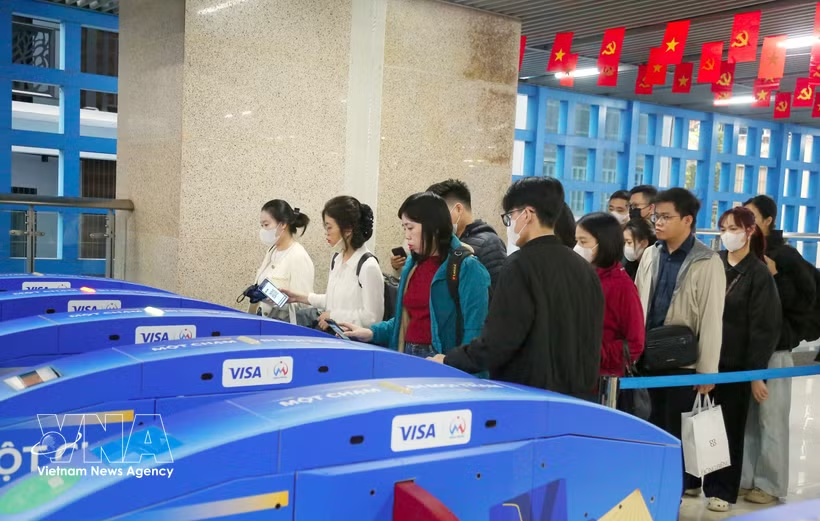
Automated ticketing system is used on the urban railway Cat Linh-Ha Dong line in Hanoi. (Photo: VNA)

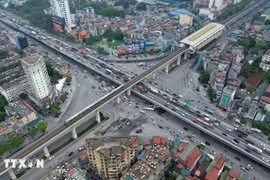
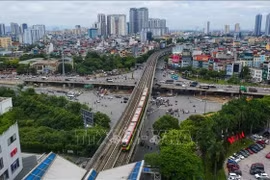
Hanoi (VNA) – Digital transformation is accelerating the expansion and appeal of Hanoi’s metro system, positioning urban rail as a key pillar of sustainable transport amid mounting congestion and pollution pressures.

The shift is evident in rising ridership and changing commuter habits. In 2025, Hanoi Metro One Member Limited Company (Hanoi Metro) recorded more than 20 million passenger trips on the Cat Linh–Ha Dong and Nhon–Hanoi Station lines, surpassing its annual target by over 7% and averaging about 57,000 passengers per day.

For many residents, the metro offers a faster, more reliable alternative to motorbikes while reducing travel costs and environmental impact.

Phan Phuong Linh, a 20-year-old student at Vietnam National University, Hanoi, said her commute from Phu Dien ward to campus has been cut from up to 30 minutes during rush hour to just 10–15 minutes by metro.

Beyond convenience, stable fares and the elimination of fuel, parking and maintenance costs have made urban rail increasingly attractive. The growing preference for metro travel is also contributing to a greener, more modern urban lifestyle.

However, experts note that sustaining this momentum will require further infrastructure investment, stronger connectivity with other transport modes and, critically, continued digitalisation of services.

Given this, Hanoi Metro has stepped up the application of technology to improve customer experience and operational efficiency. A key initiative is the rollout of mobile ticketing via the “Hanoi Metro” application and affiliated platforms.

Passengers can now register accounts, choose from single-ride, daily or monthly tickets, and make cashless payments using e-wallets, bank cards or QR codes. After purchase, tickets are scanned at automated gates, removing the need to queue.

Digital monthly passes are also available for students and frequent users, with registration completed online using personal information or citizen ID cards. Tickets are stored as QR codes or electronic cards, enabling quick and seamless access.

Le Phuong Ha, a 24-year-old office worker in Cau Giay ward, said the new system has made public transport far more convenient. “I used to avoid buses and trains because of long lines for tickets. Now I can buy a ticket on my phone in seconds and board right away,” she said.

More recently, the urban railway sector has introduced a new generation of automated fare gates using electronic identification and biometric recognition across the network. After eight months of pilot implementation, the system has been used by more than 5.7 million passengers.

According to Hanoi Metro, the adoption of digital technologies has helped boost revenue by 48% and increase ridership by 15% compared to the same period in 2025.

Hanoi Metro General Director Le Bang An said passengers can now access services using chip-based citizen ID cards, VISA credit cards or QR-coded tickets, all through cashless payment methods.

The upgraded system marks an important step in synchronising the capital’s metro lines on a unified technological platform. It is expected to enhance service quality, optimise operations and drive broader digital transformation in urban transport.

In the longer term, the platform will support the development of an integrated electronic ticketing system across all public transport modes, contributing to Hanoi’s goal of becoming a modern and sustainable city./.

VNA
See more

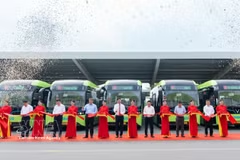
Delegates cut the ribbon to inaugurate the operation of electric bus route No. 43. (Photo: VNA)

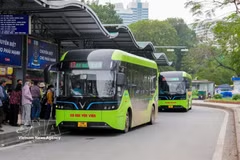
Hanoi accelerates shift to green buses, targets 100% by 2030

In the 2027–2030 period, the city will accelerate the transition towards the complete phase-out of fossil fuel-powered buses. The share of electric and green energy-fueled buses is projected to reach 79–89% by 2029 and 100% by 2030.

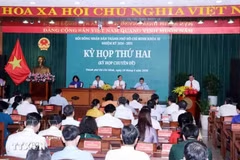
At the second session of the Ho Chi Minh City People’s Council (Photo: VNA)

Ho Chi Minh City greenlights central square, administrative centre in Thu Thiem

The new central city square and administrative centre will create a modern, centralised political-administrative complex for Ho Chi Minh City, designed to house around 8,000 officials, civil servants, and employees. It will also handle daily traffic of 1,500- 2,000 citizens and business representatives through a unified one-stop-shop administrative service system.

A working session at the job fair (Photo: VNA)

Vietnamese students flock to Seoul Job Fair 2026

The second annual Job Fair 2026 was held for Vietnamese students in the Republic of Korea. Organisers pitched it as a straight-up bridge between eager students and bosses hungry for young talent who can actually handle multicultural workplaces.

Defendants at the court (Photo: VNA)

Ho Chi Minh City court opens trial over Agribank lending scandal

The investigation revealed that multiple credit files were incomplete or riddled with inaccurate information, while some pledged assets lacked proper legal standing yet were accepted and grossly overvalued. As a result, the loans became high-risk and largely unrecoverable, leading to losses surpassing 1 trillion VND.

Hanoi introduces 53 electric buses from April 18 (Photo: VNA)

Hanoi to add 53 electric buses from April 18

According to the plan, all buses operating within Ring Road 1 will use green energy by July 1, 2026. The requirement will expand to Ring Road 2 by January 1, 2028, and to Ring Road 3 by 2030.

Illustrative image (Photo: VNA)

National, local traffic safety committees to be dissolved from June 1

Under the dicision, ministries and ministerial-level agencies will assume responsibility for tasks previously performed by the committee, in line with their mandates under the Law on Government Organisation, the Law on Road Traffic Order and Safety, the Law on Roads and other relevant legal frameworks, ensuring that traffic safety and order are maintained without disrupiton.

Visitors explore technology showcases at the exhibition held during the Da Nang Startup and Innovation Festival (SURF 2025). (Photo: VNA)

About 10,000 students expected at National Startup Day 2026

This year marks the rollout of the “Student Startup Support Programme for 2026 – 2035”, approved under Decision No. 336/QD-TTg, which places emphasis on practical outcomes, real products, real testing, real partnerships, and measurable impact.

Hong Quang High School pilots teaching mathematics in English starting from the 2025–2026 academic year. (Photo: VNA)

National foreign language proficiency framework issued

The circular establishes a unified benchmark for foreign language proficiency across the national education system, providing a foundation for curriculum design, teaching, testing, assessment, and certification. It is expected to help learners better map out their language development pathways while enabling educational institutions to improve training quality and strengthen articulation between different levels of education.