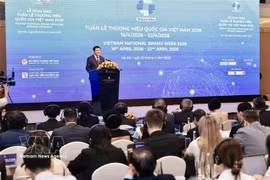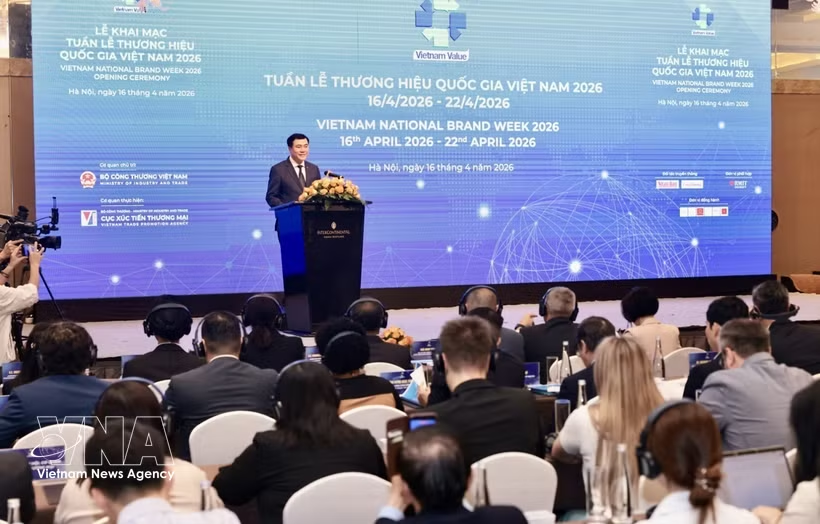
Hanoi (VNA) – National branding is emerging as a strategic tool to enhance the country’s global standing, helping businesses shift from contract manufacturing to innovation-driven growth and sustainable value creation, according to a trade official.
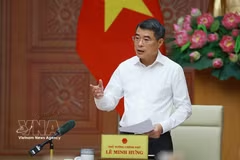
In an interview with the Vietnam News Agency (VNA), Hoang Minh Chien, Deputy Director of the Vietnam Trade Promotion Agency (Vietrade) under the Ministry of Industry and Trade, said intensifying global competition and the ongoing restructuring of supply chains are redefining how countries compete.
“Competition is no longer about price or output alone, but increasingly about trust, reputation and brand value,” he noted, stressing that the Vietnam’s national brand plays a critical role in positioning the country within global trade networks.
Chien described the national brand as a “guarantee of credibility” that helps Vietnamese firms overcome trust barriers and integrate more deeply into global supply chains. He highlighted the organic link between product brands, corporate brands and the national brand, which together serve as a “passport” for Vietnamese industries to expand internationally.

More importantly, the national brand is expected to drive a transition from quantity-based to quality-driven growth. Vietnam, he acknowledged, remains strong in original equipment manufacturing (OEM) but lags behind in original design manufacturing (ODM) and own-brand manufacturing (OBM). The National Brand Programme, built on criteria such as quality, innovation and pioneering capacity, is designed to boost value-added content and embed a stronger Vietnamese identity in exported products.
The initiative is also aligned with major national strategies, including the goal of becoming a high-income developed country by 2045 and enhancing Vietnam’s position in global value chains. The Prime Minister’s Decision No. 626/QD-TTg approving the “Going Global” programme for 2026–2030 provides a concrete framework to advance these ambitions.
“National branding is not just a trade promotion tool, but a national competitiveness strategy,” Chien said, adding that each Vietnamese product should carry a distinctive “Vietnam story” defined by quality, cultural identity and innovation.
To better support the country’s growth model transformation, the programme is being redesigned around three key pillars.
First, innovation will be placed at the centre of evaluation criteria. A newly issued circular - 18/2026/TT-BCT - has increased the weighting of innovation significantly, while redefining “pioneering” to include leadership in green transformation, digitalisation and environmental, social and governance (ESG) practices. New indicators related to circular economy principles such as resource efficiency, recycling and eco-friendly product design are now mandatory.
Second, trade promotion methods are being modernised. The agency is partnering with global e-commerce platforms such as Amazon, Alibaba and TikTok to develop “Vietnam National Brand Pavilions”, alongside virtual trade fairs and cross-border livestreaming. Digital marketing tools, search engine optimisation and multilingual data systems are also being deployed to ensure consistent and professional promotion of Vietnam’s image worldwide.
Third, branding efforts are increasingly integrated with cultural diplomacy and tourism promotion. Embedding national brand messaging into high-level diplomatic and cultural events is expected to enhance credibility and broaden international outreach.
Looking ahead, Chien underscored the need for breakthrough institutional reforms to enable the programme to nurture globally competitive corporations.
A fundamental shift in policy thinking is required, he said, with the State providing support and sharing risks with businesses while removing institutional bottlenecks and improving the business environment. The private sector, identified as a key growth driver, and State-owned enterprises, seen as pioneers in strategic sectors, must work in tandem to build firms strong enough to compete on the global stage.
He also emphasised the role of science, technology and culture as foundational pillars. Strong brands, he said, must be built on innovation, intellectual property and unique technological solutions, while leveraging Vietnam’s cultural heritage as a source of differentiation in global markets.
At the same time, support policies need to move beyond export promotion towards helping enterprises upgrade their position in value chains. This includes incentives for research and development, product design, branding, digital and green transformation, and compliance with international standards.
Given that not all firms can become global brands overnight, targeted support should focus on large enterprises, strategic sectors and businesses with strong internationalisation potential. Assistance should go beyond communication to include strategic consulting, market intelligence, investment linkages and support for overseas expansion through partnerships and mergers.
“Ultimately, the National Brand Programme must evolve from a trade promotion initiative into a strategic economic institution,” Chien said. “Only with coherent policies and concentrated resources can it become a foundation for building Vietnamese corporations capable of competing regionally and globally.”/.