Can Tho makes English second language across schools

Making English a second language in schools is no longer just a goal for big cities, it’s quickly becoming a natural part of human resources development plans in many localities across Vietnam.

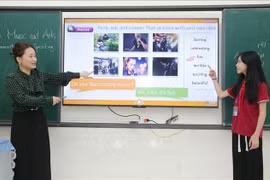
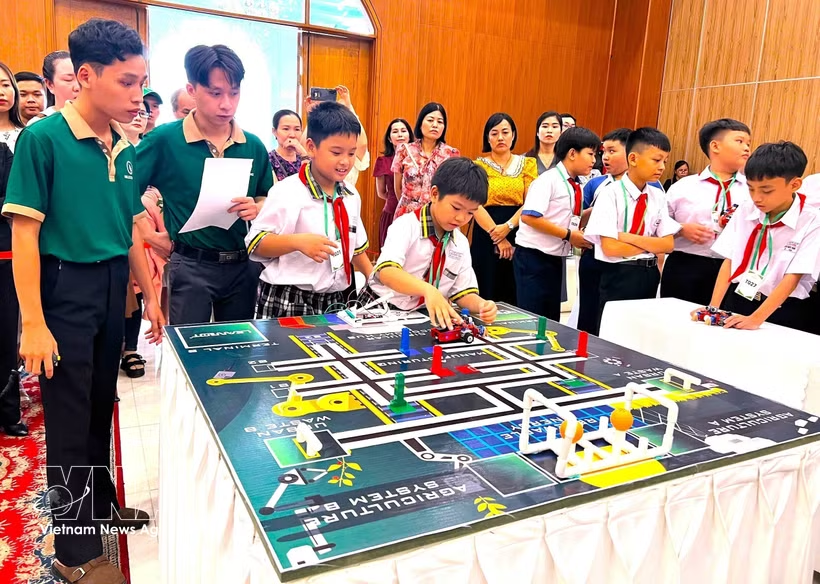
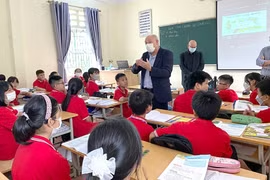
Primary school students in Can Tho city take part in an English-speaking robot programming competition. (Photo: VNA)

Can Tho (VNA) – The Mekong Delta city of Can Tho has officially approved a project to make English the second language in schools, aiming to raise education standards, create fresh momentum for international integration, and support long-term socio-economic development.

Making English a second language in schools is no longer just a goal for big cities. It’s quickly becoming a natural part of human resources development plans in many localities across Vietnam.

Can Tho is home to more than 1,200 educational institutions, serving around 670,000 students. In recent years, English teaching and learning in the city have seen notable improvements.

However, in practice, English is still taught largely as a subject rather than used as a regular language of communication within schools. Integrated teaching in English remains limited, opportunities for daily language use are not yet clearly established, and disparities in teacher capacity and facilities continue to present significant roadblocks.

The implementation of the project, therefore, is not merely educational reform. It is also seen as a strategic move to improve workforce quality and strengthen the city’s competitiveness amid deeper integration into the world.

From “learning” to “using” a foreign language

With the scheme approved on April 9 by the municipal Party Committee, English will gradually move beyond its traditional role as a school subject to become a practical tool for communication, learning and administration within the educational environment. This represents a fundamental transition – from simply “learning a foreign language” to actively “using a foreign language”.

From now until 2030, the city will focus on pilot implementation and building the necessary foundations, with the target of 100% of general education schools teaching English from the first grade onwards.

More than 705 billion VND (26.74 million USD) is to be invested in technological infrastructure, digital learning materials, artificial intelligence (AI) applications and, most importantly, improving teachers’ professional capacity.

Notably, the scheme will be implemented through a zonal approach, prioritising investment in areas facing greater challenges with facilities, teaching staff and access to technology.

In the next phase, from 2030 to 2035, Can Tho plans to expand enhanced English and bilingual teaching models. Between 2035 and 2045, the city aims to make English a core tool for learning and international engagement, with broader adoption across the entire education system.

By 2045, it’s expected that all universities will use English as the main language for teaching and research.

Building an international learning environment

At the tertiary level, many local institutions have already introduced and expanded programmes taught entirely in English.

Dr Ho Hong Lien from Can Tho University noted that the biggest challenge in this transition is the human factor. English skills among lecturers and students vary widely while the need for facilities and teaching equipment to support English-medium instruction is significant.

The speaking skill in particular, a core element of effective communication, continues to be a weakness for many students, Lien noted, perceiving that to address this, English needs to be used alongside Vietnamese across all academic activities, from teaching and research to professional communication.

Can Tho University already uses English exclusively in its advanced programmes while for courses following the Ministry of Education and Training’s standard curriculum, English currently serves as a secondary language, she shared.

One key solution proposed is the development of a comprehensive bilingual academic ecosystem, with all teaching materials, learning resources, information portals, notice boards and learning management systems available in both Vietnamese and English.

Dr Nguyen Van Quang, Rector of Nam Can Tho University, said his institution currently offers 10 degree programmes taught entirely in English, spanning strategic fields such as health care, engineering and technology, as well as economics, business administration, tourism and communications.

The project to make English the second language in schools across the city is not simply an education policy. It is a long-term development strategy.

With strong determination and a clear strategic vision, Can Tho is laying the cornerstone for a modern educational ecosystem in which English is no longer merely a compulsory subject, but a practical life tool for future generations./.
VNA

See more

The 172nd repatriation ceremony of US serviceman’s remains held in Da Nang. (Photo: qdnd.vn)

Vietnam hands over more MIA remains to US

The remains were recovered during a recent joint Vietnam–US excavation in central Hue city. On April 27, Vietnamese and US forensic specialists conducted a preliminary examination, indicating the remains may be linked to a missing US serviceman. They will be sent to a forensic laboratory in Hawaii for further analysis and identification.

Activities within the Visit Vietnam Year – Hue 2025 attract a large number of visitors (Photo: VNA)

Ministry rolls out plan to promote national image

At its core, the plan emphasises mobilising the combined strength of the political system and society, linking communications with the promotion of cultural values and soft power of the country.

People donate blood at the launch of the Humanitarian Month 2026 in Hanoi on April 29. (Photo: VNA)

Humanitarian Month 2026 launched with community support activities

Over the past five years, Humanitarian Month campaigns have raised more than 3 trillion VND (nearly 114 million USD), assisting more than 6.6 million people. Beyond figures, the initiative has helped strengthen social trust and foster compassion across society.

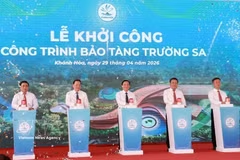
The groundbreaking ceremony for the Truong Sa Museum in Cam Lam commune, the south central province of Khanh Hoa, on April 29 (Photo: VNA)

Truong Sa Museum to honour generations safeguarding national sovereignty

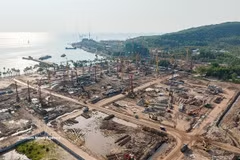
The museum covers a total area of approximately 17,100 square metres, with total investment estimated at 299.7 billion VND (11.37 million USD). Funding for the project is provided through sponsorship from Vinhomes JSC, and construction is expected to be completed in the first quarter of 2028.

Social housing projects help meet the housing needs of low-income earners and workers, while contributing to sustainable urban development. (Photo: VNA)

Social housing construction target exceeds by 44%

Minister of Construction Tran Hong Minh has issued an official dispatch urging localities to accelerate the development of social housing projects to meet the target of more than 158,700 units in 2026, as set out in Government Resolution No. 7/NQ-CP.

Deputy Director of the Ministry of Home Affairs’ Department of Local Government Nguyen Thi Tu Thanh speaks at the press briefing. (Photo: VNA)

Two-tier local administration model runs smoothly: ministry

After slashing layers of bureaucracy and pushing more power down to the commune level, a substantial volume of work has shifted to the grassroots officials. In many areas, the workforce is unevenly skilled, with a shortage of specialists. Additionally, certain units operate across multiple locations, making management, coordination, and day-to-day operations a real mess.

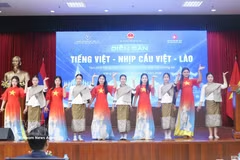
A performance at the event showcases the special solidarity between Vietnam and Laos. (Photo: VNA)

Forum promotes Vietnamese language preservation among community in Laos

Addressing a forum themed “Honouring the Vietnamese language, preserving identity, connecting the future” in Vientiane on April 27, the ambassador said preserving the language is a shared and long-term responsibility of overseas Vietnamese communities, including those in Laos.

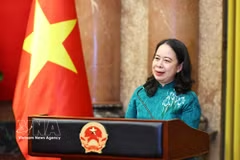
Vice State President Vo Thi Anh Xuan speaks at the meeting on April 27 with 101 outstanding grassroots trade union chairpersons recognised for achievements in workplace dialogue and collective bargaining during 2023-2025 (Photo: VNA)

Vice State President meets outstanding trade union leaders

The Vice President highlighted contributions made by the honourees, saying their efforts had secured benefits worth more than 6 trillion VND (227.6 million USD) annually for some 382,000 labourers, while improving workers’ welfare and strengthening stable and progressive labour relations in enterprises.

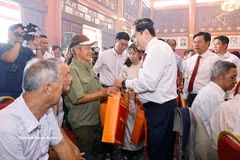
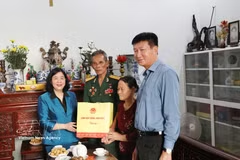
President of the Vietnam Fatherland Front’s Central Committee Bui Thi Minh Hoai on April 27 leads a delegation to visit and offer gifts to heroic Vietnamese mothers, armed forces heroes, policy beneficiary families, poor households and disadvantaged workers in Ninh Binh (Photo: VNA)

Policy beneficiaries, disadvantaged workers receive gifts ahead of national holidays

Visiting Heroic Vietnamese Mother Tran Thi Sach in Phu Ly ward, whose two sons died in wartime, President of the Vietnam Fatherland Front’s Central Committee Bui Thi Minh Hoai expressed gratitude for her sacrifices, affirming that the Party, State and people always remember and honour those who have rendered service to the nation.