Hanoi (VNA) – Recognising that high-growth targets set by localities can only be realised when commitments to support businesses are translated into concrete projects and deliverables, the central province of Khanh Hoa has held discussions with local firms to explore ways to assist with their development.
A candid dialogue
“We will not leave businesses to fend for themselves.” That was the pledge made by Vice Chairman of the Khanh Hoa People’s Committee Le Huyen at a recent dialogue between the local administration and the business community.
He stressed that the province will streamline procedures, enhance transparency, and make full use of power decentralisation to improve the effectiveness of investment incentives. Notably, a scheme to improve the performance of provincial departments is being finalised, with a core principle that their leaders will be held accountable for any unjustified delays.
“We are pushing to digitise 100% of administrative dossiers so businesses no longer have to travel multiple times and can track application status online,” he added.
Businesses, however, voiced frank concerns. Dinh Thi Hong Lien, Vice Chairwoman of the Khanh Hoa Young Entrepreneurs Association, pointed out that some projects take between one and five years just to complete preparatory procedures.
“This is a major financial burden. Can the province stay committed to a fixed timeline or fully digitise the process by 2026 so investors can proceed with confidence?” she asked.
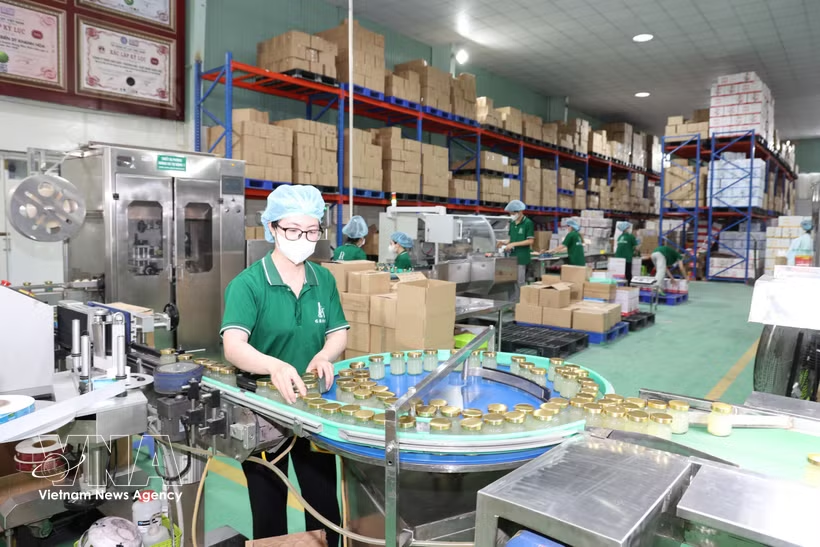
Similarly, Pham Nguyen Hoai An, Director of the Yen Sao Khang Co., Ltd, questioned whether small and medium-sized enterprises could meaningfully participate in strategic infrastructure projects. With plans to develop Cam Lam into an airport-linked urban area and Van Phong into a logistics, energy, and transshipment hub, local firms hope to join supply chains as subcontractors and service providers.
“Strategic projects are offering great opportunities for investment attraction, but it remains unclear whether local businesses will truly benefit,” he noted.
When growth requires real partnership
Such commitments are closely tied to Khanh Hoa’s ambition of achieving 10 - 11% growth in 2026. The province is among the first to adopt a double-digit growth resolution for 2025–2030, alongside plans to become a centrally governed city by 2028.
The challenge is not only to achieve fast growth, but to sustain it over time.
Vice Chairman Huyen acknowledged that removing institutional bottlenecks, reforming administrative procedures, and reducing business costs are no longer supportive measures – they are prerequisites for growth.
Experience from top-performing localities underscores this point. Central Ha Tinh province, which recorded 12.42% GRDP growth in the first quarter, benefited from major industrial drivers such as the Vung Ang 2 thermal power plant and projects by VinFast and VinES. Meanwhile, northern Ninh Binh province saw strong contributions from new manufacturing facilities by foreign-invested enterprises such as Great Market Global Vietnam, Seasunsport Nam Dinh, and Jinyoung G&T Vietnam.
These outcomes reflect not only their strong industrial and service bases, clear investment attraction directions, favourable infrastructure or an improved investment climate, but also the successful conversion of potential into concrete projects and outputs.
Execution as the decisive factor
In contrast, provinces with slower growth – between 5.3% and 7.05% – have cited familiar challenges: reliance on export processing, supply chain disruptions, rising freight costs linked to geopolitical tensions, and delays in infrastructure projects due to slow site clearance and material shortages.
While these are common issues, the difference lies in execution. Mechanisms such as the national database system for resolving stalled projects and provisions under the Government's Resolution 89/NQ-CP provide tools for localities to address bottlenecks, including proposing legal amendments or special mechanisms when needed.
Ultimately, GRDP performance – and more broadly, economic growth – bears the clear imprint of local governance effectiveness.
For Khanh Hoa, first-quarter growth of 8.37% places it mid-table but still below its double-digit target. Bridging that gap will require not just strong commitments, but swift and substantive implementation - underscoring that execution remains the decisive factor./.