Achieving double-digit growth challenging but essential: Minister

Since 1946, only 13 economies worldwide have sustained double-digit growth for over a decade to transition from low-income and developing to developed status. During Vietnam’s 40 years of renewal, growth has exceeded 9% only twice and has never reached double digits.

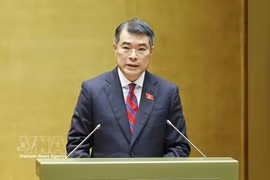
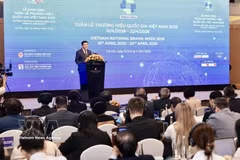
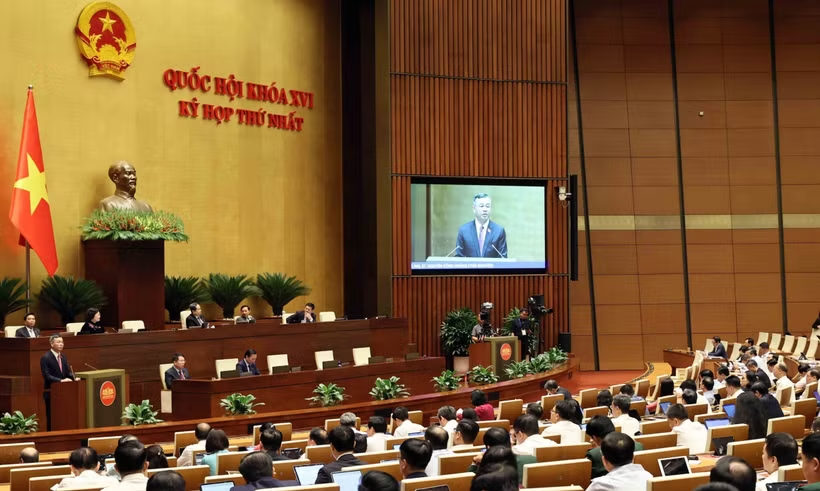
Finance Minister Ngo Van Tuan speaks at the first session of the 16th National Assembly (Photo: VNA)

Hanoi (VNA) – Achieving double-digit growth is highly challenging but essential for meeting Vietnam’s long-term development goals, stated Finance Minister Ngo Van Tuan on April 21 at the ongoing first session of the 16th National Assembly (NA).

The minister highlighted the country’s twin centenary goals – by 2030, marking 100 years since the Communist Party of Vietnam’s establishment, Vietnam aims to become an upper middle-income developing country; and by 2045, the 100th founding anniversary of the nation, to attain developed, high-income status.

Tuan noted that since 1946, only 13 economies worldwide have sustained double-digit growth for over a decade to transition from low-income and developing to developed status. During Vietnam’s 40 years of renewal, growth has exceeded 9% only twice and has never reached double digits.

Aligned with the Resolution of the 14th National Party Congress and the key Politburo resolutions, the Government has set 59 sectoral targets, 11 groups of tasks and solutions, and 92 specific assignments for 2026, he said.

Initial results are encouraging. In the first quarter of 2026, GDP grew by 7.8%, exports 19%, public investment disbursement 1.2%, and new business registrations more than 31.7%.

However, significant challenges are expected from the second quarter onward, driven by oil price volatility and global geopolitical tensions. Experts estimate that a 10% rise in oil prices could reduce growth by 0.4 percentage points while fuelling inflationary pressures. To achieve annual growth above 10%, remaining quarters would need to record 10–11% expansion.

He said that the Finance Ministry will advise the Government to review and update growth scenarios, assigning tailored targets to ministries, sectors, localities, and enterprises in line with evolving conditions. Close coordination between fiscal and monetary policies will be prioritised to ensure sufficient capital supply while maintaining macroeconomic stability.

The fiscal policy will focus on refining the tax system to ensure accurate, sufficient, and timely revenue collection and, at the same time, create the best possible conditions for business development, particularly small and medium-sized enterprises.

On public investment, Tuan went on, the ministry is accelerating the implementation of tasks assigned by the Prime Minister, with a focus on resolving stalled land-related and other delayed projects. An estimated 200,000 hectares of land, equivalent to around 3.3 quadrillion VND (125.3 billion USD) in tied-up resources, remain idle, triple the planned public investment for 2026, highlighting a major bottleneck requiring supervision and resolution.

Regarding capital needs, total investment demand is projected to rise 2.2 times compared to previous periods, with central budget requirements increasing 3.4 times and FDI attraction needing to grow 1.7 times.

The minister stressed that improving investment efficiency is critical. Without lowering the incremental capital output ratio (ICOR), achieving double-digit growth will require total social investment account for up to 70% of GDP. Therefore, the target is to reduce ICOR to 4–4.5.

He also underscored the need to rebalance the financial system, noting Vietnam’s heavy reliance on the monetary market. Developing long-term capital markets, particularly through bonds and stocks, will be key. This will demand institutional reforms, improved market infrastructure, and the development of professional investment institutions to build investor confidence and support sustainable growth./.

VNA
See more

The meeting between General Secretary of the Communist Party of Vietnam Central Committee and State President To Lam and Chairman and Chief Executive Officer of Hayleys PLC Mohan Pandithage in Colombo on May 8 (Photo: VNA)

Vietnamese leader hopes for stronger ties with Sri Lanka's Hayleys PLC

General Secretary and President To Lam said that given the complementarity of the two economies and their substantial room for growth, Vietnam wishes to enhance cooperation with major Sri Lankan enterprises, especially those with regional market networks and connectivity capabilities such as Hayleys.

The export of 1.1 million doses of vaccine lumpy skin disease (LSD) to the Republic of Korea marks an important milestone for Vietnam’s veterinary vaccine industry. (Photo: nongnghiepmoitruong.vn)

Vietnamese-made LSD vaccine enters demanding RoK market

The successful research and commercialisation of the LSD vaccine, which has been widely used in the domestic market and is gradually expanding internationally, helps affirm the position of Vietnamese veterinary vaccines globally.

General Secretary of the Communist Party of Vietnam (CPV) Central Committee and State President To Lam addresses the Vietnam – Sri Lanka Trade-Investment-Tourism Cooperation Forum in Colombo on May 8. (Photo: VNA)

Top leader urges stronger Vietnam-Sri Lanka economic connectivity

Vietnam – Sri Lanka cooperation should be viewed within the broader context of the Indian Ocean, South Asia and emerging global supply chains, and the key issue now is not potential, but swift, decisive and effective action, said Vietnam's top leader To Lam.

The meeting between Vietnamese Minister of Industry and Trade Le Manh Hung and representatives from Essar Group (Photo: VNA)

Vietnam, India step up cooperation in energy, biofuels

Vietnam encourages capable investors to participate in oil and gas, energy and energy infrastructure projects in line with the national energy development strategy, while ensuring investment efficiency and compliance with Vietnamese law.

In the first four months of 2026, total FDI inflows into Vietnam reaches 18.24 billion USD, up 32% year-on-year. (Illustrative photo: VNA)

Vietnam draws stronger foreign investment inflows despite global headwinds

In the first four months of 2026, total FDI inflows into Vietnam reached 18.24 billion USD, up 32% year-on-year. Disbursed capital was estimated at more than 7.4 billion USD, an increase of 9.8% and the highest four-month disbursement level recorded in the past five years, reflecting effective implementation of many registered projects.

A Boeing 787 aircraft of Vietnam’s national flag carrier, Vietnam Airlines, lands on its first flight at Long Thanh International Airport. (Photo: VNA)

Deputy PM stresses strategic, synchronous planning for airport system

The national airport system planning was approved by the Prime Minister under Decision No. 648/QD-TTg dated June 7, 2023. Under the planning, 30 airports (14 international and 16 domestic) are to be developed during the 2021–2030 period, with a vision to 2050 expanding the network to 33 airports (14 international and 19 domestic).

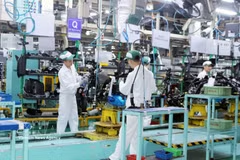
Modern machinery improves labour productivity. (Photo: VNA)

Upskilling becomes key lever for Vietnamese workforce in digital era

As the economy is pivoting to a growth model fueled by knowledge, technology and innovation, the working class, or the backbone of production, demands better professional qualifications, vocational skills, industrial discipline and work habits. Timely adaptation is the only shield against being undercut by accelerating automation, artificial intelligence and increasingly fiercer global competition.

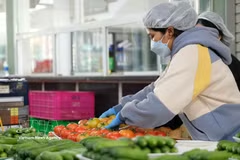
A circular organic farming model in Khanh Hoa is delivering initial economic efficiency. (Photo: VNA)

New growth potential unlocked for Vietnamese economy

Prime Minister Le Minh Hung once stressed that cutting administrative procedures and business conditions remains one of the fastest and most effective ways to stimulate growth and strengthen confidence among citizens and enterprises. He underscored that the reform process must remain continuous and responsive to practical requirements.