NA deputies propose higher base salary to boost public-sector motivation

A deputy of Vinh Long province stressed that adjusting the base salary is not merely a technical step but a decisive factor affecting income, motivation and the overall quality of the public workforce.

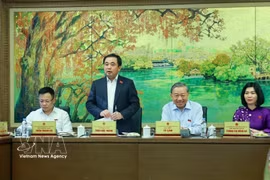
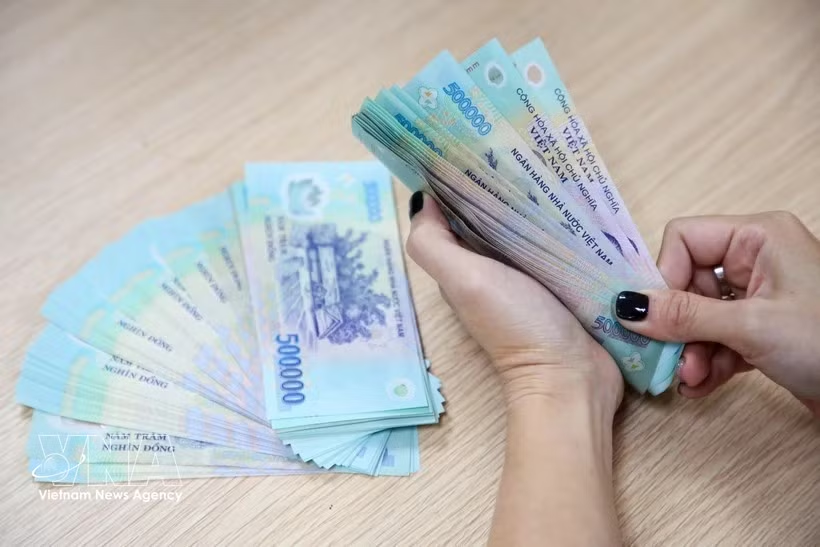
NA deputies have proposed higher base salary to boost public-sector motivation. (Illustrative photo: VNA)

Hanoi (VNA) – Lawmakers have proposed raising the statutory base salary to 2.65–2.7 million VND (101–103 USD) per month, arguing that a stronger adjustment is needed to improve living standards and create real motivation for public-sector workers amid ongoing wage reform.

At the first session of the 16th National Assembly (NA), deputies on April 21 morning reviewed socio-economic and budget performance in 2025 and early 2026, with particular focus on grassroots governance and remuneration policies for civil servants and public employees.

Deputy Thach Phuoc Binh from the Mekong Delta province of Vinh Long stressed that adjusting the base salary is not merely a technical step but a decisive factor affecting income, motivation and the overall quality of the public workforce.

Vietnam has gradually raised the base salary in recent years – from 1.49 million VND to 1.8 million VND and then 2.34 million VND per month – with a further increase to 2.53 million VND scheduled for July 1, 2026. However, Binh argued that the key question is not whether to raise salaries, but by how much.

While the planned increase represents an 8.12% rise from the curent level – higher than the inflation last year (3.63%) and in the first quarter of 2026 (3.51%), and broadly in line with the region-based minimum wage growth in the enterprise sector (about 7.2%), it remains insufficient to ensure a basic standard of living for most public employees, particularly new recruits and those in major cities.

A newly recruited civil servant with a salary coefficient of 1.86 will earn roughly 4.7 million VND per month before insurance deductions, below typical minimum living costs in urban areas, estimated at 6–7 million VND. This gap forces many workers to rely on supplementary income, resulting in undermined job motivation and quality of life.

Meanwhile, Binh noted, essential expenses such as housing, utilities and health care have risen faster than overall inflation, adding further pressure on household budgets.
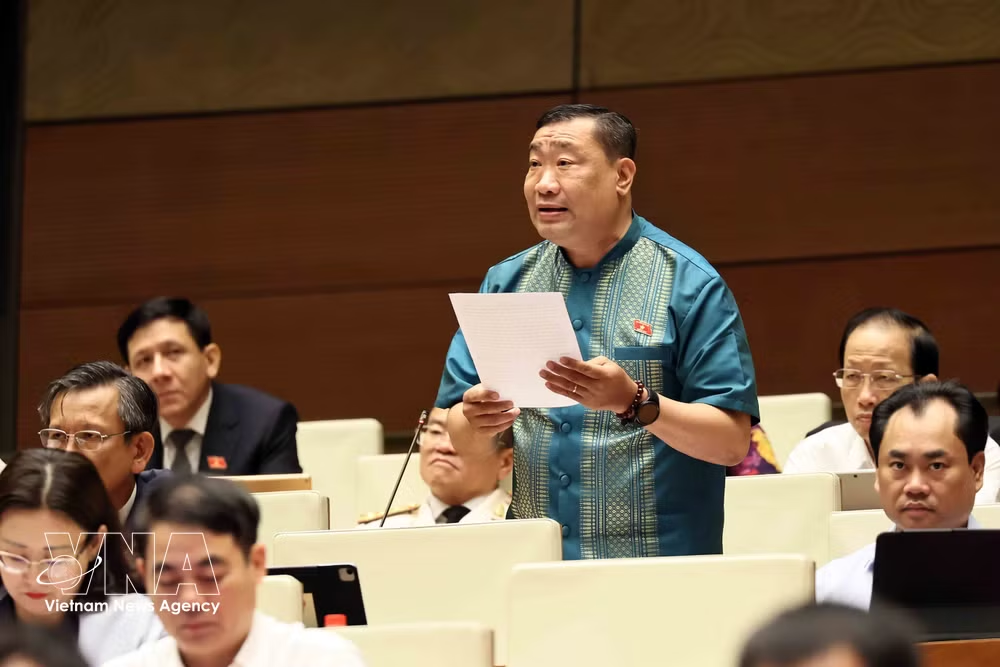
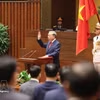
vnanet-vna-potal-ky-hop-thu-nhat-quoc-hoi-khoa-xvi-quoc-hoi-thao-luan-ve-phat-trien-kinh-te-xa-hoi-dau-nam-2026-8715283.jpg
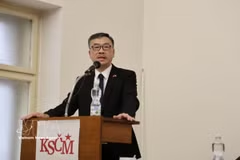
Deputy Thach Phuoc Binh of Vinh Long province speaks at the first session of the 16th National Assembly. (Photo: VNA)

From a comparative perspective, even after the base salary is raised as planned, entry-level public salaries would only slightly exceed the average region-based minimum wage and barely match the highest regional threshold.

Given these factors, Binh proposed raising the base salary to between 2.65 million VND and 2.7 million VND per month, equivalent to a 13–15% increase from the current level, as a more appropriate and feasible option.

Such an adjustment, he said, will strike a better balance between fiscal capacity and the need to deliver meaningful improvements in income, while laying the groundwork for deeper wage reform in the coming years.

Talking about the performance of commune-level administrations following administrative unit mergers, Nguyen Dang An, a deputy from the northern province of Lang Son, said the restructuring has delivered initial gains, with operations stabilising and public services becoming more accessible to citizens and businesses.

However, he pointed out that staff arrangements and organisational structures still face bottlenecks. At present, commune-level administrations typically operate with only two specialised divisions—economic and socio-cultural affairs—each subject to guidance from many provincial departments, leading to overload and limited specialisation.

Shortages of qualified personnel remain a key concern, particularly in technical fields such as construction, transport and information technology, even as workloads have increased significantly compared to the pre-merger period. This, he said, underscores the need for systematic training and retraining programmes.

Public service units in health care and education are also under strain due to staff cuts while existing caps on contract labour limit local flexibility in filling gaps.

An called for a comprehensive review of staffing allocations based on population, area and regional characteristics, including mountainous and island regions.

He added that the implementation of policies for non-specialised staff at the commune level and in residential clusters remains unclear in some cases, requiring more detailed guidance before transitional arrangements expire in mid-2026. Adjustments to criteria for residential units formed after administrative mergers were also recommended to better reflect current realities./.
VNA

See more

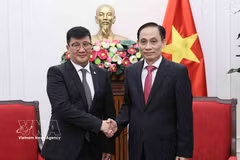
Minister of Foreign Affairs Le Hoai Trung (R) and outgoing Mongolian Ambassador Jigjee Sereejav. (Photo: VNA)

Foreign Minister hosts outgoing Mongolian Ambassador

Affirming Vietnam’s high regard for Mongolia and their longstanding friendship, Minister of Foreign Affairs Le Hoai Trung called for closer coordination to further develop the Comprehensive Partnership.

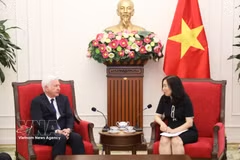
Deputy Minister of Foreign Affairs Le Thi Thu Hang (R) meets with Honorary Consul of Vietnam in Ireland Patrick McKillen in Hanoi on April 21. (Photo: VNA)

Vietnam, Ireland seek ways to step up bilateral cooperation

Hang proposed the two sides further strengthen political trust, increase high-level and all-level exchanges, and organise youth, student and cultural activities to mark the upcoming anniversary. The Deputy Minister also called on Ireland to soon ratify the EU–Vietnam Investment Protection Agreement (EVIPA), which would create fresh momentum for economic cooperation.

Vietnamese Ambassador to the Czech Republic Duong Hoai Nam speaks at the event. (Photo: VNA)

Foreign policy drives Vietnam’s development momentum in new era: Diplomat

The ambassador highlighted that after four decades of Doi Moi, Vietnam now ranks among the world’s 35 fastest-growing economies. The country has signed and implemented 17 free trade agreements, positioning itself as an important economic hub in the Asia-Pacific, while attracting 38.42 billion USD in registered foreign direct investment.

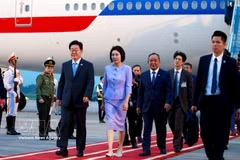
President of the Republic of Korea (RoK) Lee Jae Myung and his spouse arrive in Hanoi on April 21 afternoon. (Photo: VNA)

Korean President arrives in Hanoi, beginning state visit to Vietnam

The visit is expected to become a special milestone in the 34-year history of diplomatic relations between the two countries, marking the starting point for a strategic leap forward in the bilateral ties amid evolving global dynamics, according to Korean Ambassador to Vietnam Choi Young Sam.

Vietnamese Ambassador to Thailand Pham Viet Hung (middle) at the discussion. (Photo: VNA)

Vietnam pushes people-centred priorities for Asia-Pacific at UNESCAP

Vietnam remains firmly committed to multilateralism and the United Nations’ central role in global governance. It appreciates UNESCAP’s role in translating global commitments into concrete regional action and cooperation, sharing best practices, supporting evidence-based policymaking and tackling emerging challenges.

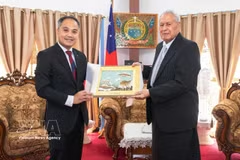
Vietnamese Ambassador to New Zealand Phan Minh Giang (L), who is concurrently in charge of Samoa, presents his credentials to Head of the Independent State of Samoa Tuimalealiifano Va’aletoa Sualauvi II in Apia on April 21. (Photo: VNA)

Vietnam seeks to deepen ties with South Pacific partners

The diplomat voiced his confidence that with joint efforts, bilateral relations will continue to grow, particularly in areas of shared interest and strength. He also underscored the importance of enhancing coordination and mutual support at regional and international multilateral forums.

Party General Secretary and State President To Lam, and leaders of Ha Tinh province. (Photo: VNA)

Ha Tinh must leverage advantages, ignite growth aspiration: Top leader

During a local working session with the standing board of the provincial Party Committee on April 21, Party General Secretary and State President To Lam urged Ha Tinh to fully recognise both the responsibility and honour of a land rich in tradition, thereby fueling an even stronger development drive.

A high-ranking military delegation from the Vietnamese Ministry of National Defence visits an exhibition booth (Photo: Ministry of National Defence)

Vietnam attends defence services, security exhibitions in Malaysia

This year’s exhibitions feature 15 thematic categories, highlighting modern military products such as aircraft, warships, armoured vehicles, man-portable low-range missile systems, anti-aircraft gun systems, laser weapons, as well as various types of ammunition, military uniforms, and logistics equipment serving defence purposes.

Deputies in a group discussion (Photo: VNA)

Lawmakers suggest groundbreaking mechanisms to revive Vietnamese culture

The draft resolution seeks to lure more investment into cultural industries, aiming for the sector to contribute 7% to GDP by 2030 and 9% by 2045. It also sets ambitious goals of ranking Vietnam among the top three countries in Southeast Asia and the global top 30 for national soft power.