China–Vietnam cooperation reaching new heights: Chinese expert

With continued high-level guidance, deeper strategic trust, expanded mutually beneficial cooperation and stronger public support, the building of the China–Vietnam community with a shared future is expected to make steady and substantive progress.

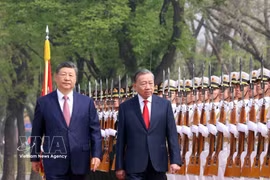
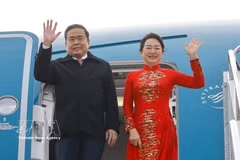
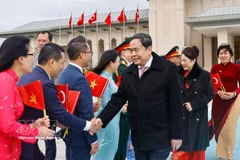
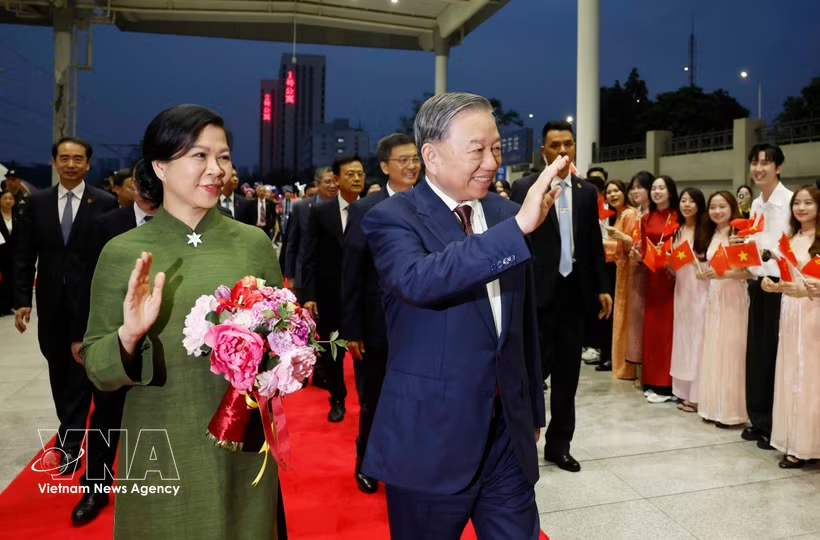
General Secretary of the Communist Party of Vietnam Central Committee and State President To Lam and his spouse Ngo Phuong Ly visit Nanning city as part of their state visit to China. (Photo: VNA)

Beijing (VNA) – Cooperation between China and Vietnam is advancing to a new level, driven by shared strategic interests, development needs and a common responsibility for regional stability, according to a Chinese scholar.

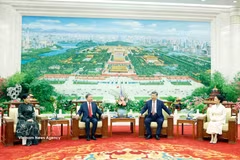
Writing in the Global Times, a publication affiliated with the People's Daily, Lei Xiaohua, a researcher at the Guangxi Academy of Social Sciences, highlighted the outcomes of the recent state visit to China by General Secretary of the Communist Party of Vietnam Central Committee and State President To Lam from April 14–17.

During the visit, the two countries issued a joint statement on further deepening the Vietnam-China Comprehensive Strategic Cooperative Partnership and advancing the building of a China–Vietnam community with a shared future that carries strategic significance at a higher level, signaling an acceleration of bilateral ties into a new phase.

According to the author, profound changes in the international environment, marked by rising unilateralism and protectionism, shifts in global supply chains, intensifying geopolitical competition, and growing uncertainties, have made regional stability and strategic cooperation more critical than ever. In this context, enhancing strategic exchanges and deepening cooperation between the two countries is both necessary for their respective modernisation efforts and essential for addressing shared challenges.

The article identifies four key dimensions underpinning the elevation of bilateral cooperation. First, political trust has reached a higher level. The joint statement underscores shared aspirations and a common future, stating that the development of China–Vietnam relations carries strategic, comprehensive, and historical significance. It also affirms that “building the China–Vietnam community with a shared future that carries strategic significance at a higher level” as the general orientation for bilateral relations in the new phase. This indicates that upgrading China–Vietnam cooperation begins with further strengthening the positioning of the relationship and mutual strategic trust.

Second, strategic connectivity has been enhanced. The joint statement outlines concrete pathways, including aligning the Belt and Road Initiative with the “Two Corridors, One Economic Belt” framework, boosting bilateral trade connectivity with infrastructure, logistics and market linkages, and accelerating cross-border transport connectivity. Railway cooperation, in particular, is expected to become a new highlight of strategic collaboration.

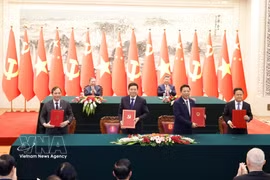
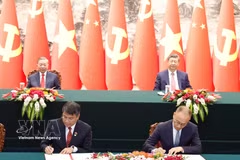
Third, cooperation content has expanded in both scope and quality. A total of 32 cooperation agreements were signed during this visit across sectors such as economy, supply chains, customs, science and technology, human resources and social development. The emphasis is shifting from scale expansion to quality enhancement and modernisation, with science, technology and innovation identified as key drivers.

Fourth, public support has been strengthened. Both sides are promoting people-to-people exchanges through initiatives such as youth programmes, cultural forums and tourism cooperation, with a view to transforming traditional friendship into broader, more stable and sustainable social consensus, Lei wrote.

The researcher further noted that the elevation of China–Vietnam relations carries broader significance. It contributes to regional peace and stability, reinforces commitment to multilateralism and an international order centred on the United Nations, and makes important contributions to regional stability and prosperity amid global uncertainties.

In conclusion, the article emphasised that elevating bilateral cooperation is an inevitable choice to meet global shifts, regional dynamics and the evolving needs of both countries. With continued high-level guidance, deeper strategic trust, expanded mutually beneficial cooperation and stronger public support, the building of the China–Vietnam community with a shared future is expected to make steady and substantive progress./.
VNA

See more

General Secretary of the Communist Party of Vietnam Central Committee and State President To Lam speaks at at a working session in Hanoi on May 21, 2026. (Photo: VNA)

Top leader calls for development of green, sustainable, self-reliant materials industry

Vietnam’s materials industry has recorded important progress in recent years. Sectors such as steel, cement, construction materials, basic chemicals, fertilisers, plastics, rubber, textiles and industrial wood processing have developed rapidly. Vietnam also possesses significant reserves of rare earths, bauxite, titanium, tungsten, graphite, silica sand and limestone.

☕ Afternoon briefing on May 21

☕ Afternoon briefing on May 21

A meeting of the standing board of the Central Steering Committee on Science, Technology, Innovation and Digital Transformation, Vietnam's participation in the 23rd ASEAN Chiefs of Defence Forces Meeting, and the opening of a series of international exhibitions on the automotive industry and transport infrastructure are among news highlights on May 21.

General Nguyen Tan Cuong attends the 23rd ASEAN Chiefs of Defence Forces Meeting (ACDFM-23) on May 21. (Photo: qdnd.vn)

Vietnam pledges to contribute more to adaptive, future-ready ASEAN

General Nguyen Tan Cuong highly valued the meeting’s theme – “Navigating Our Future, Together”, describing it as timely and reflective of ASEAN’s aspiration for solidarity, shared development and a prosperous community actively and effectively responding to present and future challenges.

Party General Secretary and State President To Lam chairs the meeting of the standing board of the Central Steering Committee on Science, Technology, Innovation and Digital Transformation in Hanoi on May 21. (Photo: VNA)

Top leader calls for strategic quantum technology development plan

Party General Secretary and State President To Lam emphasised that quantum technology is an entirely new, highly complex and rapidly evolving field closely linked to science and technology, national security, digital transformation, strategic industries and the country’s long-term competitiveness.

Deputy Minister of National Defence Sen. Lieut. Gen. Pham Hoai Nam (second from right) and delegates cut the ribbon to open IDEB 2026 (Photo: Vietnamese Embassy in Slovakia)

Vietnam attends international defence, security exhibition in Slovakia

A delegation from the Vietnam’s Ministry of National Defence led by its Deputy Minister Sen. Lieut. Gen. Pham Hoai Nam, has paid a working visit to Slovakia and attended the International Defence and Security Exhibition (IDEB 2026) at the invitation of the Slovak Ministry of Defence.

☀️ Morning digest on May 21

☀️ Morning digest on May 21

Party General Secretary and State President To Lam's meeting with the Party Committee of the Ministry of Health to look into traditional medicine, PM Le Minh Hung's phone talks with his New Zealand counterpart Christopher Luxon, and the 2026 Ho Chi Minh City – RoK investment cooperation and business networking forum are among news highlights on May 20 evening.

Prime Minister Le Minh Hung (R) hosts the UK's Ambassador to Vietnam Iain Frew in Hanoi on May 20 (Photo: VNA)

Vietnam attaches great importance to ties with UK: PM

Prime Minister Le Minh Hung suggested that the two countries work together towards raising bilateral trade turnover to 10 billion USD in 2026 and eventually 15 billion USD through expanded market access for each other’s goods.

Prime Minister Le Minh Hung (right) and Ambassador of the Democratic People’s Republic of Korea (DPRK) to Vietnam Ri Sung Guk at their meeting on May 20 (Photo: VNA)

Prime Minister receives DPRK Ambassador

Prime Minister Le Minh Hung affirmed that the Party, State and people of Vietnam always attach importance to and wish to continuously nurture and promote the Vietnam–DPRK relationship in a more substantive and effective manner in the new development era, in line with the common aspirations of the two peoples and contributing to peace, stability, cooperation and development in the region and the world.

Prime Minister Le Minh Hung (right) and Cuban Ambassador to Vietnam Rogelio Polanco Fuentes at their meeting on May 20 (Photo: VNA)

PM vows to deepen Vietnam-Cuba special ties

At a reception for Cuban Ambassador to Vietnam Rogelio Polanco Fuentes in Hanoi on May 20, Prime Minister Le Minh Hung stressed that the Party, Government and people of Vietnam always remember and treasure the solidarity and wholehearted support that the Party, Government and people of Cuba have extended to Vietnam during its past struggle for national liberation as well as the current cause of national construction and development.

Prime Minister Le Minh Hung has a phone conversation with New Zealand’s Prime Minister Christopher Luxon on May 20 (Photo: VNA)

PM holds phone talks with New Zealand counterpart

Prime Minister Le Minh Hung proposed six major orientations for future collaboration, including further strengthening political trust through increased delegation exchanges, high-level contacts and bilateral cooperation mechanisms, and promoting more substantive defence and security cooperation through enhanced exchanges and stronger naval and maritime security capabilities.

National Assembly Chairman Tran Thanh Man addresses the working session on May 20 (Photo: VNA)

NA leader urged more substantive, professional deputy affairs work

National Assembly Chairman Tran Thanh Man asked the NA Committee for Deputy Affairs to shift strongly from procedural consultation to strategic consultation, moving beyond the mindset of merely “following procedures correctly” towards policy design, process standardisation, quality control and forecasting.

General Secretary of the Communist Party of Vietnam Central Committee and State President To Lam speaks at the working session in Hanoi with the Party Central Committee’s Commission for Policies and Strategies and relevant agencies on assessing national development resources. (Photo: VNA)

Top leader orders decisive action to unlock idle resources for growth

Public resources must lead and activate private resources, while public investment should stimulate broader social investment. FDI, meanwhile, should move from quantity-based attraction toward quality-based absorption linked with technology transfer and stronger domestic linkages, said top leader To Lam.

Prof. Dr. Nguyen Xuan Thang speaks at the event. (Photo: VNA)

Editorial team meets to begin review of 100-year Party leadership

Politburo member Prof. Dr. Nguyen Xuan Thang described the review as a major strategic political task, adding that the process must deliver historical depth, theoretical vision, and strategic foresight to guide Vietnam toward fast and sustainable development in the decades ahead.