Deputy PM orders sweeping administrative reform, cutting red tape by half

The Ministry of Finance and the central bank must take full responsibility before the Government and the Prime Minister, stressing that agencies must not cite sector-specific characteristics as a reason to delay or avoid reform, said Deputy PM Nguyen Van Thang.

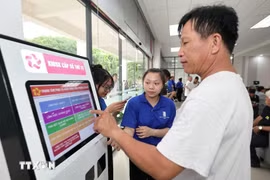
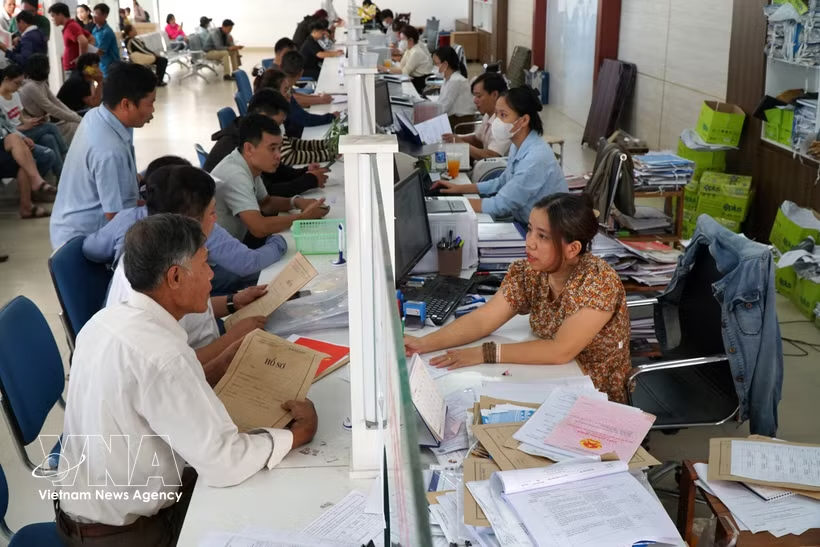
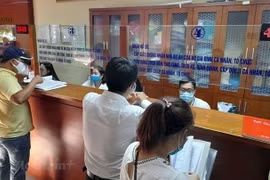
People come to do procedures at the “one-stop shop” of the People’s Committee of Hoa Vang district, Da Nang city. (Photo: VNA)

Hanoi (VNA) – Deputy Prime Minister Nguyen Van Thang has instructed the Ministry of Finance (MoF) and the State Bank of Vietnam (SBV) to urgently review and incorporate feedback from relevant ministries to finalise plans to decentralise administrative procedures, halve compliance costs and processing time, and eliminate all unnecessary business conditions.

Chairing a working session in Hanoi on April 20 with the two agencies, Deputy PM Thang emphasised that reform efforts must be substantive and aligned with the Government’s directive to streamline regulations and improve the business environment.

He called on the MoF and the central bank to take full responsibility before the Government and the Prime Minister, stressing that agencies must not cite sector-specific characteristics as a reason to delay or avoid reform.

The official called on the MoF and the central bank to take full responsibility before the Government and the Prime Minister, stressing that agencies must not cite sector-specific characteristics as a reason to delay or avoid reform.

The two bodies were asked to absorb reasonable opinions from the Ministry of Justice, the Ministry of Public Security, the Ministry of Home Affairs, and the Ministry of Science and Technology to finalise plans for decentralising administrative procedures. These include reducing at least 50% of administrative compliance costs and processing time, and scrapping 100% of unnecessary business conditions. The revised proposals must be submitted to the Ministry of Justice immediately after the meeting.

The two agencies were also requested to closely coordinate with the Ministry of Justice and the Ministry of Finance in drafting and finalising resolutions of the Government on reducing, decentralising, and simplifying administrative procedures.

Separately, the Ministry of Finance is tasked with leading the development of plans to reduce conditional business sectors, also to be finalised in April 2026 in accordance with Document No. 423 issued by the Prime Minister.

The Minister of Finance and the Governor of the SBV have been directed to take strong and proactive measures to accelerate the digitalisation of administrative records and results, issue electronic outputs in administrative procedures, and, in particular, promote the reuse of digitised data in line with the Government’ requirements.

The Deputy PM requested the Ministry of Justice to study and incorporate relevant recommendations from the SBV and the MoF, and to consolidate them for reporting and submission to the PM for consideration and decision.

He acknowledged the strong efforts made by ministries, particularly the MoF and the central bank, in recent years. However, he pointed out that decentralisation remains limited and some reforms have yet to deliver tangible results, falling short of the ambitious targets set under Conclusion No. 18-KL/TW by the Party Central Committee.

He stressed that while many administrative procedures and business conditions remain in place, reform must focus on removing impractical regulations while separately assessing genuinely necessary sector-specific requirements.

According to a report presented by Deputy Minister of Finance Nguyen Thi Bich Ngoc, as of April 15, 2026, the ministry oversees 738 valid administrative procedures across 25 sectors - one of the largest and most complex portfolios in the Government, directly affecting citizens and businesses.

The Ministry of Finance has proposed reducing the number of business sectors and occupations under its management to seven, reaching a rate of 36.8% (exceeding the target of six sectors, or 30%).

It plans to cut and simplify 821 administrative procedures, with an estimated total reduction in compliance costs of 41.46 trillion VND, accounting for 54.96%, and an estimated reduction in total processing time of 6,678 days, making up 54.35%.

Regarding the State Bank of Vietnam’s 2026 plan, Deputy Governor Pham Tien Dung stated that the number of administrative procedures expected to be cut and simplified is 93, with a projected reduction in processing time of 734 days. In 2025, the central bank reviewed and eliminated 260 out of 260 unnecessary business investment conditions, achieving a 100% rate./.

VNA
See more

The meeting between General Secretary of the Communist Party of Vietnam Central Committee and State President To Lam and Chairman and Chief Executive Officer of Hayleys PLC Mohan Pandithage in Colombo on May 8 (Photo: VNA)

Vietnamese leader hopes for stronger ties with Sri Lanka's Hayleys PLC

General Secretary and President To Lam said that given the complementarity of the two economies and their substantial room for growth, Vietnam wishes to enhance cooperation with major Sri Lankan enterprises, especially those with regional market networks and connectivity capabilities such as Hayleys.

The export of 1.1 million doses of vaccine lumpy skin disease (LSD) to the Republic of Korea marks an important milestone for Vietnam’s veterinary vaccine industry. (Photo: nongnghiepmoitruong.vn)

Vietnamese-made LSD vaccine enters demanding RoK market

The successful research and commercialisation of the LSD vaccine, which has been widely used in the domestic market and is gradually expanding internationally, helps affirm the position of Vietnamese veterinary vaccines globally.

General Secretary of the Communist Party of Vietnam (CPV) Central Committee and State President To Lam addresses the Vietnam – Sri Lanka Trade-Investment-Tourism Cooperation Forum in Colombo on May 8. (Photo: VNA)

Top leader urges stronger Vietnam-Sri Lanka economic connectivity

Vietnam – Sri Lanka cooperation should be viewed within the broader context of the Indian Ocean, South Asia and emerging global supply chains, and the key issue now is not potential, but swift, decisive and effective action, said Vietnam's top leader To Lam.

The meeting between Vietnamese Minister of Industry and Trade Le Manh Hung and representatives from Essar Group (Photo: VNA)

Vietnam, India step up cooperation in energy, biofuels

Vietnam encourages capable investors to participate in oil and gas, energy and energy infrastructure projects in line with the national energy development strategy, while ensuring investment efficiency and compliance with Vietnamese law.

In the first four months of 2026, total FDI inflows into Vietnam reaches 18.24 billion USD, up 32% year-on-year. (Illustrative photo: VNA)

Vietnam draws stronger foreign investment inflows despite global headwinds

In the first four months of 2026, total FDI inflows into Vietnam reached 18.24 billion USD, up 32% year-on-year. Disbursed capital was estimated at more than 7.4 billion USD, an increase of 9.8% and the highest four-month disbursement level recorded in the past five years, reflecting effective implementation of many registered projects.

A Boeing 787 aircraft of Vietnam’s national flag carrier, Vietnam Airlines, lands on its first flight at Long Thanh International Airport. (Photo: VNA)

Deputy PM stresses strategic, synchronous planning for airport system

The national airport system planning was approved by the Prime Minister under Decision No. 648/QD-TTg dated June 7, 2023. Under the planning, 30 airports (14 international and 16 domestic) are to be developed during the 2021–2030 period, with a vision to 2050 expanding the network to 33 airports (14 international and 19 domestic).

Modern machinery improves labour productivity. (Photo: VNA)

Upskilling becomes key lever for Vietnamese workforce in digital era

As the economy is pivoting to a growth model fueled by knowledge, technology and innovation, the working class, or the backbone of production, demands better professional qualifications, vocational skills, industrial discipline and work habits. Timely adaptation is the only shield against being undercut by accelerating automation, artificial intelligence and increasingly fiercer global competition.

A circular organic farming model in Khanh Hoa is delivering initial economic efficiency. (Photo: VNA)

New growth potential unlocked for Vietnamese economy

Prime Minister Le Minh Hung once stressed that cutting administrative procedures and business conditions remains one of the fastest and most effective ways to stimulate growth and strengthen confidence among citizens and enterprises. He underscored that the reform process must remain continuous and responsive to practical requirements.