Deputy PM pushes for swift rollout of strategic technology list

The list will serve as a legal and scientific basis to design policies and incentives to support entities and enterprises engaged in strategic tech development.

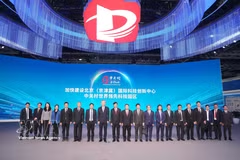
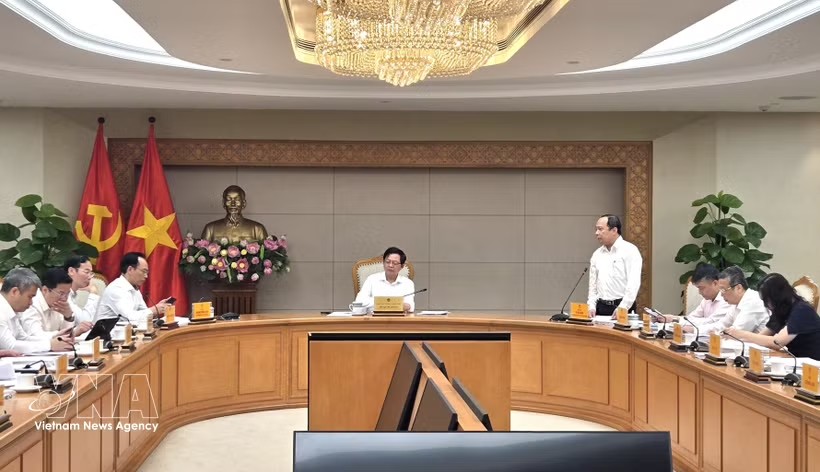
The meeting chaired by Deputy Prime Minister Ho Quoc Dung in Hanoi on April 20 (Photo: VNA)

Hanoi (VNA) – Deputy Prime Minister Ho Quoc Dung chaired a meeting in Hanoi on April 20 to review the list of strategic technologies and tech products, pressing for immediate rollout once approved.

Identifying major challenges tied to strategic techs

The rollout of strategic technology and product list follows directives from Party and State leaders, in line with the Prime Minister’s decision dated June 12, 2025, and aims to activate the amended Law on High Technology. The list will serve as a legal and scientific basis to design policies and incentives to support entities and enterprises engaged in strategic tech development.

Priority technologies will be selected based on three key criteria, including the need to sharpen economic competitiveness, capitalise on domestic industry strengths and potential, and build robust value chains and markets for tech products.

The proposed framework splits strategic technologies into two groups: those with ready markets and immediate impact, including agriculture, processing industries, apparel, construction, steel, and energy; and those poised to fuel future growth, such as foundational and security-related fields such as quantum technology, missile systems, small nuclear reactors, the low-altitude space economy, small satellites, and unmanned aerial vehicles (UAVs).

Minister of Science and Technology Vu Hai Quan said the ministry has worked closely with relevant agencies to compile the list, covering key sectors such as digital technology, biomedicine, advanced materials, energy, and automation.

Several ministries and agencies identified major real-world challenges tied to strategic technologies, contributing to digital transformation, improved governance, and greater production efficiency. Concrete results include sector-specific virtual assistants, digital mapping of raw material zones, and blockchain-based agricultural traceability systems.

Vietnam has made early inroads in mastering core technologies. Universities and research institutes have begun setting up specialised hubs in artificial intelligence (AI), semiconductors, and new energy. Localisation rates have climbed, hitting about 50% in industrial robotics and nearly 80% in machine vision and AI systems.

Domestic companies are advancing toward technological self-reliance. Achievements include initial breakthroughs in quantum technologies, over 50% localisation in AI-powered surveillance cameras, and about 85% mastery of core 5G technologies by Viettel. Other gains cover autonomous robots for logistics and manufacturing, roughly 70% localisation in UAV technologies, and progress in natural language processing and digital infrastructure.

Accelerating review and rollout

Deputy PM Dung described strategic technologies and tech products as critical drivers for socio-economic growth in the new development phase.

According to him, ministries and agencies have actively reviewed and proposed revisions to the list, in line with directives from Party General Secretary and State President To Lam, who also heads the Central Steering Committee for science, technology, innovation, and digital transformation.​

Dung called for careful evaluation of Vietnam’s comparative advantages, the potential to build value chains and markets, and the imperative to concentrate resources on truly strategic sectors while steering clear of scattered and inefficient spending.

Ministries and agencies were urged to promptly review, adjust, and finalise their proposed lists for submission to competent authorities. Other specific tasks were also assigned to relevant ministries.

The leader demanded the formation of an inter-ministerial task force by late April, together with the formal submission and issuance of the strategic tech list. Ministries must then propose dedicated funding allocations./.

VNA

See more

Phuc Loi ward in Hanoi has launched the “Digital Literacy for All” movement, forming support teams to help residents install applications such as iHanoi and eTax. (Photo: VNA)

Hanoi advances technological innovation in key economic sectors

The municipal People's Committee recently issued Plan No. 109/KH-UBND on technological innovation in key economic sectors through 2035, which serves as both a catalyst and a strategic move to systematise, elevate and reinforce the capital’s leading role in the digital era.

General Secretary of the Communist Party of Vietnam (CPV) Central Committee and State President To Lam (first, right, front row) listens to a presentation about the China-ASEAN AI Application Cooperation Centre (Photo: VNA)

Top Vietnamese leader visits China–ASEAN AI Application Cooperation Centre

The China–ASEAN AI Application Cooperation Centre, jointly established by the Guangxi Zhuang Autonomous Region and ASEAN countries, aims to promote inclusive and mutually beneficial development of AI globally. It is regarded as a flagship project in advancing the “Digital Silk Road” initiative in Nanning.

A view of the 224th session of the UNESCO Executive Board in Paris. (Photo: VNA)

UNESCO extends recognition of 2 Category II science centres in Vietnam

The continued operation and enhancement of the two Category II centres under UNESCO’s auspices reflect Vietnam’s policy of positioning science, technology and innovation as key drivers of development, while closely linking scientific advancement with deeper and more substantive international integration in the current context.

China–ASEAN Artificial Intelligence Application Cooperation Centre deeply integrates future technologies with distinctive ASEAN cultural characteristics. (Photo: VNA)

China–ASEAN AI cooperation centre drives regional tech cooperation

With strong policy support and growing participation from businesses and research institutions, the China–ASEAN Artificial Intelligence (AI) Application Cooperation Centre is expected to act as a digital bridge, promoting technological integration and opening new avenues for Vietnam–China cooperation in the digital era.

Politburo member and Chairman of the Party Central Committee’s Organisation Commission Nguyen Duy Ngoc (ninth, left) and the Vietnamese delegation pose for a group photo with leaders of the Zhongguancun Science Park and Beijing city. (Photo: VNA)

Vietnam, China step up cooperation in science, technology, innovation

Politburo member and Chairman of the Party Central Committee’s Organisation Commission Nguyen Duy Ngoc, who also serves as Standing Deputy Head of the Central Steering Committee for the Development of Science, Technology, Innovation and Digital Transformation, toured the park’s exhibition area and was briefed on the formation and development of Zhongguancun, along with Beijing’s achievements in science, technology and innovation.

A technician from Viettel Bac Ninh examines equipment at a 5G base transceiver station. (Photo: VNA)

Bac Ninh accelerates development of 5G, data infrastructure

In the first quarter, Bac Ninh’s telecommunications infrastructure continued to develop in a synchronous manner. All communes have been connected to dedicated data transmission networks, and 100% of the population is covered by mobile services.

Illustrative photo (Photo: VNA)

An Giang identifies key tasks in science-technology development

The priorities focus on four pillars: science and technology, innovation, digital transformation, and real-world applications to boost socio-economic development. These are expected to create breakthroughs in governance, production, and daily life.

Illustrative image (Photo: VNA)

Vietnam Research Excellence Fellowship for 2026-2030 approved

Under the Vietnam Research Excellence Fellowship (VREF) for the 2026–2030 period, PhD students are identified as a core research force directly contributing to breakthroughs in sci-tech and innovation. Investing in top-tier doctoral candidates is more than workforce development, but a high-stakes strategic bet to forge a cohort of world-class scientists and technologists who can power Vietnam’s long-term economic ambitions.

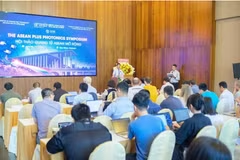
Participants in the ASEAN Plus Photonics Symposium in Gia Lai province on April 8 (Photo: baogialai.com.vn/)

Gia Lai province hosts ASEAN Plus Photonics Symposium

Participants presented and discussed a wide range of advanced topics shaping the future of photonics, including nanophotonics and metasurfaces; topological and non-Hermitian photonics; photonic crystals and optical lattices; light–matter interactions and polariton systems.

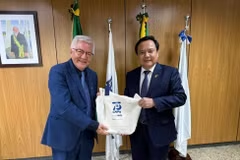
Vietnamese Ambassador to Brazil Bui Van Nghi (right) and Professor and quantum physicist Olival Freire Juniorin, President of Brazil's National Council for Scientific and Technological Development, at their meeting on April 7. (Photo: Vietnamese Embassy in Brazil)

Vietnam, Brazil to strengthen cooperation in science, technology

Ambassador Bui Van Nghi expressed Vietnam’s interest in strengthening cooperation with Brazil in areas such as renewable energy and environmental technologies, as well as high-tech sectors including artificial intelligence (AI), quantum technology, and the semiconductor industry.