Top Vietnamese leader visits China–ASEAN AI Application Cooperation Centre

The China–ASEAN AI Application Cooperation Centre, jointly established by the Guangxi Zhuang Autonomous Region and ASEAN countries, aims to promote inclusive and mutually beneficial development of AI globally. It is regarded as a flagship project in advancing the “Digital Silk Road” initiative in Nanning.
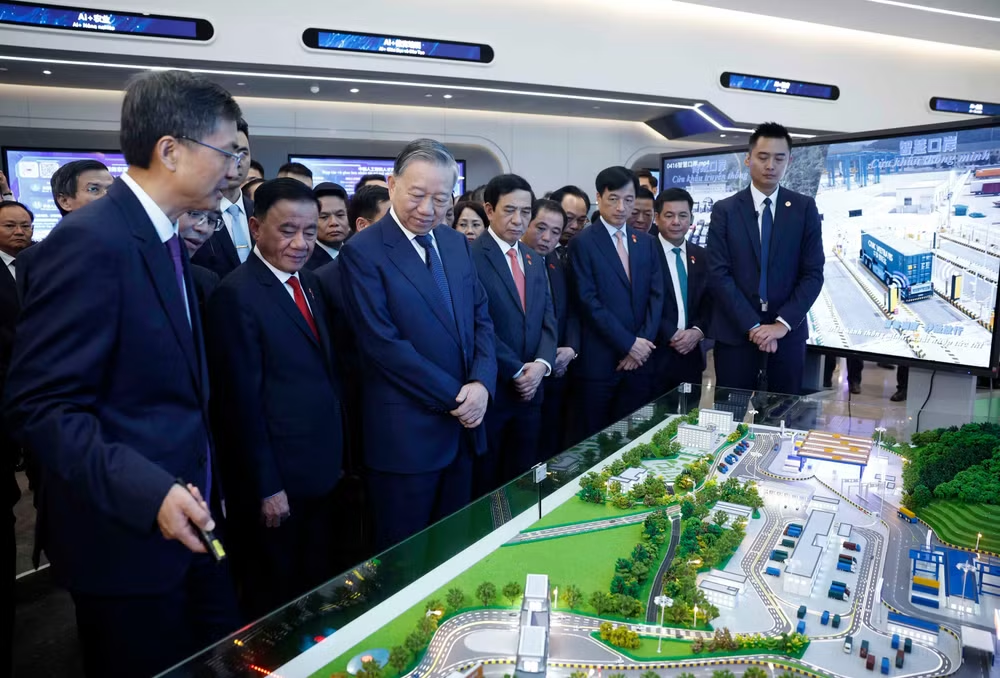
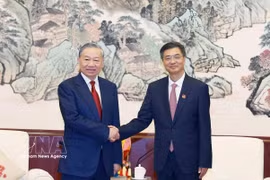
General Secretary of the Communist Party of Vietnam (CPV) Central Committee and State President To Lam (first, right, front row) listens to a presentation about the China-ASEAN AI Application Cooperation Centre (Photo: VNA)

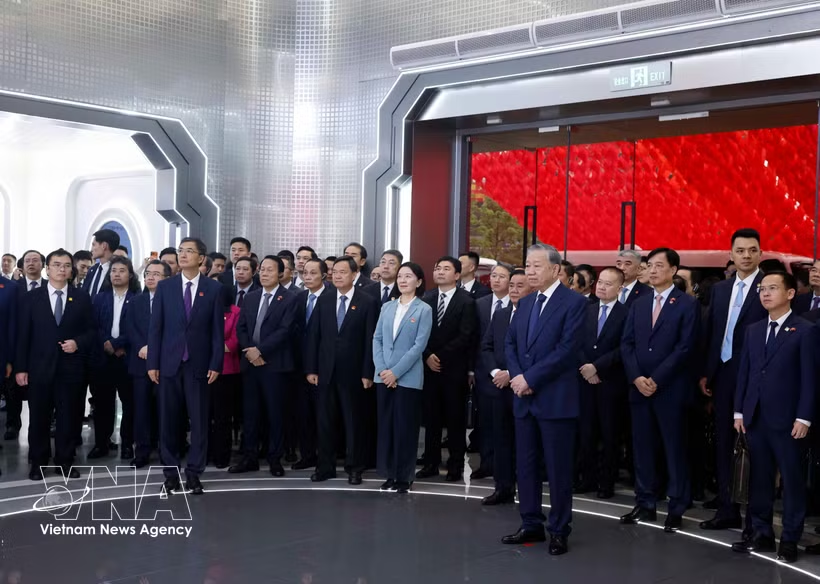
Nanning (VNA) – General Secretary of the Communist Party of Vietnam (CPV) Central Committee and State President To Lam, along with a high-ranking Vietnamese delegation, visited the China–ASEAN AI Application Cooperation Centre in Nanning city, the Guangxi Zhuang Autonomous Region, on April 17, as part of his ongoing state visit to China.

Chen Gang, member of the Communist Party of China (CPC) Central Committee, Secretary of the CPC Committee, and Chairman of the Standing Committee of the People’s Congress of the Guangxi Zhuang Autonomous Region, accompanied the Vietnamese leader and delegation during their tour of an exhibition on China–Vietnam cooperation in AI applications, as well as a showcase of outstanding AI-powered products developed by Chinese enterprises.

The China–ASEAN AI Application Cooperation Centre, jointly established by the Guangxi Zhuang Autonomous Region and ASEAN countries, aims to promote inclusive and mutually beneficial development of AI globally. It is regarded as a flagship project in advancing the “Digital Silk Road” initiative in Nanning.

ai-centre2.jpg
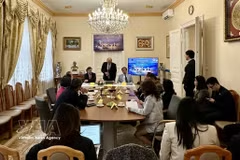
General Secretary of the Communist Party of Vietnam (CPV) Central Committee and State President To Lam (third, left) and delegates at the China-ASEAN AI Application Cooperation Centre on April 17 (Photo: VNA)

On June 30, 2025, the centre commenced operation of Phase 1, covering a total area of 7.78 sq.km.

The centre facilitates capable Chinese enterprises in tapping into the potential and demand of the ASEAN countries, while working with partner countries to promote AI applications across sectors such as agriculture, healthcare, tourism, education, finance, and logistics, in line with each country’s specific needs. It also focuses on training AI human resources.

By the end of 2025, a total of 51 projects in China and 16 others in ASEAN countries had been signed under this framework. The centre is expected to establish additional branches in other cities across China and ASEAN. On November 26, 2025, Hanoi and Guangxi signed a memorandum of understanding to jointly study the development of a Vietnam–China AI application cooperation centre./.

VNA

See more

A view of the 224th session of the UNESCO Executive Board in Paris. (Photo: VNA)

UNESCO extends recognition of 2 Category II science centres in Vietnam

The continued operation and enhancement of the two Category II centres under UNESCO’s auspices reflect Vietnam’s policy of positioning science, technology and innovation as key drivers of development, while closely linking scientific advancement with deeper and more substantive international integration in the current context.

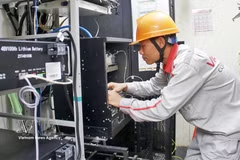
A technician from Viettel Bac Ninh examines equipment at a 5G base transceiver station. (Photo: VNA)

Bac Ninh accelerates development of 5G, data infrastructure

In the first quarter, Bac Ninh’s telecommunications infrastructure continued to develop in a synchronous manner. All communes have been connected to dedicated data transmission networks, and 100% of the population is covered by mobile services.

Illustrative photo (Photo: VNA)

An Giang identifies key tasks in science-technology development

The priorities focus on four pillars: science and technology, innovation, digital transformation, and real-world applications to boost socio-economic development. These are expected to create breakthroughs in governance, production, and daily life.

Illustrative image (Photo: VNA)

Vietnam Research Excellence Fellowship for 2026-2030 approved

Under the Vietnam Research Excellence Fellowship (VREF) for the 2026–2030 period, PhD students are identified as a core research force directly contributing to breakthroughs in sci-tech and innovation. Investing in top-tier doctoral candidates is more than workforce development, but a high-stakes strategic bet to forge a cohort of world-class scientists and technologists who can power Vietnam’s long-term economic ambitions.

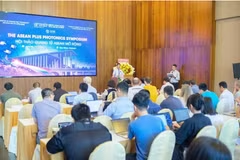
Participants in the ASEAN Plus Photonics Symposium in Gia Lai province on April 8 (Photo: baogialai.com.vn/)

Gia Lai province hosts ASEAN Plus Photonics Symposium

Participants presented and discussed a wide range of advanced topics shaping the future of photonics, including nanophotonics and metasurfaces; topological and non-Hermitian photonics; photonic crystals and optical lattices; light–matter interactions and polariton systems.

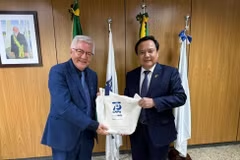
Vietnamese Ambassador to Brazil Bui Van Nghi (right) and Professor and quantum physicist Olival Freire Juniorin, President of Brazil's National Council for Scientific and Technological Development, at their meeting on April 7. (Photo: Vietnamese Embassy in Brazil)

Vietnam, Brazil to strengthen cooperation in science, technology

Ambassador Bui Van Nghi expressed Vietnam’s interest in strengthening cooperation with Brazil in areas such as renewable energy and environmental technologies, as well as high-tech sectors including artificial intelligence (AI), quantum technology, and the semiconductor industry.

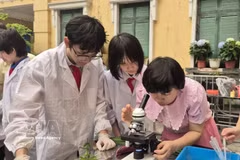
Teachers guide students in experiencing the application of science (Photo: VNA)

Results become benchmark for science-technology governance

The transition to facilitative governance marks not only an operational reform but also a shift in development thinking. With expanded autonomy and controlled risk acceptance, science, technology, innovation and digital transformation are expected to become key drivers of rapid and sustainable growth in the years ahead.

Students experience robotic products (Photo: VNA)

AI powers sweeping overhaul of Vietnam’s education system

Nguyen Son Hai, Deputy Director General of the Department of Information and Communication Technology under the Ministry of Education and Training (MoET), said the sector has made rapid strides in digital transformation, from online classes during the COVID-19 pandemic to nationwide platforms covering the national education database, registration for high school graduation exam, and online university admissions.