Vietnam fast-tracks crypto asset market piloting

The Vietnamese Government plans to pilot exchanges for crypto and digital assets starting from the second quarter of 2026, as part of efforts to bring the emerging market into operation.

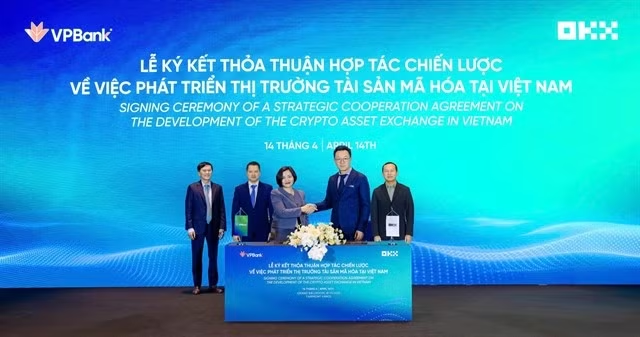
Representatives of VPBank and OKX sign the strategic memorandum of understanding. —(Photo courtesy of VPBank)

Hanoi (VNA) - The sprint toward piloting Vietnam’s crypto asset market is heating up, driven by the formal entry of international exchanges and the rapid rollout of tax and accounting frameworks, paving the way for the market to begin operations.

A notable catalyst is the strategic partnership between VPBank and OKX, one of the world’s leading digital asset platforms. Under a memorandum of understanding (MoU) signed on April 14, OKX will work closely with VPBank to provide strategic advice, share operational expertise, deliver technology solutions and facilitate compliant liquidity connections for the digital asset trading platform operated by Vietnam Prosperity Crypto Asset Exchange JSC (CAEX), a member of VPBank’s ecosystem. At the same time, OKX, through its investment arm OKX Ventures, will inject capital into CAEX, enabling the company to meet the minimum capital requirement of 10 trillion VND (approximately 380 million USD) to participate in Vietnam’s pilot programme for the crypto asset market.

The partnership between VPBank and OKX is drawing strong interest from foreign investors in the digital asset space.

According to Dr. Tran Quy, President of the Vietnam Institute of Digital Economy Development, Chairman of the MetaDAP digital asset platform, the partnership represents more than a single investment, serving instead as a prototype for the market’s future structure. He described it as a pathway for other major players to invest in Vietnam’s digital asset sector.

Vietnam’s regulatory framework sets relatively strict conditions, including a minimum capital requirement of 10 trillion VND, a foreign ownership cap of 49%, and a mandate that at least 65% of capital must come from domestic financial and technology institutions. These rules effectively limit the ability of foreign exchanges to establish wholly owned entities, making joint ventures the most viable route for market entry, Quy said.

Earlier, the Military Commercial Joint Stock Bank (MBBank) also entered into a technical cooperation agreement with Dunamu, the operator of the Upbit exchange, to research and develop a crypto trading model tailored to Vietnam.

Tran Xuan Tien, Secretary General of the Ho Chi Minh City Blockchain Association, said that with their experience, operational technology, and ability to address liquidity and user-related challenges, the participation of international exchanges will help accelerate the pilot process. This, he noted, will offer users faster, more familiar, and more modern experiences.

Legal framework taken shape


Meanwhile, competition to secure pilot licences is intensifying. The Ministry of Finance has confirmed that five out of seven applications for crypto exchange pilots are valid. These include VIX Digital Asset Exchange JSC (VIXEX), Loc Phat Vietnam Crypto Asset Exchange JSC (LPEX), CAEX, Techcom Crypto Exchange JSC (TCEX), and Vietnam Digital Assets JSC.

At a recent policy dialogue on piloting crypto assets hosted by the State Securities Commission (SSC) of Vietnam and the Vietnam Blockchain Association, TCEX General Director Doan Mai Hanh said its system is capable of processing up to 100,000 transactions per second while meeting stringent information security standards. Preparations in asset custody, staffing, and compliance are also underway across applicants.

To obtain licences, candidates must pass regulatory appraisal, including certification from the Ministry of Public Security for level-4 information system safety and proof of meeting the capital threshold, she said.

On the policy front, the legal framework is quickly taking shape. Over March and April, the Ministry of Finance issued a series of circulars guiding key aspects of the market. Experts say these regulations establish a foundational operating environment, with synchronised guidance on accounting standards, taxation policies, and tax compliance procedures, offering clearer rules for businesses and investors.

In a report presented on April 9 at the first session of the 16th National Assembly, Prime Minister Le Minh Hung outlined plans to advance new economic models, with a review and refinement of related mechanisms, policies, and development plans set for completion by the third quarter of 2026. The government also plans to pilot exchanges for crypto and digital assets starting from the second quarter of 2026, as part of efforts to bring the emerging market into operation./.

VNA

See more

Sorting fish prior to transport for distribution. (Photo: VNA)

Fishermen keep pace with digital technology

Across central coastal provinces, authorities have introduced policies to restructure fleets, reduce vessel numbers, and support fishermen in transitioning to more sustainable livelihoods. Provinces such as Dak Lak and Gia Lai have earmarked nearly 1 trillion VND to support occupational changes and decommission inefficient vessels, while others including Nghe An, Quang Tri, Hue, and Quang Ngai are implementing roadmaps to phase out thousands of underqualified boats.

Phuc Loi ward in Hanoi has launched the “Digital Literacy for All” movement, forming support teams to help residents install applications such as iHanoi and eTax. (Photo: VNA)

Hanoi advances technological innovation in key economic sectors

The municipal People's Committee recently issued Plan No. 109/KH-UBND on technological innovation in key economic sectors through 2035, which serves as both a catalyst and a strategic move to systematise, elevate and reinforce the capital’s leading role in the digital era.

General Secretary of the Communist Party of Vietnam (CPV) Central Committee and State President To Lam (first, right, front row) listens to a presentation about the China-ASEAN AI Application Cooperation Centre (Photo: VNA)

Top Vietnamese leader visits China–ASEAN AI Application Cooperation Centre

The China–ASEAN AI Application Cooperation Centre, jointly established by the Guangxi Zhuang Autonomous Region and ASEAN countries, aims to promote inclusive and mutually beneficial development of AI globally. It is regarded as a flagship project in advancing the “Digital Silk Road” initiative in Nanning.

A view of the 224th session of the UNESCO Executive Board in Paris. (Photo: VNA)

UNESCO extends recognition of 2 Category II science centres in Vietnam

The continued operation and enhancement of the two Category II centres under UNESCO’s auspices reflect Vietnam’s policy of positioning science, technology and innovation as key drivers of development, while closely linking scientific advancement with deeper and more substantive international integration in the current context.

China–ASEAN Artificial Intelligence Application Cooperation Centre deeply integrates future technologies with distinctive ASEAN cultural characteristics. (Photo: VNA)

China–ASEAN AI cooperation centre drives regional tech cooperation

With strong policy support and growing participation from businesses and research institutions, the China–ASEAN Artificial Intelligence (AI) Application Cooperation Centre is expected to act as a digital bridge, promoting technological integration and opening new avenues for Vietnam–China cooperation in the digital era.

Politburo member and Chairman of the Party Central Committee’s Organisation Commission Nguyen Duy Ngoc (ninth, left) and the Vietnamese delegation pose for a group photo with leaders of the Zhongguancun Science Park and Beijing city. (Photo: VNA)

Vietnam, China step up cooperation in science, technology, innovation

Politburo member and Chairman of the Party Central Committee’s Organisation Commission Nguyen Duy Ngoc, who also serves as Standing Deputy Head of the Central Steering Committee for the Development of Science, Technology, Innovation and Digital Transformation, toured the park’s exhibition area and was briefed on the formation and development of Zhongguancun, along with Beijing’s achievements in science, technology and innovation.

A technician from Viettel Bac Ninh examines equipment at a 5G base transceiver station. (Photo: VNA)

Bac Ninh accelerates development of 5G, data infrastructure

In the first quarter, Bac Ninh’s telecommunications infrastructure continued to develop in a synchronous manner. All communes have been connected to dedicated data transmission networks, and 100% of the population is covered by mobile services.

Illustrative photo (Photo: VNA)

An Giang identifies key tasks in science-technology development

The priorities focus on four pillars: science and technology, innovation, digital transformation, and real-world applications to boost socio-economic development. These are expected to create breakthroughs in governance, production, and daily life.

Illustrative image (Photo: VNA)

Vietnam Research Excellence Fellowship for 2026-2030 approved

Under the Vietnam Research Excellence Fellowship (VREF) for the 2026–2030 period, PhD students are identified as a core research force directly contributing to breakthroughs in sci-tech and innovation. Investing in top-tier doctoral candidates is more than workforce development, but a high-stakes strategic bet to forge a cohort of world-class scientists and technologists who can power Vietnam’s long-term economic ambitions.