Da Nang targets crypto inflows with bold fintech sandbox push

Da Nang is positioning itself as a billion-dollar fintech sandbox rather than a skyline of skyscrapers, aiming to capture part of a projected 16-trillion-USD digital-asset market.

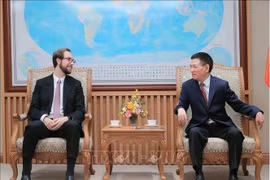
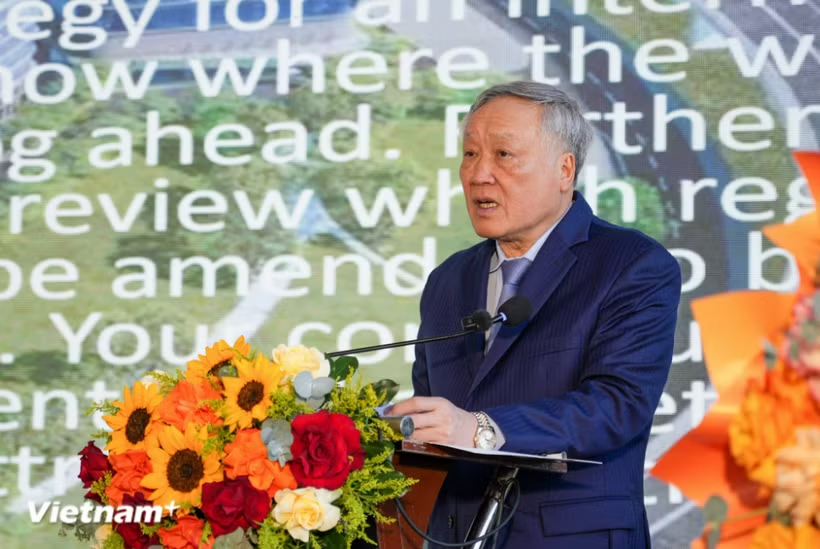
 Permanent Deputy Prime Minister Nguyen Hoa Binh (Photo: VietnamPlus)
Permanent Deputy Prime Minister Nguyen Hoa Binh (Photo: VietnamPlus)

Da Nang (VNA) - Da Nang is positioning itself as a billion-dollar fintech sandbox rather than a skyline of skyscrapers, aiming to capture part of a projected 16-trillion-USD digital-asset market.

As an estimated 220 billion USD in crypto assets flows into Vietnam each year—still largely an “unknown” for regulators, Da Nang has opted for a bold strategy. Backed by the government, Da Nang is prioritising a controlled “sandbox” model for fintech, seeking to become a hub for innovation instead of following the traditional playbook of building financial areas defined by high-rise towers.

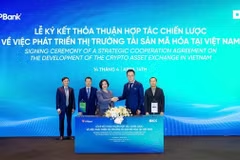
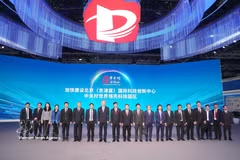
The vision began to take concrete shape on January 9, when the Vietnam International Financial Centre (VIFC) in Da Nang was officially launched at Software Park No. 2. The event marked a shift from institutional preparation to real-world implementation under Decree No. 323/ND-CP.

Addressing the launch ceremony, Permanent Deputy Prime Minister Nguyen Hoa Binh described the VIFC as a strategic move for Vietnam to integrate more deeply into global financial markets and stay ahead of the restructuring of capital flows and value chains.

Within the “one centre, two destinations” strategic framework —closely linked with Ho Chi Minh City—Da Nang is expected to serve as a digital gateway to international markets.

Crucially, the city has been tasked with piloting new models under a clear directive to move away from a “ask-and-give” administrative mindset toward a facilitative and enabling approach. This shift is widely seen as the most important prerequisite for attracting innovative business models with no precedent in Vietnam.

Positioning to capture 16 trillion USD capital flow

Da Nang’s decision to focus on fintech and digital assets is grounded in compelling data. According to Phan Duc Trung, Chairman of the Vietnam Blockchain and Digital Assets Association (VBA), Vietnam consistently ranks among the top countries globally for crypto adoption, with inflows estimated at nearly 220 billion USD between 2023 and 2024.

Globally, the emergence of tokenised real-world assets (RWA)—ranging from real estate to securities and energy—signals a transformative shift. The market is projected to reach over 16 trillion USD by 2030, accounting for roughly 10% of global GDP.

Nguyen Thi Minh Tho, Deputy Director of the Anti-Money Laundering Department at the State Bank of Vietnam, noted that the country’s pilot model prioritises asset-backed tokens tied to real cash flows and tangible cash flows. For instance, rental income from a building could be tokenised and traded, allowing investors to benefit both from token ownership and underlying revenue streams.

By developing digital infrastructure to accommodate such flows, Da Nang aims to reposition Vietnam from a latecomer to an attractive destination in the digital economy era.

Sandbox – “testing of aspirations"

At the core of this strategy is the sandbox mechanism—a controlled legal environment where companies can test new technologies under regulatory supervision. One early participant is PayD JSC – the first member of the VIFC, which offers solutions enabling users to convert digital assets into Vietnamese dong for real-world spending.

Le Duc Hanh, CEO of PayD, said joining the VIFC in Da Nang opens opportunities to collaborate with major financial and technology partners while operating within a transparent legal framework. He emphasised that safety and compliance will remain top priorities of PayD.

The involvement of pioneering firms, alongside cooperation commitments from global players such as Tether, Binance and Bybit, underscores Da Nang’s growing appeal as a hub for a new wave of financial technology innovation./.

VNA

See more

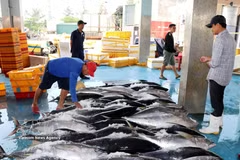
Sorting fish prior to transport for distribution. (Photo: VNA)

Fishermen keep pace with digital technology

Across central coastal provinces, authorities have introduced policies to restructure fleets, reduce vessel numbers, and support fishermen in transitioning to more sustainable livelihoods. Provinces such as Dak Lak and Gia Lai have earmarked nearly 1 trillion VND to support occupational changes and decommission inefficient vessels, while others including Nghe An, Quang Tri, Hue, and Quang Ngai are implementing roadmaps to phase out thousands of underqualified boats.

Phuc Loi ward in Hanoi has launched the “Digital Literacy for All” movement, forming support teams to help residents install applications such as iHanoi and eTax. (Photo: VNA)

Hanoi advances technological innovation in key economic sectors

The municipal People's Committee recently issued Plan No. 109/KH-UBND on technological innovation in key economic sectors through 2035, which serves as both a catalyst and a strategic move to systematise, elevate and reinforce the capital’s leading role in the digital era.

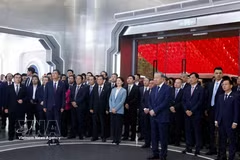
General Secretary of the Communist Party of Vietnam (CPV) Central Committee and State President To Lam (first, right, front row) listens to a presentation about the China-ASEAN AI Application Cooperation Centre (Photo: VNA)

Top Vietnamese leader visits China–ASEAN AI Application Cooperation Centre

The China–ASEAN AI Application Cooperation Centre, jointly established by the Guangxi Zhuang Autonomous Region and ASEAN countries, aims to promote inclusive and mutually beneficial development of AI globally. It is regarded as a flagship project in advancing the “Digital Silk Road” initiative in Nanning.

A view of the 224th session of the UNESCO Executive Board in Paris. (Photo: VNA)

UNESCO extends recognition of 2 Category II science centres in Vietnam

The continued operation and enhancement of the two Category II centres under UNESCO’s auspices reflect Vietnam’s policy of positioning science, technology and innovation as key drivers of development, while closely linking scientific advancement with deeper and more substantive international integration in the current context.

China–ASEAN Artificial Intelligence Application Cooperation Centre deeply integrates future technologies with distinctive ASEAN cultural characteristics. (Photo: VNA)

China–ASEAN AI cooperation centre drives regional tech cooperation

With strong policy support and growing participation from businesses and research institutions, the China–ASEAN Artificial Intelligence (AI) Application Cooperation Centre is expected to act as a digital bridge, promoting technological integration and opening new avenues for Vietnam–China cooperation in the digital era.

Politburo member and Chairman of the Party Central Committee’s Organisation Commission Nguyen Duy Ngoc (ninth, left) and the Vietnamese delegation pose for a group photo with leaders of the Zhongguancun Science Park and Beijing city. (Photo: VNA)

Vietnam, China step up cooperation in science, technology, innovation

Politburo member and Chairman of the Party Central Committee’s Organisation Commission Nguyen Duy Ngoc, who also serves as Standing Deputy Head of the Central Steering Committee for the Development of Science, Technology, Innovation and Digital Transformation, toured the park’s exhibition area and was briefed on the formation and development of Zhongguancun, along with Beijing’s achievements in science, technology and innovation.

A technician from Viettel Bac Ninh examines equipment at a 5G base transceiver station. (Photo: VNA)

Bac Ninh accelerates development of 5G, data infrastructure

In the first quarter, Bac Ninh’s telecommunications infrastructure continued to develop in a synchronous manner. All communes have been connected to dedicated data transmission networks, and 100% of the population is covered by mobile services.

Illustrative photo (Photo: VNA)

An Giang identifies key tasks in science-technology development

The priorities focus on four pillars: science and technology, innovation, digital transformation, and real-world applications to boost socio-economic development. These are expected to create breakthroughs in governance, production, and daily life.

Illustrative image (Photo: VNA)

Vietnam Research Excellence Fellowship for 2026-2030 approved

Under the Vietnam Research Excellence Fellowship (VREF) for the 2026–2030 period, PhD students are identified as a core research force directly contributing to breakthroughs in sci-tech and innovation. Investing in top-tier doctoral candidates is more than workforce development, but a high-stakes strategic bet to forge a cohort of world-class scientists and technologists who can power Vietnam’s long-term economic ambitions.