Ho Chi Minh City (VNA) – A series of Politburo resolutions is placing new demands on Vietnam’s growth model, particularly in Ho Chi Minh City, making it essential to reassess the roles of key economic sectors and improve coordination between the state and the market to sustain rapid and durable growth.
Economists say that in the new development phase, the state and private sectors are not in competition but complement each other within a unified growth ecosystem. The state sector plays a guiding role, ensuring macroeconomic balance, while the private sector acts as a key engine of growth, innovation and global integration. Strengthening institutions to enable both sectors to develop in harmony, in line with Resolutions 68 and 79, will be critical to achieving fast, sustainable growth and elevating Vietnam’s economic standing.
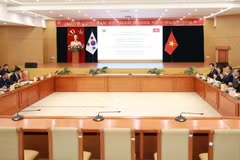
Vice Chairman of the Ho Chi Minh City People’s Committee Nguyen Manh Cuong stressed the need for greater input from academia, experts and businesses to assess the feasibility of double-digit growth targets in the coming period. This will help the city identify new growth drivers and design policies to better tap its development potential.
Experts also highlighted the need for policies to accelerate private sector expansion in high-tech industries, the digital economy and high value-added services, while improving the efficiency of the state sector, particularly in leading infrastructure development, innovation and green transition.
In its next development phase, Ho Chi Minh City aims to maintain its role as Vietnam’s economic locomotive while shifting towards a productivity-driven model powered by science, innovation and digital transformation. It aspires to become a leading regional hub for finance, services and innovation, with a focus on the digital and green economy, high-value industries, stronger regional connectivity, modern infrastructure and improved living standards.
However, challenges remain. Growth has been uneven in recent years, with fluctuations between rapid recovery and slower expansion, while traditional drivers are losing momentum. Labour productivity, though above the national average, has improved slowly without a clear breakthrough.
Total factor productivity, reflecting technological progress and innovation, accounts for only 35–38% of growth, below the city’s target of over 45%, suggesting that science and innovation have yet to fully underpin growth.
Nguyen Ngoc Hoa, Chairman of the Members’ Council of Ho Chi Minh City Finance and Investment Company (HFIC) and head of Ho Chi Minh City Business Association, noted that while the private sector remains dynamic, most enterprises are small, with limited technological capacity and weak participation in global value chains. The innovation ecosystem has yet to produce large-scale technology firms.
Meanwhile, the state sector still requires further restructuring to enhance efficiency, strengthen its leading role and improve coordination with the private sector. Both sectors also face challenges related to infrastructure, digital transformation, workforce quality, regional connectivity and urban governance, highlighting the need for new policy approaches.
Bui Quang Hung of the University of Economics Ho Chi Minh City (UEH) noted that Resolution 68 identifies the private sector as a key growth driver, while Resolution 79 underscores the state sector’s leading and regulatory role, forming two strategic pillars of Vietnam’s socialist-oriented market economy.
In practice, however, the state sector’s efficiency has yet to match its resource base, while private firms still face barriers in accessing development resources, underscoring the need for a more transparent, stable and equitable business environment, particularly in Ho Chi Minh City.
From 2020 to 2025, UEH implemented the “Connecting Community – Sharing Knowledge – Sustainable Action” programme to strengthen links between academia, business and society. Its 2026 events mobilised nearly 14 billion VND (531,700 USD) for education and sustainability, connected over 5,000 quality job opportunities, and attracted more than 60 leading firms across key sectors.
The initiative has since evolved into a platform for co-creating value, forming a broad partnership ecosystem with over 1,500 partners, more than 213 billion VND in scholarships awarded to over 16,000 learners, and thousands of internship and research opportunities. Hung stressed that such collaboration helps generate long-term value, with knowledge-sharing serving as a foundation for sustainable development./.