Domestic conglomerates needed to drive export value growth: Experts

Statistics showed that accounting for over 70% of Vietnam’s total export turnover, the foreign-invested (FDI) sector continues to expand its dominance, underscoring the need for stronger leadership from domestic economic groups to rebalance growth.

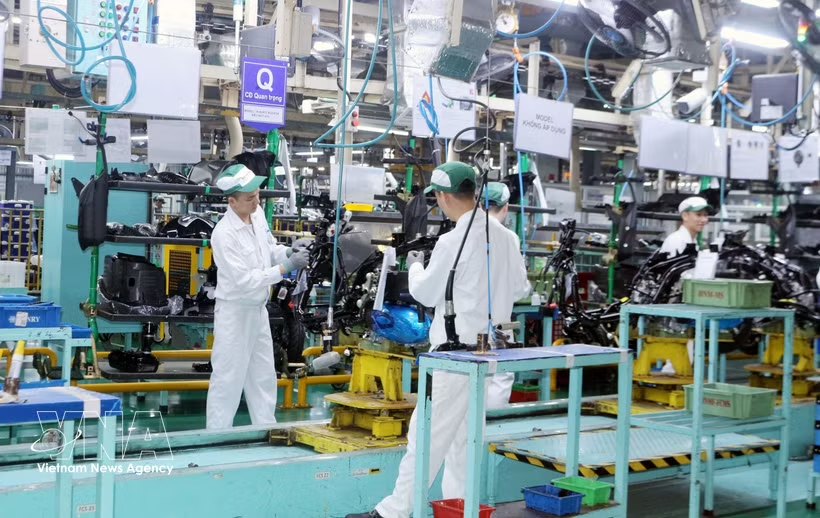
Workers at a factory in Ninh Binh province (Photo: VNA)

Hanoi (VNA) – In order to realise the target of faster and more sustainable growth of the private economic sector experts underlined that greater policy space must be created for domestic private businesses to grow, with particular emphasis on the leading role of large private economic conglomerates.

Statistics showed that accounting for over 70% of Vietnam’s total export turnover, the foreign-invested (FDI) sector continues to expand its dominance, underscoring the need for stronger leadership from domestic economic groups to rebalance growth.

Dau Anh Tuan of the Vietnam Chamber of Commerce and Industry said the FDI share in exports has surpassed 70% with no sign of reversal. If this trend persists, Vietnam risks remaining a “processing hub” for multinational corporations.

Data from the Ministry of Finance’s Foreign Investment Agency showed that in the first quarter of 2026, FDI exports (including crude oil) exceeded 98.4 billion USD, up 33.3% year-on-year and accounting for around 80% of total exports.

According to Dr. Bui Thanh Minh, Vice Director of the Office of the Private Sector Development Research Board (Board IV), Vietnam has achieved high trade openness and export scale, but export capacity and trade surplus remain heavily concentrated in the FDI sector. In 2025, domestic firms contributed just 22.7% of total exports and recorded a trade deficit, while the FDI sector posted a large surplus.

This imbalance highlights that Vietnam’s export success does not fully reflect the strength of domestic enterprises. In many manufacturing industries, local firms remain concentrated in low value-added segments, while higher-value activities -such as design, branding, and distribution - are dominated by foreign companies.

Tuan noted that FDI firms control key links in major industrial value chains. In electronics, corporations like Samsung dominate production and exports; in textiles and footwear, Vietnamese firms largely remain subcontractors; and in sectors such as wood processing and seafood, FDI firms are expanding into areas once held by domestic businesses.

He added that while Vietnam enjoys large trade surpluses with major markets such as the US, EU, Japan, and the Republic of Korea, most exports to these markets are carried out by FDI enterprises.

By comparison, China reduced the FDI share in exports from 58% in 2005 to 27% in 2024, while domestic private firms rose to 65%. Vietnam, however, continues to see FDI dominance increase.

Experts say this poses a major challenge for domestic enterprises, which remain constrained in scale, capital, technology, and market access. In line with the Politburo’s Resolution 68-NQ/TW, which identifies the private sector as a key growth driver, Vietnam aims to build a strong domestic business base capable of leading industrialisation and global integration.

Notably, by 2045, the private sector is targeted to develop rapidly, robustly and sustainably, taking a proactive role in global production and supply chains while achieving strong regional and international competitiveness. The goal is to have at least three million enterprises operating in the economy, contributing over 60% of GDP.

To achieve this, Tuan stressed the need to develop a new generation of private enterprises with technological capacity and leadership in regional and global value chains.

Assoc. Prof. Dr. Pham Manh Hung from the Banking Academy highlighted access to capital as a critical bottleneck, calling for a comprehensive approach combining financial market development, improved corporate capacity, and stronger state coordination.

Meanwhile, Minh emphasised institutional reform as a breakthrough solution. A transparent, stable, and predictable legal framework, ensuring property rights, reducing administrative barriers, and lowering compliance costs, is essential for nurturing large domestic conglomerates.

He added that policies should facilitate market-based capital accumulation and resource concentration, enabling the emergence of enterprises with sufficient scale to compete in high-tech, capital-intensive industries.

Only with such reforms, experts say, can Vietnam’s private sector move from supporting growth to truly leading economic transformation and enhancing the value of its exports./.

VNA

See more

1st floor, No. 05 Ly Thuong Kiet Street

Notice of Office Auction in Hanoi

The Office of the Vietnam News Agency will conduct an auction for office leasing at No. 05 Ly Thuong Kiet street, No. 79 Ly Thuong Kiet street, No. 33 Le Thanh Tong street, and No. 11 Tran Hung Dao street in Cua Nam ward, Hanoi.

The opening ceremony of the Mining & Construction Vietnam 2026 exhibition. (Photo: VNA)

Expo promotes smart mining and green construction solutions in Vietnam

Mining & Construction Vietnam 2026 showcases a wide range of new technologies and trends, including advanced mining equipment, modern mineral processing technologies, sustainable and energy-efficient infrastructure solutions, as well as automation and digital transformation in management and operations.

An aircraft of Vietravel Airlines (Photo: VNA)

Vietravel Airlines moves to add nine aircraft

This aircraft marks the first in a plan to add nine more planes over the next six months. Continued induction of Airbus A321 aircraft throughout 2026 will allow the airline to optimise scheduling, improve efficiency and better meet growing market demand.

The Long Hai Co., Ltd., located in Industrial Cluster No. 1 in Thach Khoi ward, Hai Phong city, produces hundreds of tonnes of goods annually for both domestic consumption and export. (Photo: VNA)

State – private synergy key to Vietnam’s growth ambitions

Vice Chairman of the Ho Chi Minh City People’s Committee Nguyen Manh Cuong stressed the need for greater input from academia, experts and businesses to assess the feasibility of double-digit growth targets in the coming period. This will help the city identify new growth drivers and design policies to better tap its development potential.

Finance Minister Ngo Van Tuan speaks at the first session of the 16th National Assembly (Photo: VNA)

Achieving double-digit growth challenging but essential: Minister

Since 1946, only 13 economies worldwide have sustained double-digit growth for over a decade to transition from low-income and developing to developed status. During Vietnam’s 40 years of renewal, growth has exceeded 9% only twice and has never reached double digits.

Vegetables and fruits remain among the key foreign currency earners of Lam Dong province, with export turnover estimated at 30.42 million USD in the first quarter of 2026. (Photo: VNA)

Vietnam’s fruit sector reaches new milestones

In the first quarter of 2026, Vietnam’s fruit and vegetable exports rose 31.4% year-on-year to 1.53 billion USD, driven by strong demand in China and growing shipments to major markets including the US, Japan, and Europe.

Inside Bach Dang shipbuilding factory (Photo: VNA)

Vietnam's industry spearheads transition to circular economy

The circular economy is no longer just a policy choice. It has become an inevitable trend for delivering sustainable and green growth, sharpening competitiveness at home and abroad, and meeting Vietnam’s net-zero emissions target by 2050. It is now a prerequisite to sustain long-term economic expansion, particularly in industrial production and supporting industries.

Algerian officials, representatives of foreign embassies, and numerous global oil and gas companies attend the Bid Round. (Photo: VNA)

Vietnam joins int'l bidding for oil and gas exploration in Algeria

Currently, PVEP is involved in oil exploitation at Blocks 433a and 416b of the Bir Seba field in the Hassi Messaoud area, Ouargla province, located more than 600 km south of Algiers. The project stands as one of Petrovietnam’s most successful overseas ventures, demonstrating the operational capacity and technical expertise of Vietnamese engineers on the global stage.

A customer is making payment via QR code at a coffee shop. The Ministry of Finance has proposed new regulations on taxable revenue thresholds for household businesses. (Photo: VNA)

Finance ministry eyes flexible tax thresholds

In a draft law amending several articles of the laws on personal income tax, corporate income tax and value-added tax, Vietnam's finance ministry proposed scrapping the fixed revenue threshold of 500 million VND. Instead, it suggested the threshold be set by the Government based on prevailing economic conditions.

Part of the Vung Ang II Thermal Power Plant. (Photo: VNA)

Vung Ang II thermal power plant inaugurated in Ha Tinh

With a total investment of 2.2 billion USD, the Vung Ang II Thermal Power Plant is developed under a build-operate-transfer (BOT) model and has a designed capacity of 1,200 MW, comprising two turbines. The plant is expected to play a key role in ensuring stable electricity supply for the central region and neighbouring areas, thereby facilitating the development of industries, agriculture and services.

Aircraft at the Noi Bai International Airport in Hanoi. (Photo: VNA)

Vietnam seeks stable jet fuel supplies from China amid Middle East disruptions

On the basis of the long-standing friendship and cooperation between Vietnam and China, as well as close ties between their aviation authorities, the Civil Aviation Authority of Vietnam has asked the Civil Aviation Administration of China to direct relevant fuel suppliers to ensure sufficient and stable supplies for Vietnam.

Illustrative photo (Photo: Xinua/VNA)

Remittances to Ho Chi Minh City decline in Q1 amid global headwinds

Data from the State Bank of Vietnam (SBV)'s Region 2 branch showed that remittances transferred through credit institutions and economic organisations in Ho Chi Minh City exceeded 2 billion USD in the January–March period, down 15.6% from the previous quarter and 16.9% year-on-year.