Vietnam turning ideas into value, aspirations into reality

Resolution No. 57 of the Politburo on breakthroughs in science-technology development, innovation, and national digital transformation is being vigorously implemented nationwide. Within this framework, innovation is increasingly recognised as a key engine for rapid and sustainable growth.

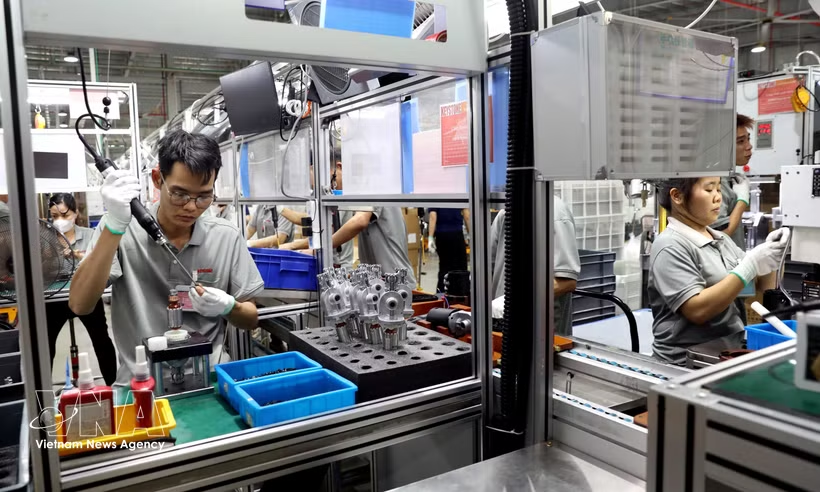
Workers manufacture products at Keystone Electrical Vietnam Co., Ltd. in the Lien Ha Thai industrial park. (Photo: VNA)

Hanoi (VNA) – World Creativity and Innovation Day (April 21) offers an opportunity to promote tangible action, helping to embed innovation as a central driver of Vietnam’s socio-economic development.

Resolution No. 57 of the Politburo on breakthroughs in science-technology development, innovation, and national digital transformation is being vigorously implemented nationwide. Within this framework, innovation is increasingly recognised as a key engine for rapid and sustainable growth.

This year, the United Nations’ World Creativity and Innovation Day further underscores the pivotal role of creativity in socio-economic progress, providing fresh impetus for Vietnam to refine institutions, mobilise resources, and foster a culture of innovation. Activities marking the occasion are scheduled to run through April 26, contributing to the widespread diffusion of an innovation-driven mindset across society.

According to Chu Thuc Dat, Deputy Director of the State Agency for Technology And Innovation under the Ministry of Science and Technology, a notable feature of ongoing institutional reforms is the clear shift from a management mindset to one of facilitative governance.

The Law on Science, Technology and Innovation has begun to establish a legal framework for controlled testing mechanisms, or regulatory sandboxes, enabling pilot deployment of new technologies, products, services, and business models within a supervised environment. These provisions are helping to shorten access to advanced technologies, reduce innovation costs for businesses, and accelerate the application and commercialisation of new solutions, thereby creating sustained growth drivers.

Particularly significant is the introduction of mechanisms for risk acceptance and sharing in research and venture investment. Dat noted that allowing organisations and individuals to avoid reimbursing state funding for scientific projects that do not meet expected outcomes but properly followed necessary procedures will help remove the fear of failure and encourage bold, high-risk innovation.

In response to the 2026 observance, the Ministry of Science and Technology has issued a plan to organise activities nationwide and called on ministries, sectors, localities, and relevant organisations to take proactive steps. These initiatives focus on policy communication, multi-platform outreach, the promotion and scaling of innovative models, and strengthened linkages between the State, research institutions, universities, businesses, and the wider community.

The development of innovation centres, creative spaces, and connectivity platforms is expected to provide a conducive environment for nurturing ideas, testing new concepts, and transforming them into high value-added products and services./.

VNA
See more

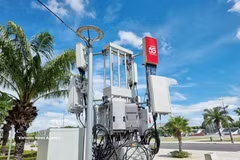
A Viettel 5G base station in Dong Hai ward, Khanh Hoa province (Photo: VNA)

Vietnam develops digital infrastructure aligned with demands of AI era

The data centre and cloud computing sector is entering a phase of redefinition. Infrastructure is no longer merely a backbone for data storage and processing, but is evolving into a foundational platform powering complex digital ecosystems—from AI and advanced analytics to real-time applications.

MK Smart achieves Common Criteria EAL5+ Certification, expanding opportunities in global digital identity

MK Smart achieves Common Criteria EAL5+ Certification, expanding opportunities in global digital identity

As countries accelerate the development of digital governments, electronic identification (eID) and electronic passports (ePassport) are becoming essential infrastructure. At the same time, security requirements are becoming increasingly stringent security requirements, particularly for systems that store sensitive data such as citizens’ identity and biometric information.

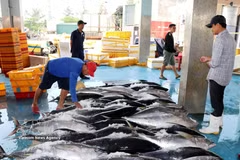
Sorting fish prior to transport for distribution. (Photo: VNA)

Fishermen keep pace with digital technology

Across central coastal provinces, authorities have introduced policies to restructure fleets, reduce vessel numbers, and support fishermen in transitioning to more sustainable livelihoods. Provinces such as Dak Lak and Gia Lai have earmarked nearly 1 trillion VND to support occupational changes and decommission inefficient vessels, while others including Nghe An, Quang Tri, Hue, and Quang Ngai are implementing roadmaps to phase out thousands of underqualified boats.

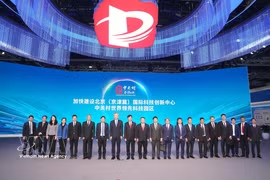
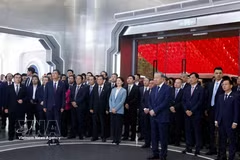
General Secretary of the Communist Party of Vietnam (CPV) Central Committee and State President To Lam (first, right, front row) listens to a presentation about the China-ASEAN AI Application Cooperation Centre (Photo: VNA)

Top Vietnamese leader visits China–ASEAN AI Application Cooperation Centre

The China–ASEAN AI Application Cooperation Centre, jointly established by the Guangxi Zhuang Autonomous Region and ASEAN countries, aims to promote inclusive and mutually beneficial development of AI globally. It is regarded as a flagship project in advancing the “Digital Silk Road” initiative in Nanning.

A view of the 224th session of the UNESCO Executive Board in Paris. (Photo: VNA)

UNESCO extends recognition of 2 Category II science centres in Vietnam

The continued operation and enhancement of the two Category II centres under UNESCO’s auspices reflect Vietnam’s policy of positioning science, technology and innovation as key drivers of development, while closely linking scientific advancement with deeper and more substantive international integration in the current context.

China–ASEAN Artificial Intelligence Application Cooperation Centre deeply integrates future technologies with distinctive ASEAN cultural characteristics. (Photo: VNA)

China–ASEAN AI cooperation centre drives regional tech cooperation

With strong policy support and growing participation from businesses and research institutions, the China–ASEAN Artificial Intelligence (AI) Application Cooperation Centre is expected to act as a digital bridge, promoting technological integration and opening new avenues for Vietnam–China cooperation in the digital era.

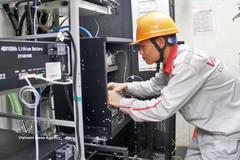
A technician from Viettel Bac Ninh examines equipment at a 5G base transceiver station. (Photo: VNA)

Bac Ninh accelerates development of 5G, data infrastructure

In the first quarter, Bac Ninh’s telecommunications infrastructure continued to develop in a synchronous manner. All communes have been connected to dedicated data transmission networks, and 100% of the population is covered by mobile services.

Illustrative photo (Photo: VNA)

An Giang identifies key tasks in science-technology development

The priorities focus on four pillars: science and technology, innovation, digital transformation, and real-world applications to boost socio-economic development. These are expected to create breakthroughs in governance, production, and daily life.

Illustrative image (Photo: VNA)

Vietnam Research Excellence Fellowship for 2026-2030 approved

Under the Vietnam Research Excellence Fellowship (VREF) for the 2026–2030 period, PhD students are identified as a core research force directly contributing to breakthroughs in sci-tech and innovation. Investing in top-tier doctoral candidates is more than workforce development, but a high-stakes strategic bet to forge a cohort of world-class scientists and technologists who can power Vietnam’s long-term economic ambitions.