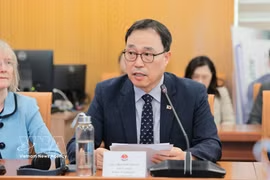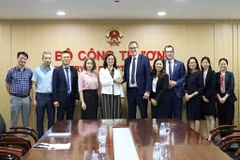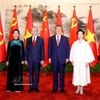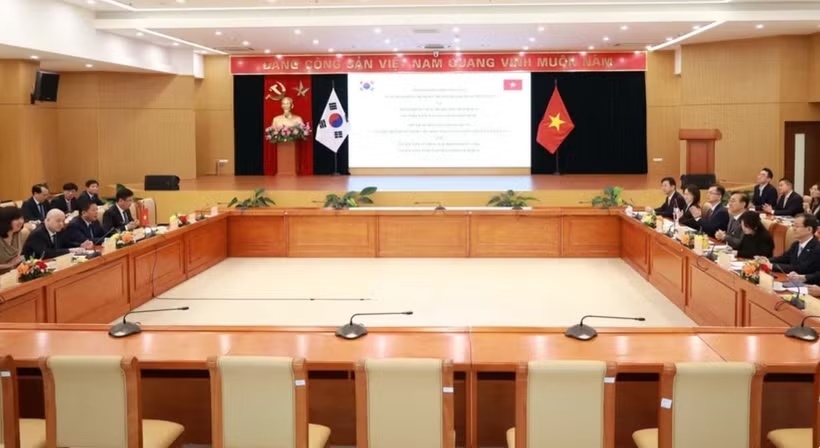
Hanoi (VNA) – Vietnamese Minister of Construction Tran Hong Minh and the Republic of Korea (RoK)’s Minister of Land, Infrastructure and Transport Kim Yun-duk held talks on April 21 in Hanoi, aiming to expand cooperation in transport infrastructure and urban development.
Minh noted that in transport, the RoK is currently Vietnam’s second-largest bilateral donor. Since 1996, the Korean Government has provided significant capital for Vietnam’s transport infrastructure, with nine projects completed to date, totalling over 1 billion USD, and six others underway worth nearly 600 million USD.
In urban development and housing, the RoK’s Ministry of Land, Infrastructure and Transport (MOLIT) has actively supported Vietnam through policy consultation, training, and experience sharing. This cooperation contributed to the formulation of the revised Housing Law and Law on Real Estate Business in 2023, helping create a more favourable investment climate.
Korean firms have also made their mark in Vietnam through modern urban projects, notably the Starlake urban area in Hanoi. The Korea Land and Housing Corporation (LH) is developing the Southeast New Urban Area project in Hung Yen province. The two sides have also implemented three ODA-funded technical assistance projects related to smart cities and social housing.
At the talks, Korean agencies and businesses proposed expanding cooperation in housing development, smart urban construction, and urban management, including waste treatment, environmental protection, and energy. They also called for stronger collaboration in building policy and institutional capacity.
Kim stressed the need to boost bilateral ties amid global instability, pointing to ongoing conflicts in the Middle East that have disrupted supply chains and threatened energy security.
He affirmed MOLIT’s commitment to promoting cooperation in transport and urban infrastructure, and proposed establishing a Vietnam–RoK infrastructure and technology cooperation board to enhance information sharing and coordination.
Railway cooperation has emerged as a key pillar. The head of MOLIT’s railway bureau recently met with Vietnamese Ambassador to the RoK to discuss potential projects, reflecting growing momentum in this field.
The RoK, which has operated high-speed rail since 2004, has gradually mastered core technologies in construction, operation, maintenance, and rolling stock manufacturing, and is now exporting high-speed trains to various countries. It has expressed interest in supplying trains for Ho Chi Minh City’s Metro Line No. 2.
Korean partners also proposed deeper cooperation with Vietnam in railway development, including technology transfer and workforce training, to support the country’s goal of building a self-reliant rail industry. They suggested holding the first conference on Vietnam–RoK railway cooperation in June 2026, based on a memorandum of understanding signed in 2025.
Beyond railways, the RoK aims to expand cooperation to roads, seaports and aviation, including mobilising finance through ODA and public-private partnership (PPP) models.
Minh welcomed the proposals, affirming Vietnam’s readiness to facilitate the RoK's participation while stressing the need for appropriate and effective implementation mechanisms. He noted that Vietnam is accelerating decentralisation, meaning Korean firms should engage with local authorities in projects such as urban areas, industrial parks and urban railways.
He also updated the Korean side on the progress of the North–South high-speed railway project and Vietnam’s social housing policies, expressing support for Korean enterprises’ participation.
To advance cooperation, the Ministry of Construction will coordinate with relevant agencies to establish the proposed joint board, organise the first railway cooperation conference in June 2026, promote PPP projects in transport and urban development, and implement initiatives under the Vietnam–RoK Smart City Cooperation Centre./.