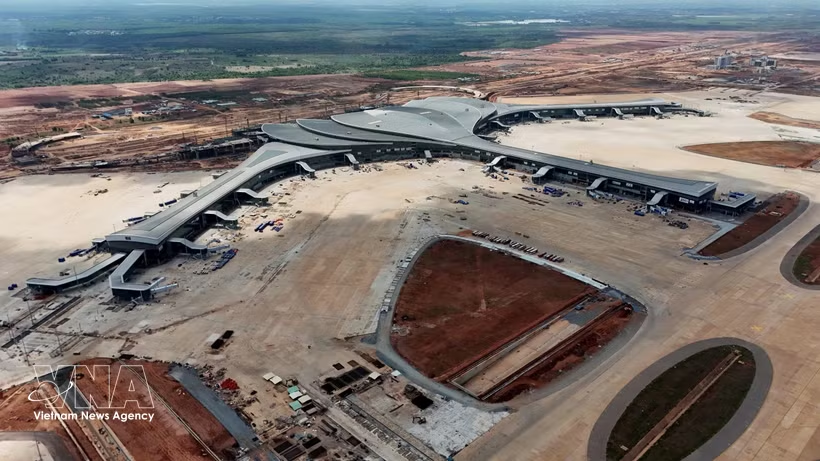
Dong Nai (VNA) – The People’s Council of the southern province of Dong Nai has approved investment plans for three major transport projects with a total capital exceeding 110 trillion VND (4.3 billion USD), aimed at strengthening connectivity between Dong Nai, Ho Chi Minh City, and key economic regions in the Central Highlands, central, and southwestern regions.
At its third session on April 28, the 11th-term provincial People’s Council passed a resolution approving the extension of the Ben Thanh – Suoi Tien metro line to the new administrative centre of Dong Nai and Long Thanh International Airport.
According to a proposal by the provincial People’s Committee, southern Dong Nai already has a multimodal transport network, with National Highway 51 serving as a vital corridor linking the region to seaports and Long Thanh airport. However, the highway is currently operating at around 156% of its designed capacity, leading to frequent congestion that is expected to worsen once major infrastructure projects become operational from 2026.
The metro extension is therefore considered necessary to ease pressure on National Highway 51, establish a high-capacity public transport axis, enhance regional connectivity, and promote socio-economic development.
Local authorities said the project would create a new transport corridor, reduce traffic congestion, especially along the stretch from Vung Tau intersection to the Ho Chi Minh City – Long Thanh – Dau Giay Expressway, and stimulate urban development along the Dong Nai River.
The metro line is also expected to form a new economic corridor connecting major centres such as Bien Hoa and Long Thanh, boosting investment, trade, and services, and contributing to local GRDP growth. It will also support the development of a modern, multimodal public transport system suited to an international aviation gateway, thereby enhancing airport efficiency, competitiveness, and national image.
The project is scheduled for implementation between 2026 and 2030, with a total length of 44.6 km. It will be developed under a public-private partnership (PPP) model in the form of a build-transfer (BT) contract, financed through land resources and the state budget. The preliminary investment is estimated at over 65.57 trillion VND (2.49 billion USD).
Also at the session, the council also approved the construction of an elevated road along National Highway 51, stretching from Vung Tau intersection to the junction of Vo Nguyen Giap street and the Bien Hoa – Vung Tau Expressway.
Authorities noted that National Highway 51 is a key transport route linking southeastern provinces with Ba Ria – Vung Tau (now part of Ho Chi Minh City), as well as connecting industrial zones and regional ports to major seaports such as Cai Mep – Thi Vai.
Frequent traffic congestion on the route has significantly affected transport and logistics activities, increasing costs and hindering regional economic development.
The provincial People’s Committee stressed that upgrading the section from Vung Tau intersection to Gate 11 junction is both necessary and urgent to improve traffic capacity, reduce congestion, and minimise accidents. However, expanding the existing road faces major challenges due to dense residential areas along the corridor.
To address these constraints, building an elevated road is seen as a suitable solution to minimise land clearance requirements and accelerate project implementation.
The project will span 6.2 km, with six lanes and a designed speed of 80 km/h. It is expected to be carried out between 2026 and 2029 under a PPP model in the form of a build-operate-transfer (BOT) contract, with an estimated investment of over 16.4 trillion VND.
The council also approved an investment plan for a road connecting Ma Da Bridge to Ring Road 4 of Ho Chi Minh City.
According to local authorities, the DT.753–DT.761 corridor is a crucial internal and external transport axis, linking northern and southern Dong Nai. It will also shorten travel time from the Central Highlands to Long Thanh International Airport and the Cai Mep – Thi Vai deep-water port complex.
The project is considered highly important for forming a key transport artery that directly connects northern and southern administrative units of Dong Nai, facilitating the transport of goods and agricultural products from the Central Highlands and northern Dong Nai to Long Thanh airport and major seaports. It is expected to support socio-economic development, as well as national defence and security in Dong Nai, the Central Highlands and the southern key economic region.
The route will have a total length of approximately 44.5 km and is scheduled for implementation from 2026 to 2028. It will be developed under a PPP model using a build-transfer (BT) contract funded by the state budget, with an estimated investment of 28.79 trillion VND./.