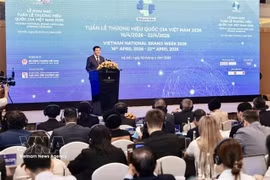
Hanoi (VNA) – A stronger, more brand-driven growth strategy is expected to help Vietnamese enterprises enhance their value and competitiveness in global markets, as the national brand continues to gain momentum in recent years.
Vietnam’s national brand has steadily strengthened in recent years, reflected in the growing number of products recognised under the National Brand Programme. The trend underscores that with well-planned investment in strategy, technology and brand management, Vietnamese enterprises can generate strong brand value and compete globally.
The 2020–2025 period has seen robust growth in the Vietnam National Brand, with its total value reaching nearly 520 billion USD in 2025, ranking 32nd among 193 economies worldwide, and posting a growth rate of 63%.
However, underlying weaknesses remain.
According to Brand Finance, Viettel has maintained its position as Vietnam’s most valuable brand for a decade, valued at nearly 7.4 billion USD. It is followed by Vinamilk at over 2.6 billion USD and Vietcombank at nearly 2.4 billion USD. Despite these leading performers, the combined value of the Top 100 Vietnamese brands fell by 14% year-on-year in 2025 to 38.4 billion USD, highlighting uneven internal capacity among businesses.
Ta Hoang Lan, Deputy Head of the Trade Promotion Capacity Development Division under the Vietnam Trade Promotion Agency (Vietrade), noted that many Vietnamese firms still focus on outsourcing and contract manufacturing, while their capabilities in design and building independent brands in international markets remain limited. Businesses also face mounting challenges in meeting stringent requirements related to the green economy, digital transformation and social responsibility. Meanwhile, limited awareness of intellectual property protection has led to cases where brands are lost even in the domestic market.
As such, the challenge is not merely to increase the number of exporters, but to enhance the quality and value of Vietnamese brands. Enterprises need to move beyond low-value processing to master technology, foster innovation, and proactively design and develop their own brands, thereby repositioning Vietnamese goods and services in higher market segments globally.
Lai Tien Manh, a branding expert from Mibrand Vietnam, observed that while Vietnamese businesses are ambitious about brand building, they often lack implementation and governance capacity due to shortages of skilled personnel, creative ideas and innovation capability, all essential elements for sustainable brand development. As an intangible asset, brand value is difficult to measure directly, requiring strong strategic management, an area where many domestic firms remain weak.
He added that some companies still approach brand communication with a short-term mindset, expecting advertising expenses to generate immediate revenue. While commercially understandable, this approach does not reflect the true nature of brand building, which requires time to gradually shape consumer perception and translate into long-term economic value.
Leveraging culture as a “launchpad”
Tran Dinh Tai, Deputy General Director of the Hoa Sen Group, likened a brand to a company’s “health”. Without regular investment and care, it will deteriorate, leading to a decline in market credibility. At its core, branding is about building trust. Once trust is established, customers not only choose products but also remain loyal over time.
Over its 25-year development, Hoa Sen has opted against flashy, short-term branding campaigns, instead focusing on meaningful community programmes that foster emotional connections with consumers and build lasting trust.
He suggested closer cooperation between enterprises and state management agencies to create shared platforms that help bring Vietnamese brands to global markets.
Vietnam should also host more large-scale international trade events and exhibitions domestically to attract global partners. With stronger connection platforms, businesses would not have to act alone but could generate a collective momentum to amplify the global presence of Vietnamese brands.
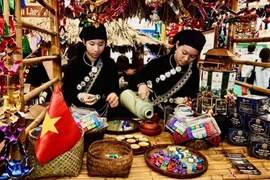
According to Manh, Vietnam’s rich and distinctive cultural heritage offers a unique advantage for national branding. Iconic symbols such as the ao dai, conical hats and traditional brocade garments can serve as powerful “brand materials” that resonate emotionally with consumers and leave lasting impressions. He cited the Republic of Korea as a typical example of leveraging culture from K-pop and films to cuisine and consumer products to enhance its national image and boost exports.
However, to fully tap into this resource, stronger state guidance is needed. Authorities should develop an official cultural database that systematically compiles Vietnam’s distinctive values, providing a foundation for businesses to innovate and build brands in a structured manner. At the same time, clear mechanisms must ensure that the use of cultural assets respects their origins and delivers shared benefits to the communities that preserve them./.