Ho Chi Minh City (VNA) – Vietnam’s fisheries sector is maintaining positive growth momentum but faces mounting challenges from intensifying global competition and increasingly stringent market requirements. In this context, science, technology and innovation have been identified as both the foundation and a critical driving force for restructuring the sector, enhancing productivity, quality and added value.
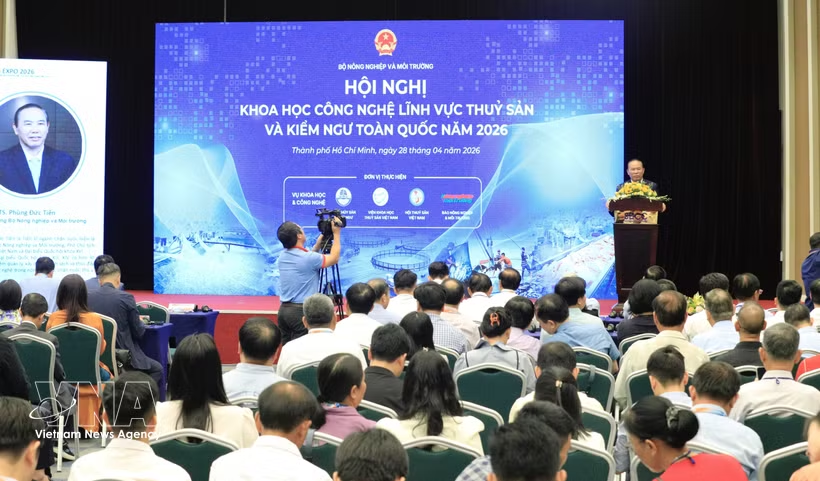
This assessment was shared by experts at the 2026 national conference on fisheries science, technology and surveillance, held in Ho Chi Minh City on April 28.
Sustained growth amid rising pressures
The fisheries sector remains a pillar of the agriculture and environment sector, making significant contributions to export earnings and providing livelihoods for millions of people in coastal and rural areas, according to Tran Dinh Luan, Director of the Directorate of Fisheries and Fisheries Surveillance under the Ministry of Agriculture and Environment.
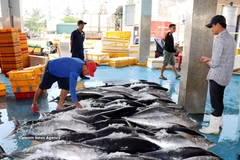
During the 2021–2025 period, the sector’s production structure continued to shift toward reduced capture and increased aquaculture. By the end of 2025, total output reached nearly 10 million tonnes, with aquaculture accounting for over 6.1 million tonnes and serving as the main growth driver. Meanwhile, capture output stabilised at around 3.8–3.9 million tonnes, declining slightly by an average of 0.9% per year, reflecting efforts to manage fishing intensity and protect marine resources.
Aquatic product processing has also expanded, with major enterprises investing in modern technologies to meet standards in demanding markets such as the US, the European Union and Japan. Total export turnover exceeded 11.3 billion USD, placing Vietnam among the world’s leading aquatic product exporters.
Despite these encouraging figures, long-term challenges persist. Associate Professor Dr. Dang Thi Lua of the Research Institute for Aquaculture noted that climate change impacts, including sea-level rise, salinity intrusion and extreme weather events, are placing increasing pressure on the sector, requiring adaptive breeding technologies and resilient farming systems.
At the same time, stricter trade barriers, particularly on traceability and the fight against illegal, unreported and unregulated (IUU) fishing, are compelling the sector to accelerate digital transformation in management and monitoring. Environmental protection requirements and emission reduction targets are also pushing the industry toward green and circular economy models.
While science and technology have significantly contributed to growth, their practical application remains limited. Dr. Nguyen Van Long, Director of the Department of Science and Technology under the ministry, pointed to bottlenecks in breeding research and seed supply, with the sector still dependent on imports. The commercialisation of scientific products also remains modest, while support services such as technology transfer and innovation infrastructure are underdeveloped.
Toward comprehensive transformation
Vietnam’s Fisheries Development Strategy to 2030, with a vision to 2045, sets ambitious goals of building a modern, sustainable and globally competitive sector. Key solutions include shifting from production to an economic approach, promoting marine aquaculture, reducing capture fisheries, enhancing traceability, and strengthening marine conservation.
Lua emphasised that biotechnology and next-generation genetics will play a central role, with the goal of gradually replacing up to 80% of imported broodstock with high-performance domestic varieties. The development of new-generation vaccines and biological products is expected to reduce reliance on antibiotics and move toward comprehensive health management. Advances in feed technology and smart nutrition are also seen as crucial, given that feed costs account for 60–70% of production expenses. Innovations such as insect-based protein and artificial intelligence in feeding management could reduce costs by 15–20% while minimising environmental impacts.
Offshore aquaculture development will require significant infrastructure upgrades, including replacing traditional wooden cages with durable modern materials. The application of robotics and unmanned underwater equipment is expected to enhance efficiency and reduce risks for workers.
Digital transformation is regarded as an irreversible trend. Experts called for the development of a sector-wide big data system and the application of blockchain technology for traceability to meet international standards.
In processing, the focus will shift from raw exports to deep processing, maximising value from by-products such as collagen, chitosan and omega-3 fatty acids, thereby promoting a circular economy.
Green technologies and climate-adaptive farming models are also gaining prominence. Recirculating aquaculture systems and biofloc technology can significantly reduce water use and waste discharge, and renewable energy is expected to replace 20–30% of traditional energy sources.
Long stressed that addressing existing bottlenecks will require coordinated efforts among the State, scientists and enterprises. With clear strategies, market-driven demand and applied research, Vietnam is well-positioned to realise its goal of becoming a global hub for high-value aquatic product processing by 2045./.
See more
Vietnam charts UAV strategy as Hanoi eyes low-altitude economy
Vietnam is accelerating a national strategy to develop unmanned aerial vehicles (UAVs) as a cornerstone of its emerging low-altitude economy, with Hanoi positioning itself to pilot new governance models, regulatory sandboxes and early-stage applications in controlled airspace.
SK Group partners to build AI ecosystem in Vietnam
SK Innovation and SK Telecom signed MoUs with Nghe An province and the National Innovation Centre of Vietnam to advance AI ecosystem development and support the country’s long-term growth strategy.
Vietnam, RoK team up on sci-tech, innovation at Hanoi forum
The event focused on matching demand, forging partnerships and accelerating concrete joint projects to deliver actual results for both economies.
CMC signs AI cooperation deal with Korean partner
Under the agreement, CMC Global - a member of CMC Corporation - and FuriosaAI will collaborate on developing AI application software, leveraging their respective technological strengths and customer ecosystems to roll out joint projects in the coming period.
Vietnam, RoK step up investment cooperation in tech, innovation startups
The Vietnam – RoK cooperation is shifting from traditional models to innovation-driven partnerships and co-creation of value, said Minister Counsellor Nguyen Thi Thai Binh.
Vietnam, RoK promote science, technology cooperation
Deputy Prime Minister Ho Quoc Dung encouraged Korean enterprises to scale up investment in Vietnam, particularly in priority sectors such as infrastructure development, high-tech electronics manufacturing, semiconductors, big data, biotechnology, and smart urban development.
Scientific Innovation Competition opens to OVs, boosting global talent linkages
In response to World Creativity and Innovation Day 2026, the contest provides a platform for individuals and teams nationwide who are passionate about research, creativity, and practical application of science, while promoting a movement of scientific inquiry within the community, particularly among young people.
Biotechnology cooperation – new driver of Vietnam - Cuba relations
A representative from BioCubaFarma emphasised that the longstanding Vietnam – Cuba friendship provides a solid foundation for further advancing comprehensive cooperation, especially in science and technology – a key driver of socio-economic development and national healthcare sovereignty.
Vietnam develops digital infrastructure aligned with demands of AI era
The data centre and cloud computing sector is entering a phase of redefinition. Infrastructure is no longer merely a backbone for data storage and processing, but is evolving into a foundational platform powering complex digital ecosystems—from AI and advanced analytics to real-time applications.
Vietnam turning ideas into value, aspirations into reality
Resolution No. 57 of the Politburo on breakthroughs in science-technology development, innovation, and national digital transformation is being vigorously implemented nationwide. Within this framework, innovation is increasingly recognised as a key engine for rapid and sustainable growth.
MK Smart achieves Common Criteria EAL5+ Certification, expanding opportunities in global digital identity
As countries accelerate the development of digital governments, electronic identification (eID) and electronic passports (ePassport) are becoming essential infrastructure. At the same time, security requirements are becoming increasingly stringent security requirements, particularly for systems that store sensitive data such as citizens’ identity and biometric information.
Deputy PM pushes for swift rollout of strategic technology list
The list will serve as a legal and scientific basis to design policies and incentives to support entities and enterprises engaged in strategic tech development.
Fishermen keep pace with digital technology
Across central coastal provinces, authorities have introduced policies to restructure fleets, reduce vessel numbers, and support fishermen in transitioning to more sustainable livelihoods. Provinces such as Dak Lak and Gia Lai have earmarked nearly 1 trillion VND to support occupational changes and decommission inefficient vessels, while others including Nghe An, Quang Tri, Hue, and Quang Ngai are implementing roadmaps to phase out thousands of underqualified boats.
Vietnam fast-tracks crypto asset market piloting
The Vietnamese Government plans to pilot exchanges for crypto and digital assets starting from the second quarter of 2026, as part of efforts to bring the emerging market into operation.
Ho Chi Minh City becomes first locality to issue comprehensive digital data strategy
To fuel this digital evolution, the city has allocated 12.7 trillion VND (500 million USD) for 2026, representing 4.2% of total budget expenditure.
Hanoi advances technological innovation in key economic sectors
The municipal People's Committee recently issued Plan No. 109/KH-UBND on technological innovation in key economic sectors through 2035, which serves as both a catalyst and a strategic move to systematise, elevate and reinforce the capital’s leading role in the digital era.
Top Vietnamese leader visits China–ASEAN AI Application Cooperation Centre
The China–ASEAN AI Application Cooperation Centre, jointly established by the Guangxi Zhuang Autonomous Region and ASEAN countries, aims to promote inclusive and mutually beneficial development of AI globally. It is regarded as a flagship project in advancing the “Digital Silk Road” initiative in Nanning.
“Made by Vietnam” technology boosts value of agricultural products
Vietnam's agricultural sector is investing more in deep processing technologies, particularly smart drying solutions that help increase product value and ensure compliance with international standards.
Vietnam, Hungary step up cooperation in AI research, application in judicial sector
The Vietnamese Embassy in Hungary pledged to continue serving as a bridge to promote concrete and practical cooperation initiatives in science-technology and innovation, including AI, thereby contributing to Vietnam’s policy-making, digital transformation, and socio-economic development.
UNESCO extends recognition of 2 Category II science centres in Vietnam
The continued operation and enhancement of the two Category II centres under UNESCO’s auspices reflect Vietnam’s policy of positioning science, technology and innovation as key drivers of development, while closely linking scientific advancement with deeper and more substantive international integration in the current context.