Electronic fishing logbooks boost transparency, modernise fisheries management in Ho Chi Minh City

Electronic logbooks improve the traceability of seafood and strengthen oversight of fishing activities, helping authorities monitor catches more effectively.

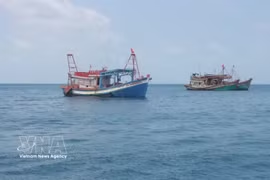
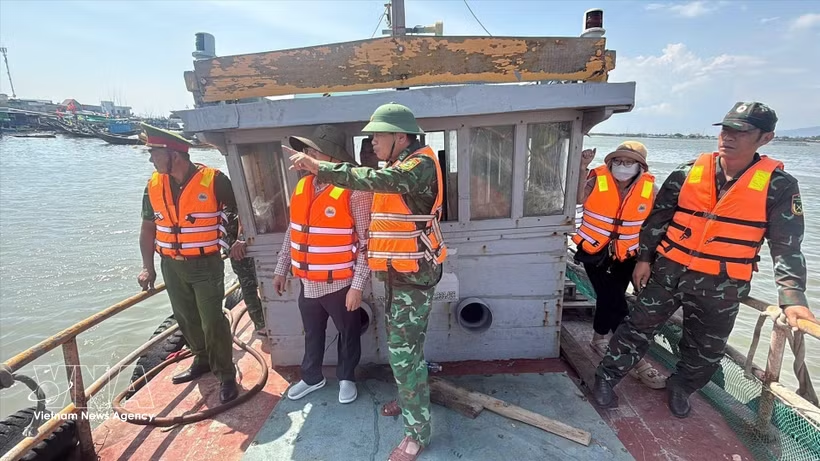
Authorities inspect a fishing boat in Ho Chi Minh City. (Photo: VNA)

Ho Chi Minh City (VNA) – After a three-year pilot programme, electronic fishing logbooks for vessels in Ho Chi Minh City have proved effective, contributing to modernising fisheries management, enhancing data transparency, and improving control over fishing activities in line with regulations.

At the Loc An fishing port in Phuoc Hai commune, fishermen are increasingly adopting the system with support from port authorities. Many have sought assistance from authorities to install applications and learn how to record electronic logbooks before each fishing trip.

Huynh Van Thin, a fisherman in Phuoc Hai, said he initially struggled with the system due to unfamiliarity with smartphones. However, with dedicated support from officials, he has now mastered its use, noting that the electronic method is more convenient and efficient than traditional record-keeping.

Similarly, Le Minh Nhat, also from Phuoc Hai, said most fishermen are older and have limited education, making the adoption of digital tools challenging at first. Thanks to hands-on guidance from local authorities and port staff, most can now use the application proficiently, enabling them to report fishing activities anytime and anywhere via mobile devices.

Since 2023, vessels measuring over 15m in Binh Chau commune have been selected for pilot implementation. When docking, data can be extracted directly from onboard devices or software, enabling authorities to quickly capture catch volumes, verify seafood origins, and compile reports.

The municipal Department of Agriculture and Environment said the city currently has 4,445 fishing vessels, including 80 boats operating in deep-sea areas joining in the pilot programme. The initiative marks an important step in the digital transformation roadmap for the fisheries sector while meeting the requirements for sustainable management and exploitation.

The application has significantly reduced the time and errors linked with manual record-keeping.

Nguyen Van Huy, a staff member at the Loc An port, said data entry now requires only a few steps such as recording net deployment, retrieval, and catch volume. Upon docking, the system automatically compiles and prints logbooks for fishermen to verify.

In addition, electronic logbooks improve the traceability of seafood and strengthen oversight of fishing activities, helping authorities monitor catches more effectively, according to Cu Duy Cao Vy, a representative of the Ben Loi – Binh Chau storm shelter management board in Binh Chau commune.

Under the roadmap, the system will become mandatory for vessels 24m or longer from July 1, for those between 15m and under 24m from September 1, and for vessels between 12m and under 15m from the beginning of next year.

A key advantage of the software is its ability to operate without a mobile signal. Fishermen can record data while at sea, with information automatically synchronised once vessels return to areas with network coverage, ensuring continuity and accuracy.

Pham Thi Na, Deputy Director of the municipal Department of Agriculture and Environment, said the adoption of the system plays an important role in building a seafood traceability system from catching to processing and export, particularly for demanding markets such as the EU, thereby improving transparency and product value.

She added that the synchronised deployment of electronic logbooks, vessel monitoring systems (VMS), and port-based catch control is expected to support efforts to remove the European Commission's “yellow card” warning on illegal, unreported and unregulated (IUU) fishing, creating opportunities to expand export markets.

Despite positive results, challenges remain, including limited digital skills among some fishermen and high equipment costs. Thus, authorities are stepping up communications and technical support to ensure wider adoption of the system in the coming time./.
VNA

See more

Construction of Tu Lien bridge in Hanoi (Photo: VNA)

CPI up 0.84% in April on rising energy, dining costs

The CPI in April advanced 3.31% compared to December 2025 and 5.46% from a year earlier. For the first four months of 2026, the index climbed 3.99% against the same period last year, with core inflation growing 3.89%.

At Giang Dien Industrial Park in Dong Nai province (Photo: VNA)

FDI flows to Vietnam up 32% in four months

Realised FDI in Vietnam during the first four months was estimated at 7.40 billion USD, up 9.8% year-on-year, the highest level for the period in the past five years.

Rooftop solar panels in the Mekong Delta city of Can Tho. (Photo: VNA)

Rooftop solar power to ease pressure on electricity supply

As electricity demand surges, particularly during the hot season, Vietnam is stepping up efforts to promote rooftop solar power as a practical solution to ensure energy security, improve efficiency, and ease pressure on the national grid.

An unmanned aerial vehicle is used in rice cultivation in Vi Thanh 1 commune, Can Tho city. (Photo: VNA)

Shrinking farmland forces agriculture to go high-tech

Ministry of Finance data show that about 60% of companies have started using basic digital tech, while roughly 20% now have clear digital strategies. But only 5% has gone all the way with full-blown digital transformation.

SIAL Canada CEO Stéphane Thuillier (right) visits the Vietnam pavilion and speaks with a representative of the Vietnam Trade Office. (Photo: VNA)

Vietnamese exports expand foothold in Canada

The Vietnam Trade Office in Canada organised a national pavilion this year, supporting 15 companies in product displays while helping connect five others operating independent booths. The initiative is designed to enhance product promotion, facilitate partnerships and broaden market access in North America, particularly in the processed food segment.

Core site (Vinh Truong hamlet, Phuoc Dinh commune) for the construction of the Ninh Thuan 1 nuclear power plant. (Photo: VNA)

All-out push to fast-track Vietnam’s first nuclear power plants

Khanh Hoa province has also intensified oversight, introduced housing support of 5 million VND (nearly 190 USD) per month for displaced residents awaiting resettlement, and clarified responsibilities for land inventory, measurement and site selection. Notably, more than 9.8 billion VND has been disbursed to relocate 570 graves, helping accelerate clearance for the Ninh Thuan 1 Plant.

Traditional handicraft products at the Vietnamese booth attract visitors at the Paris Fair (Photo: VNA)

Vietnamese products shine at Paris Fair

Amid deepening international integration, the presence of Vietnamese enterprises at the annual Foire de Paris continues to affirm the appeal of Vietnamese goods and culture in the French market. The event also provides an opportunity for Vietnamese businesses to directly engage with French and European consumers, thereby strengthening their foothold in this promising market.

Do Gia Thang, Secretary-General of the Vietnam Business Association in Australia (VBAA) and Chairman of the Vietnam–Australia Young Entrepreneurs Club (Photo: VNA)

International Financial Centre - Vietnam's strategic move in global race: Expert

Vietnam is pursuing a “one centre – two destinations” model. Ho Chi Minh City is envisioned as a comprehensive financial hub linked with a free trade zone, while Da Nang will focus on innovation, fintech, digital assets and serve as a testing ground for new financial models. This complementary structure allows Vietnam to develop a tailored approach rather than replicate existing financial centres.

Financial buildings in central Ho Chi Minh City along the Saigon River, facing the Thu Thiem peninsula in An Khanh ward. (Photo: VNA)

Ho Chi Minh City attracts significant investment from France

Ho Chi Minh City is emerging as an attractive destination for French investors, particularly in infrastructure, sustainable urban development and green transition. French investment of more than 2.2 billion USD is contributing to economic growth and opening up broader prospects for long-term cooperation.

An aerial view of a crossroads in Hanoi (Photo: VNA)

Hanoi pushes SOEs to lead breakthrough growth

According to experts, Resolution 79-NQ/TW reaffirms the state economic sector’s leading role in the socialist-oriented market economy. The real shift, however, is moving SOEs from simply “holding” assets to actively “leading” development, and from traditional “management” to enabling growth across the board.

A representative of the Coast Guard speaks at the meeting. (Photo: VNA)

Ho Chi Minh City steps up decisive action to lift IUU “yellow card”

The city will fast-track eCDT implementation, study the feasibility of a fishing port in Can Gio, and propose granting accounts to border guard stations to strengthen oversight of vessel movements. Enhanced inter-provincial coordination, particularly with Lam Dong, Da Nang, Quang Tri and Ninh Binh, was also emphasised to tighten control and strictly handle violations, especially those related to VMS.