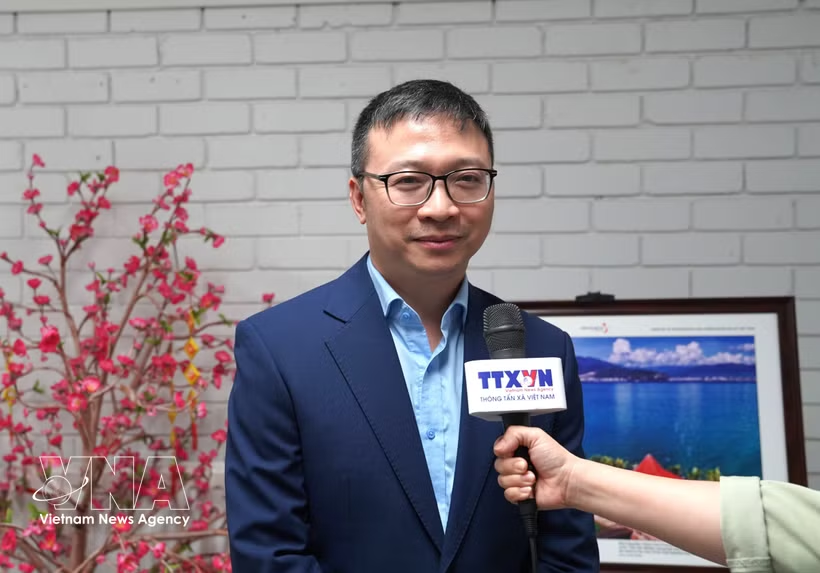
Hanoi (VNA) - Vietnam’s decision to establish a Vietnam International Financial Centre (VIFC) in Ho Chi Minh City and Da Nang marks not merely an economic project, but a significant shift in institutional reform thinking, according to Do Gia Thang, Secretary-General of the Vietnam Business Association in Australia (VBAA) and Chairman of the Vietnam–Australia Young Entrepreneurs Club.
This is an inevitable step for the country to move beyond the “middle-income trap”, and shift its growth model from processing and manufacturing toward capital flow management, financial services, and higher value-added services.
With the National Assembly’s adoption of Resolution No. 222/2025/QH15 on the VIFC, establishing special mechanisms on taxation, investment, foreign exchange, immigration and residency for investors and experts, Vietnam has sent a clear signal that it is moving beyond discussion to actively building a competitive legal framework. The VIFC could thus serve as an “institutional laboratory”, piloting breakthrough mechanisms before refining and scaling them nationwide.
According to Thang, amid a global financial order increasingly reshaped by artificial intelligence, blockchain and green finance, failure to proactively engage risks relegating Vietnam to lower tiers of the value chain. Remaining on the sidelines is no longer an option; the country must help shape the rules of the game or remain confined to manufacturing and low-cost labour supply roles.
He noted that Vietnam possesses several distinctive advantages that traditional financial centres do not have.
First, in terms of geopolitical positioning and integration, Vietnam has signed 17 free trade agreements, including multiple new-generation FTAs, creating substantial opportunities in trade finance, insurance, logistics and global supply chain services.
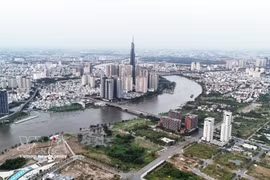
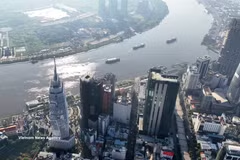
Second, Vietnam is pursuing a “one centre – two destinations” model. Ho Chi Minh City is envisioned as a comprehensive financial hub linked with a free trade zone, while Da Nang will focus on innovation, fintech, digital assets and serve as a testing ground for new financial models. This complementary structure allows Vietnam to develop a tailored approach rather than replicate existing financial centres.
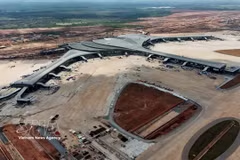
Third, the country is shaping a “Seaport – Aviation – Finance” ecosystem along the Thu Thiem – Long Thanh – Cai Mep axis. The connectivity between the VIFC in Thu Thiem, Long Thanh International Airport and the Cai Mep–Thi Vai deep-water port cluster, integrated with the Cai Mep Ha free trade zone, is expected to optimise flows of capital, goods and people. This could create a strong “digital gravity”, attracting multinational financial institutions, investment funds and professional service firms to Vietnam, said the expert. However, Thang emphasised that Vietnam’s greatest challenge lies not in physical infrastructure but in the “soft infrastructure of trust”. While hard infrastructure can be built within years, investor confidence in legal, judicial and enforcement systems requires sustained effort and discipline.
He held that institutional bottlenecks remain a key constraint. Although Resolution 222/2025/QH15 provides a framework for advanced mechanisms, the broader legal system still reflects traditional regulatory thinking and has yet to fully align with international standards in complex areas such as maritime insurance, ship financing, derivatives and structured financial products. Without accelerated legal harmonisation, it will be difficult to attract global financial institutions to relocate core operations to Vietnam.
The expert also pointed to challenges in high quality human resources, adding that fragmented governance also poses risks. Overlapping mandates among ministries and local authorities could slow decision-making, a critical factor in attracting major financial investors. A strong, centralised coordination mechanism with clear accountability will be essential to ensure the VIFC’s success, he explained.
Thang noted that Vietnam is at a pivotal juncture, completing previous development goals while entering a new growth cycle. On the global financial map, the country is no longer merely an observer but an emerging contender, provided it seizes the current “window of opportunity”.
Thang highlighted three priorities: developing a regulatory sandbox for new financial models; strengthening investor protection through internationally aligned legal mechanisms; and prioritising human capital development, including attracting overseas Vietnamese and global experts.
He expressed his confidence that with appropriate policies, institutional breakthroughs and broad-based support, Vietnam has the potential to emerge as a leading aviation–finance–maritime hub in the region in the coming years./.
VNA