Top leader's visit to create new momentum for Vietnam–India ties: Scholar

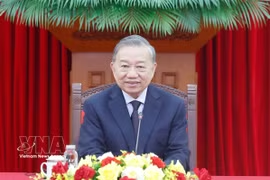
The upcoming state visit to India by General Secretary of the Communist Party of Vietnam Central Committee and State President To Lam is expected to inject fresh impetus into Vietnam–India relations, ushering in a more substantive, comprehensive and forward-looking phase of cooperation.

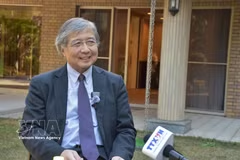
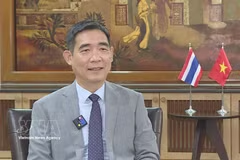
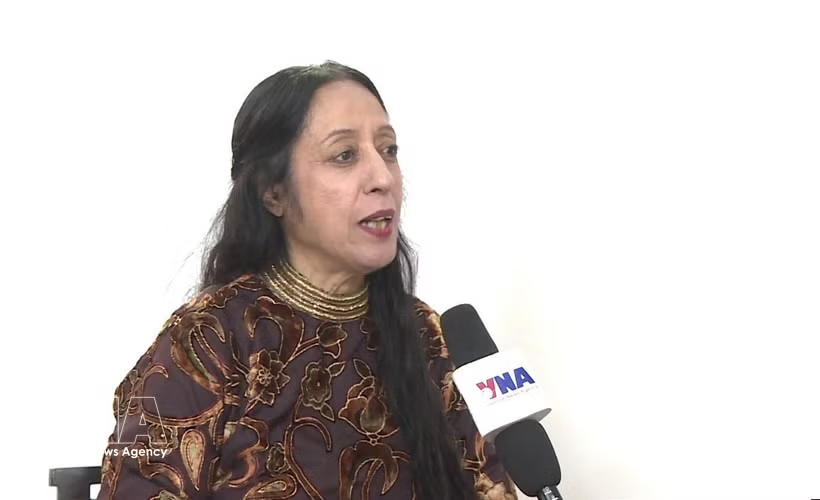
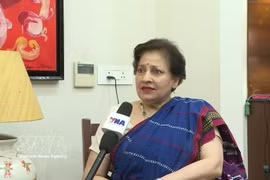
Professor Reena Marwah of the University of Delhi (Photo: VNA)

New Delhi (VNA) - As Vietnam and India mark the 10th anniversary of their Comprehensive Strategic Partnership (2016–2026), the upcoming state visit to India by General Secretary of the Communist Party of Vietnam Central Committee and State President To Lam is seen as a significant milestone, not only to consolidating political trust but also opening up fresh momentum for bilateral cooperation in the next phase of development.

Professor Reena Marwah of the University of Delhi, who also serves as Secretary-General of the Association of Asian Scholars, said deep political trust built over generations of leadership has been the key factor underpinning the steady development of bilateral ties. In a rapidly evolving regional and global landscape, both countries pursue strategic autonomy, uphold independence in foreign policy making, and support a rules-based international order – a foundation for sustainable growth in bilateral relations.

According to Professor Marwah, cooperation has expanded significantly over the past decade, from traditional areas such as defence, energy and people-to-people exchanges to new fields including digital transformation, green transition, logistics, seaport development, innovation and human resources development.

Defence cooperation remains a key strategic pillar, with potential for expansion into emerging areas such as unmanned aerial systems, missile technology, air defence systems and high-tech defence industries, she said.

On the economic front, she noted strong complementarity between the two economies. Vietnam’s strategic location, long coastline and growing role in global supply chains make it an attractive destination for foreign direct investment (FDI), while its experience in port and logistics development aligns with India’s infrastructure needs.

Meanwhile, India’s strengths in information technology, innovation, artificial intelligence (AI), digital services and high-quality human resources could complement Vietnam’s production capacity and integration capabilities, creating new growth drivers.

Professor Marwah also highlighted Vietnam’s policy orientation towards science and technology, innovation and digital transformation, as reflected in recent Party resolutions, as well as its push to develop the private sector. These moves signal a shift towards a knowledge- and technology-driven growth model, opening up significant cooperation opportunities in areas such as AI, semiconductors, software development, high-tech workforce training, and emerging sectors including rare earths, strategic minerals, batteries and Industry 4.0–5.0, she stated. In terms of trade and investment, she said bilateral turnover remains below potential. Vietnam has strengths in textiles, footwear, electronics, manufactured goods, coffee and tea – products with strong prospects in India’s rapidly expanding middle-class market.

India, for its part, holds advantages in pharmaceuticals, renewable energy and heavy industry. Trade could be further boosted by reducing non-tariff barriers and expediting the review of the ASEAN–India Trade in Goods Agreement (AITIGA). Increasing business presence in each other’s markets, such as VinFast’s investment in India and Indian firms’ interest in Vietnam’s port and logistics sectors, are also positive signs, the scholar noted.

Beyond economics, people-to-people exchanges are emerging as an increasingly important pillar. With nearly 90 flights per week and a sharp rise in Indian tourist arrivals to Vietnam, connectivity demand is growing. Both sides could consider expanding direct air routes, improving tourism workforce training and attracting investment in hospitality and services to better tap this potential.

At the strategic and regional level, Professor Marwah noted that Vietnam and India share common interests in promoting peace, stability, freedom of navigation and respect for international law, particularly the 1982 United Nations Convention on the Law of the Sea (UNCLOS). With their rising roles in Asia and the Global South, both countries have the potential to become key partners in shaping a balanced, open and rules-based regional order.

“While the past decade has laid a solid foundation, the next step is to translate the partnership into more substantive outcomes in the next 10 years ahead,” she stressed.

Regarding the May 5–7 state visit of the top Vietnamese leader, Professor Marwah said its timing – shortly after Vietnam’s 14th National Party Congress and the consolidation of leadership under the 16th National Assembly – underscores the country’s determination to deepen bilateral ties and highlights India’s growing importance in realising Vietnam’s foreign policy.

Beyond its symbolic significance, the visit is expected to inject fresh impetus into Vietnam–India relations, ushering in a more substantive, comprehensive and forward-looking phase of cooperation, the scholar underlined./.

VNA
See more

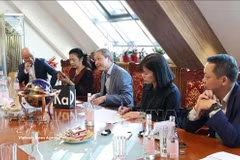
Nguyen Viet Duc, Vice President of the Union of Vietnamese Associations in Germany, delivers remarks at the working session. (Photo: VNA)

Vietnamese community in Germany strengthens connectivity

Solidarity, mutual support, and resilience remain key characteristics of the Vietnamese community in Germany, with Vietnamese people continuing to value family, prioritise education, make continuous efforts to integrate into host society, and preserve cultural identity while maintaining ties with their homeland.

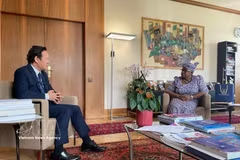
Ambassador Mai Phan Dung and WTO Director-General Ngozi Okonjo-Iweala in a meeting. (Photo: VNA)

Vietnam continues to contribute effectively to multilateral mechanisms: Ambassador

With a solid foundation of political stability, a clear development orientation, and strong international support, Vietnam is well-positioned to continue enhancing its role in multilateral forums, contributing actively to addressing global challenges, and realising its aspiration to become a high-income, developed country by 2045.

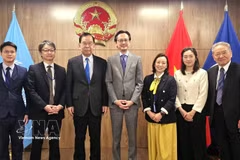
Ambassador Do Hung Viet (centre) and Chairman of the Presidium of the Central Committee of the Japanese Communist Party Shii Kazuo (third from the left) and other delegates pose for a group photo (Photo: VNA)

Vietnam values growing ties with Japan: diplomat

Vietnam attaches great importance to the increasingly close and effective Comprehensive Strategic Partnership with Japan, as well as the close and foundational ties between their Communist Parties, Ambassador Do Hung Viet has said.

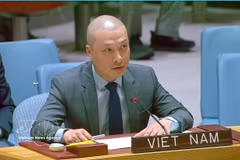
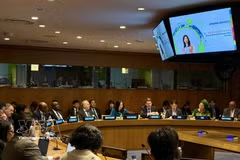
Minister Counsellor Nguyen Hoang Nguyen, Deputy Permanent Representative of Vietnam to the UN addresses the session (Photo: VNA)

Vietnam calls for de-escalation of tension in Middle East

Minister Counsellor Nguyen Hoang Nguyen, Deputy Permanent Representative of Vietnam to the UN reaffirmed Vietnam’s consistent stance of supporting the Palestinian people’s right to self-determination, Palestine’s UN full membership, and the two-state solution based on pre-1967 borders, in accordance with international law and relevant UN resolutions.

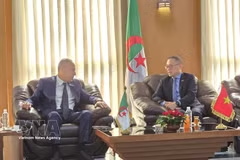
Vietnamese Ambassador to Algeria Tran Quoc Khanh (R) meets with Annaba Governor Abdelkrim Lamouri. (Photo: VNA)

Vietnam promotes multifaceted cooperation with Algerian locality

Ambassador Tran Quoc Khanh affirmed that Vietnam attaches importance to its relationship with Algeria and wishes to expand cooperation with localities, including Annaba, particularly following the elevation of bilateral ties to a Strategic Partnership in November 2025.

Deputy Minister of Foreign Affairs Le Thi Thu Hang, head of the Vietnamese delegation to the 11th NPT Review Conference, addresses the roundtable discussion on April 29. (Photo published by VNA)

Vietnam chairs roundtable on peaceful use of nuclear energy

Deputy Minister of Foreign Affairs Le Thi Thu Hang called for strengthened international cooperation in nuclear applications, with a focus on capacity-building, training, technology transfer and mobilisation of sustainable financial resources to support long-term development goals.

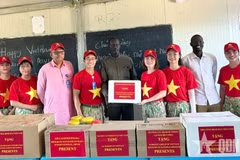
Representatives of Vietnam's Engineering Unit Rotation 4 present gifts to pupils at the Abyei secondary school. (Photo: qdnd.vn)

Vietnam's Engineering Unit Rotation 4 marks new milestone in Abyei

Vietnam's Engineering Unit Rotation 4 recently completed upgrading the Abyei – Agok road, which holds special strategic significance for the United Nations Interim Security Force for Abyei (UNISFA) as local authorities and residents have always longed for convenient transportation links between the North and the South.

The 80th session of the UN General Assembly elected members of the UN Human Rights Council for the 2026–2028 term at the UN headquarters on October 14, 2025 (New York time). Vietnam was elected to this position with 180 votes, the highest among the Asia-Pacific candidates. (Photo: VNA)

Vietnam makes imprints in human rights protection, promotion

As a UNHRC member during 2026–2028, Vietnam has been acting in accordance with some main orientations, including actively and proactively contributing to the UNHRC’s activities, enhancing the council’s efficiency; and fully participating in all regular and special sessions of the council.

Poldi Sosa Schmidt, Chairwoman of the Argentina-Vietnam Culture Institute. (Photo: VNA)

Argentine friend lauds Vietnam’s development achievements

Schmidt, who has supported Vietnam for more than six decades and visited the Southeast Asian nation nearly 30 times, highlighted Vietnam’s achievements in poverty reduction, infrastructure development and deep international integration, particularly through participation in multiple free trade agreements (FTAs).

Prime Minister Le Minh Hung orders bold reforms to unlock resources, drive double-digit growth at the working session with the Ministry of Agriculture and Environment on April 29, 2026. (Photo: VNA)

PM orders bold reforms to unlock resources, drive double-digit growth

The PM called for continued streamlining of the apparatus, improved governance, and deeper decentralisation, alongside reforms to address bottlenecks in land, environment and minerals. He also urged more flexible rice land policies to allow conversion of inefficient areas while safeguarding food security.

Ambassador Do Hung Viet addresses the reception before the 11th Review Conference of the Treaty on the Non-Proliferation of Nuclear Weapons. (Photo: VNA)

UN official praises Vietnam’s preparations for 11th NPT Review Conference

United Nations Under-Secretary-General Izumi Nakamitsuon praised Vietnam’s capacity and efforts, along with those of Ambassador Do Hung Viet in his role as President of the conference, believing that Vietnam’s methodical preparations and constructive approach would steer the meeting toward tangible results that meet the expectations of the global community.