Exchange rate, interest rate, credit management must align with 2-digit growth target: PM

Prime Minister Le Minh Hung also called for measures to stabilise interest rates, reduce operational costs within credit institutions, promote digital transformation, and ensure adequate system liquidity.

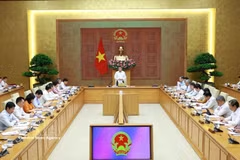
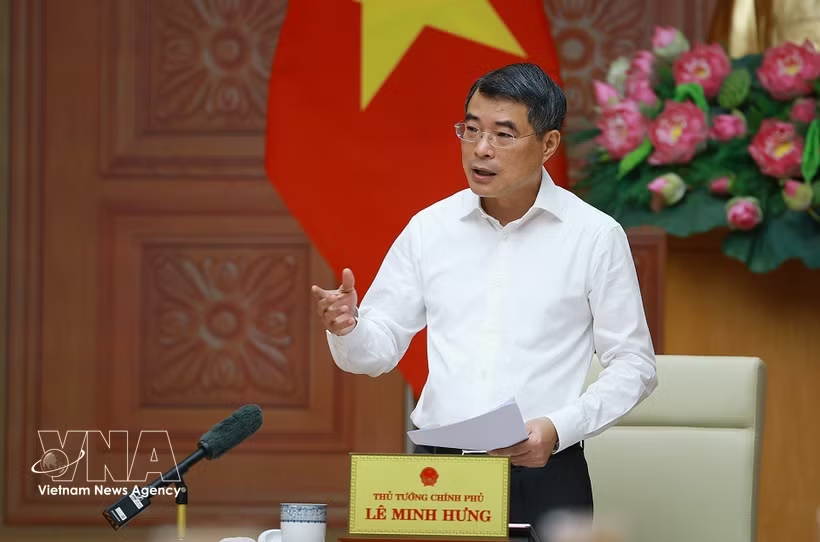
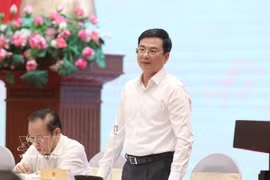
Prime Minister Le Minh Hung speaks at the working session with the State Bank of Vietnam on April 29. (Photo: VNA)

Hanoi (VNA) - Prime Minister Le Minh Hung on April 29 chaired a working session with the State Bank of Vietnam (SBV), stressing that the management of exchange rates, interest rates and credit must be conducted in a flexible and coordinated manner to meet higher demands in the new context, especially the double-digit growth target.

PM Hung commended the banking sector for its proactive, responsive and effective policy management, which has delivered tangible contributions to the country’s overall socio-economic performance.

Analysing the world situation and assigning tasks for the coming time, he stressed that the SBV must adopt a more forward-looking and development-oriented approach, shifting from administrative management to development facilitation. By ensuring a stable and predictable macroeconomic environment, the central bank can help foster confidence among businesses and citizens, thereby supporting production and investment. At the same time, maintaining macroeconomic stability, controlling inflation and ensuring the safety of the banking system were described as foundational priorities.

The Prime Minister also highlighted the importance of safeguarding banking and payment system security, strengthening risk prevention, enhancing both off-site supervision and on-site inspections, and ensuring cybersecurity and payment safety.

The SBV was instructed to closely follow resolutions and conclusions of the Party, National Assembly and Government, while developing detailed action plans with clear responsibilities, timelines and measurable outcomes. Coordination with relevant ministries to develop policy scenarios for each quarter and the full year was also emphasised, requiring careful calibration of policy tools in terms of timing and intensity.

The Government leader requested the central bank to enhance its capacity for analysis and forecasting, closely monitor domestic and international financial developments, and take prompt and effective responses. Monetary policy management should remain proactive, flexible and closely coordinated with fiscal and other macroeconomic policies.
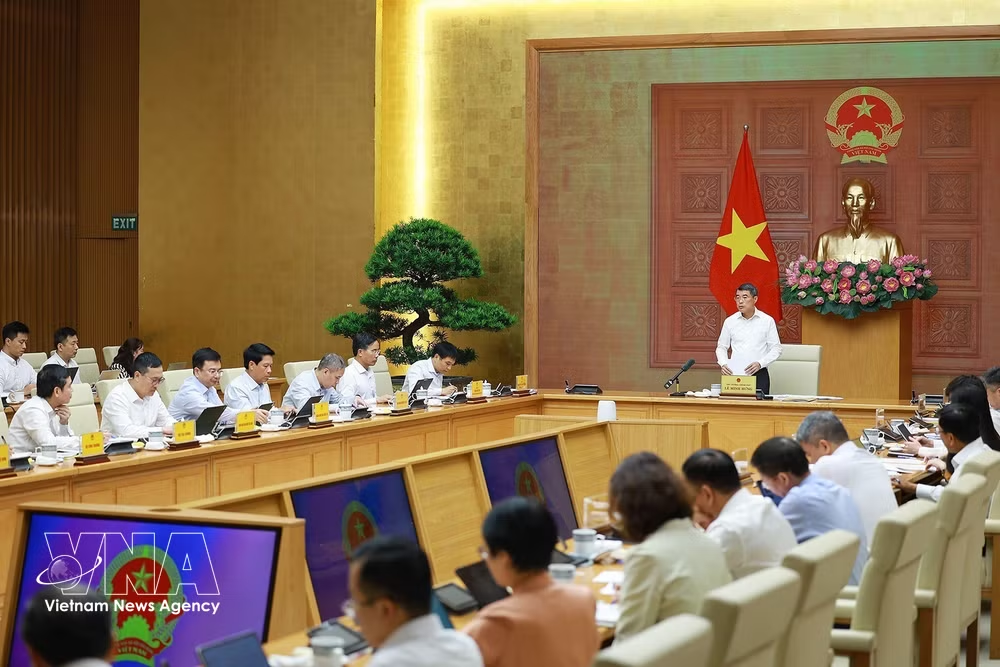
vnanet-potal-thu-tuong-lam-viec-voi-lanh-dao-ngan-hang-nha-nuoc-8732279.jpg
Prime Minister Le Minh Hung speaks at the working session with the State Bank of Vietnam on April 29. (Photo: VNA)

PM Hung also called for measures to stabilise interest rates, reduce operational costs within credit institutions, promote digital transformation, and ensure adequate system liquidity. He urged coordination with the Ministry of Finance to develop capital markets and the international financial centre, thereby reducing reliance on bank credit.

Credit growth should be managed flexibly, with improved quality and efficiency, and directed toward production, priority sectors and key growth drivers. At the same time, stricter oversight is required for high-risk sectors, including real estate, with appropriate credit allocation mechanisms to encourage social housing and industrial development, he stressed.

The PM reiterated the need to effectively manage the gold market, in line with existing directives, noting that while gold is a legitimate asset, excessive speculation should be discouraged as it does not contribute to value creation in the economy.

Further priorities include completing the restructuring of credit institutions, addressing non-performing loans, improving access to finance, particularly for small- and medium-sized enterprises, and modernising the banking system. The SBV was also tasked with refining the legal framework governing monetary and banking activities, including amendments to key laws and simplifying administrative procedures to reduce compliance costs for businesses and citizens.

In addition, the sector is expected to accelerate digital transformation, expand cashless payments, explore new payment technologies including cross-border systems, and implement regulatory sandboxes.

The Prime Minister underscored the importance of transparent and timely policy communication to strengthen market confidence. He called on the SBV and the banking system to enhance responsibility, innovation and proactiveness in advising the Government, with a view to successfully fulfilling the tasks entrusted by the Party, State and people./.
VNA

See more

A representative of the Coast Guard speaks at the meeting. (Photo: VNA)

Ho Chi Minh City steps up decisive action to lift IUU “yellow card”

The city will fast-track eCDT implementation, study the feasibility of a fishing port in Can Gio, and propose granting accounts to border guard stations to strengthen oversight of vessel movements. Enhanced inter-provincial coordination, particularly with Lam Dong, Da Nang, Quang Tri and Ninh Binh, was also emphasised to tighten control and strictly handle violations, especially those related to VMS.

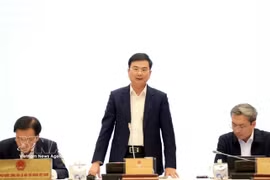
An overview of Prime Minister Le Minh Hung's working session with the Ministry of Finance on April 29 (Photo: VNA)

PM emphasises need for governance shift to drive growth

Ministries and agencies must enhance forecasting capacity, adopt more responsive policy tools, and fundamentally rethink how policies are designed and executed in a rapidly evolving environment, said PM Le Minh Hung.

Long Thanh International Airport is currently under construction and is expected to be put into operation by the end of 2026. (Photo: VNA)

Dong Nai rolls out 4.3 billion USD plan for key transport links

Dong Nai will implement three major transport projects with a total capital exceeding 110 trillion VND (4.3 billion USD), aimed at strengthening connectivity between Dong Nai, Ho Chi Minh City, and key economic regions in the Central Highlands, central, and southwestern regions.

Vietnamese products are on show at the Home InStyle exhibition in Hong Kong (China). (Photo: VNA)

Vietnam’s eco-friendly products welcomed in Hong Kong

The Home InStyle and Fashion InStyle exhibitions, taking place at the Hong Kong Convention and Exhibition Centre from April 27 to 30, showcases the latest global trends in home products, interior décor, lifestyle goods, apparel and fashion.

A wind farm in Vinh Long province (Photo: VNA)

Green growth: from imperative to a new growth engine

The 2026–2035 period is widely seen as a critical window. If leveraged effectively, Vietnam can upgrade its economic structure and move deeper into global value chains; if not, it risks losing competitiveness and market share.

Of the total planned borrowing, around 60% will be used to cover the State budget deficit, while the remainder will go toward principal debt repayment. (Photo: VNA)

Government plans to borrow 37 bilion USD in 2026

The main funding source this year will be domestic government bond issuance, with an estimated volume of 500 trillion VND to be raised through auctions at the Hanoi Stock Exchange. This is expected to help ensure proactiveness and stability in the domestic capital market. ​

Deputy Minister of Agriculture and Environment Phung Duc Tien and delegates visit a booth at the VINAFIS EXPO 2026. (Photo: VNA)

Vietnam hosts first comprehensive fisheries tech expo

The event marks the first exhibition of its kind to cover the entire fisheries sector, providing a platform for domestic and international organisations and businesses to connect across the full value chain, from capture and aquaculture to logistics, processing and distribution. It is expected to accelerate integration and promote sustainable development of the industry.

Large-capacity fishing vessels from Quynh Phu commune, Nghe An province, dock at Lach Quen fishing port, where nearly all offshore boats have now been equipped with LED lighting systems. (Photo: VNA)

LED lighting drives efficiency gains in fisheries

LED systems are stable, cost-efficient and productivity-enhancing thanks to stronger water penetration and optimised light spectra that attract high-value species, ensuring consistent catches.