Hanoi (VNA) – Vietnam’s monetary policy in 2026 will remain focused on macroeconomic stabilisation while staying flexible to support growth amid global uncertainties, Deputy Governor of the State Bank of Vietnam (SBV) Pham Thanh Ha has said.
Speaking to the Vietnam News Agency on the occasion of the Lunar New Year 2026, Ha reviewed policy governance outcomes in 2025 and outlined key directions for the year ahead.
He noted that 2025 posed significant challenges as the global economy and financial markets remained volatile, compounded by geopolitical tensions and shifting tariff policies of major countries. Domestically, the economy also faced mounting pressures.
Against this backdrop, the SBV maintained a flexible approach to balance multiple objectives, including inflation control, macroeconomic stability, and economic growth. The monetary policy was closely coordinated with fiscal and other macroeconomic policies, ensuring responsiveness to global and domestic developments.
Credit was steered towards production and business activities, priority sectors, and key growth drivers, while lending to high-risk areas was tightly controlled. Lending interest rates continued to decline, improving access to capital for businesses and individuals. Meanwhile, the foreign exchange market remained stable, with legitimate demand fully met and the USD/VND exchange rate managed flexibly.

Last year’s total outstanding credit rose by 19.01% from 2024 to over 18.58 quadrillion VND. The credit structure was aligned with the overall economic structure, meeting people and businesses’ demand. Digital transformation in the banking sector also accelerated, diversifying services and improving customer experience.
As a result, the banking sector substantially contributed to national socio-economic development, he went on, noting that the macroeconomy basically remained stable, inflation was kept at 3.31%, and GDP growth reached 8.02%, with major economic balances ensured.
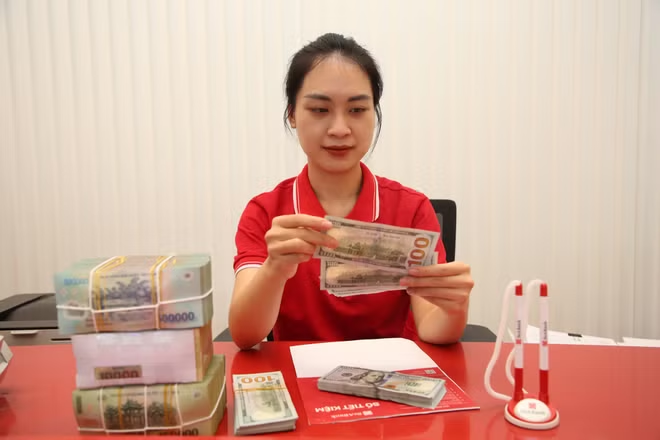
Credit growth in 2025 posted strong results, supported by the State Bank of Vietnam’s (SBV) credit governance framework aligned with the Government’s macroeconomic targets. From the beginning of the year, the SBV publicly allocated credit growth quotas to credit institutions and adjusted them mid-year to ensure flexibility in line with economic development. At the same time, banks were directed to expand lending to meet capital demand for production, business, and consumption; prioritise key sectors and growth drivers; and maintain strict control over lending to high-risk areas.
Efforts were also made to simplify administrative procedures, accelerate digital transformation in credit granting processes, and reduce operational costs, thereby lowering lending rates and improving access to finance for businesses and individuals, the official noted.
To address bottlenecks in credit access, the SBV strengthened the bank – enterprise connection efforts and organised 13 conferences nationwide to facilitate dialogue and timely policy responses.
He added the banking sector also rolled out many credit programmes as directed by the Government and the Prime Minister, including large-scale packages for agriculture, infrastructure, social housing, and strategic technologies, many of which proved highly effective and were continuously expanded. In addition, timely support measures such as debt restructuring, interest rate reductions, and new loans were implemented to assist those affected by natural disasters.

For 2026, the Deputy Governor warned that risks to global and regional economy remain, including slow growth, geopolitical tensions, unpredictable monetary policies in major economies, global trade fragmentation, climate change and strong digital transformation. As a highly open economy, Vietnam will be directly affected while it has to concurrently ensure fast economic growth and macroeconomic stability.
In response, the SBV’s monetary policy governance will continue focusing on inflation control, macroeconomic stability, and sustainable growth. The central bank will draw on lessons from the 2021–2025 period to make timely and appropriate policy responses. Coordination between the monetary, fiscal and other macroeconomic policies will be enhanced to keep the macroeconomy stable, curb inflation and reinforce key balances.
It will also direct credit institutions to ensure safe and efficient credit growth, channel capital into production – business activities, priority areas and economic growth engines as demanded by the Government, and tighten control over credit for high-risks fields. In addition, procedures will be further simplified and digital transformation boosted to facilitate people and enterprises’ access to bank financing. Legal frameworks will also be fine-tuned to support policy implementation, market development and international integration, Ha said.
At the same time, the SBV will step up inspection and supervision of areas vulnerable to high risks and non-performing loans, ensure the safety of the banking system, improve governance capacity, and safeguard payment system security.

These measures are expected to underpin effective monetary policy governance, maintain liquidity, stabilise exchange rates, and reinforce confidence among businesses, investors, and the public, according to the Deputy Governor./.